GREECE · SPORT & HISTORY
The Olympic Games: from Olympia to modern Greece
Sports, gods, honor and world politics with Athens 1896, Athens 2004 And a Cretan connection.
Added: · approx. 23 minutes read · 25 chapters
1. From Greek shrine to world stage
The Olympic Games connect Greece with one of the most famous international events in the world. Yet modern games are not a continuous continuation of one antique sports party. Between Olympia and the current Olympic program lies a long interruption, changing societies and a nineteenth-century plan to give meaning to antiquity again.
This file follows both histories. First we go to the sanctuary of Zeus in Olympia, with his competitions, religious rituals and inequalities. Then follow the restart in Athens in 1896, modern symbols, the growth of the participants' group and Athens 2004. The common thread is how people use sports to express honor, community and an image of themselves. [1]
2. Olympia is not Olympus and not Athens
Olympia is located on the western Peloponnese. It is an archaeological site in a valley, with remains of an important shrine and sports buildings. Olympus is a mountain area elsewhere in Greece, known as the residence of the gods in mythology. Athens is the city where in 1896 The first modern Olympic Games took place. These three names are easily confused, but refer to different places and histories. [2][11]
Those who visit Olympia do not end up at an antique stadium in Athens. The location in a green valley is part of the character of the place. The most important question is not only where the athletes walked, but how the sports facilities related to the sacred space.
| Name | What's in it? |
|---|---|
| Olympia / Ολυμπία | Sanctuary of Zeus and location of the ancient Olympic Games at the Peloponnese. |
| Olympus / Όλυμπος | The mountain area connected to the world of gods in mythology. |
| Athene / Αθήνα | Guest town of modern games of 1896 and 2004. |
3. When did the antique games start?
The traditional starting point is: 776 for Christ, the year associated with the early tradition of Olympic victors. It is wise not to read this as an exact proven founding moment. Religious and sporting history is older and not fully reconstructed. The IOC itself mentions that the real beginning is not exactly known and that history and mythology intersect. [1]
The games were held every four years. The period between two editions was called an olympiad and could be used as a tool for dating. An olympiad is therefore in origin the four-year period, not just the few days on which the games took place.
For reading ancient history this is a nice example of different kinds of time. An archaeologist can date a construction phase, a text can link a winner to an olympiad and a myth can tell a much older divine origin. Those data complement each other sometimes, but they don't have the same probative force.
4. Zeus, Herakles and the mythical origins
The games were connected to the worship of Zeus. Different stories circulated about their origins. Among other things, the IOC describes a tradition around the Idaïsche Daktyl Herakles and other stories about Zeus or the more famous hero Herakles. The fact that there are several founding stories is characteristic of the way in which Greek communities could describe the importance of an institution religiously. [3]
For our Crete guide is especially interesting that Idaic connection. She gives a reason to read the stories around Zeus and Crete. However, it is not proof that the historic Olympic Games in Crete began or originated directly from the Minoan bull jumps. A shared mythical motive is something other than a demonstrable organisational descent.
So you can read the story on two levels: what did the Greeks want to express with the divine origin, and what do we know from texts and material remains about the actual festival? The first question is about meaning, the second one is about historical reconstruction.
5. A religious festival with sport as its centrepiece
The ancient Olympia was a shrine, not a modern sports park with an accidental temple. The Altis, the sacred core, included important cult sites and monuments. UNESCO stresses the link between the shrine and the remains of sports facilities. The site has been standing since 1989 on the World Heritage List. [2]
A visit is therefore better understood when you do not walk directly to the track and treat the rest as a decor. The worship of Zeus, the community of visitors and the honour of the participants were part of the same feast. Sport had a religious and social context that does not correspond to a contemporary stadium visit.
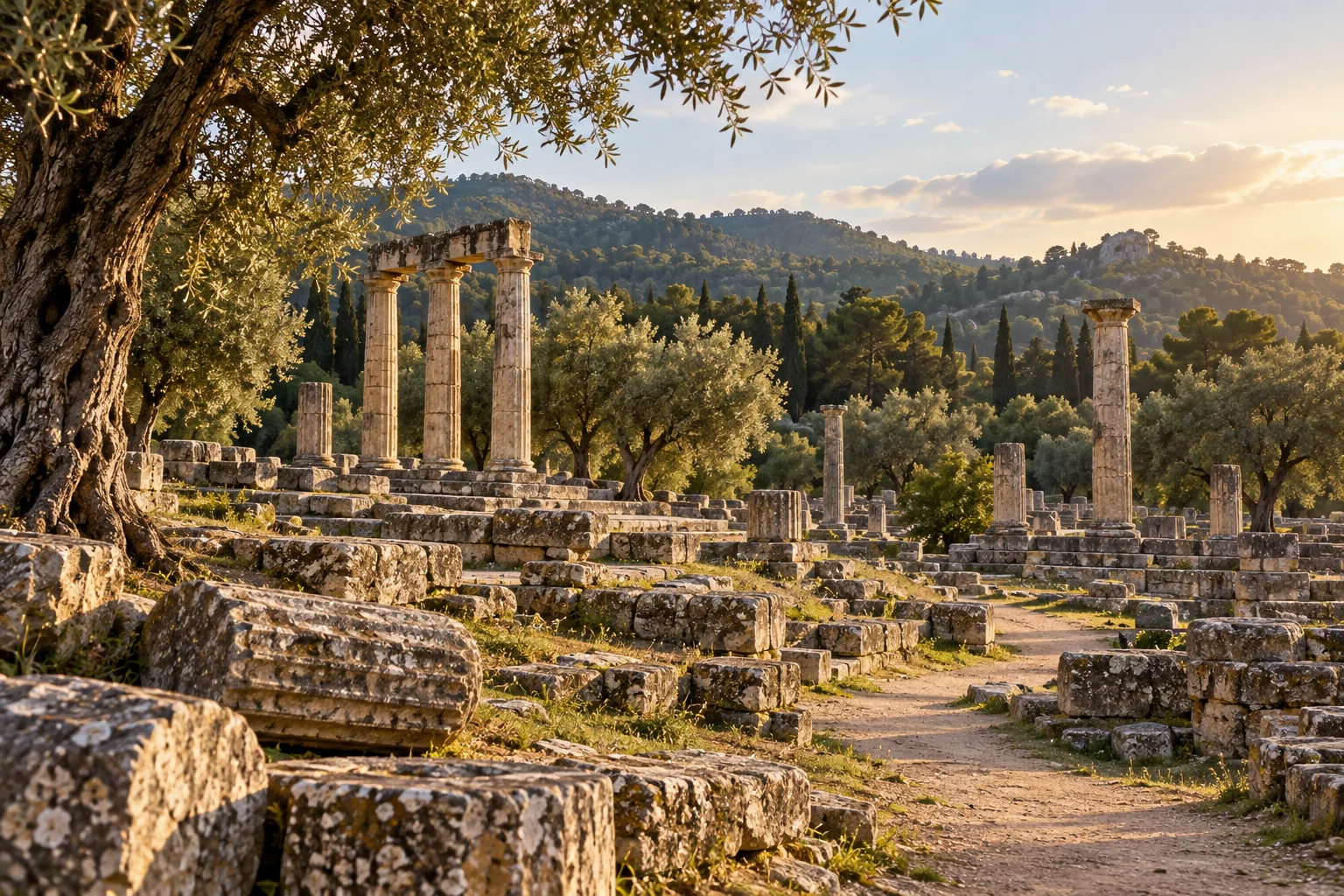
Please note the differences between a temple, a training room and the stadium. The archaeological remains can be low and difficult to read; a map helps to organize the whole. The atmospheric illustration of this file is an imaginary ruin landscape that reminds of Olympia. She is not an exact reconstruction or documentary recording of the map.
6. What sports were on the program?
The program grew over the centuries. Running competitions, wrestling, boxing, pankration and horse and car races are well-known components. The antique five-camp combined walks, long jumps, discus throws, spear throws and wrestling. This combination is not the same as a modern camp with parts of the same name. [4]
| Component | What distinguishes it from a modern association? |
|---|---|
| Stadium loop | A sprint over the length of the track; no modern track with exactly the same distance and layout. |
| Diaulos and longer walks | Different loop forms; not automatically translate to the current Olympic program. |
| Jump | Springers used halters, weights that were used at the jump. |
| Discus and Spear | Known pitch disciplines, with historical differences in material and execution. |
| Wrestling and boxing | Competition practices and protective equipment other than in current regulated sports. |
| Horse races and car races | Precious parts in which ownership and wealth could play a major role. |
An image of an antique athlete does not show a simple early stage of exactly the same modern sport. The name can be recognizable, while rules, goals and societal significance differ greatly.
7. Pankration: power, technology and a hard world
Pankration combined elements of wrestling and boxing. The restrictions were small compared to contemporary martial arts regulations; biting and grasping in the eyes were known prohibitions. The stories about famous champions show how strongly the Greeks could admire strength and perseverance, even when the struggle caused severe bodily harm. [5]
A comparison with modern mixed martial arts can help to understand the combination of techniques, but should not brush away the differences. Medical supervision, safety rules, weight classes and the way a winner is determined are part of specific historical systems.
For cultural history, the question is above all what a society requires of its athletes. Does she admire control, stamina, courage or dominance? And who decides what harm is acceptable? Such questions connect the antique contest with contemporary discussions without pretending that both worlds are equal.
8. Who was allowed to participate and who was allowed to watch?
The antique games were not an event with equal access for all. The classical contestant world was focused on free Greek men; the conditions and meaning changed in the long history of the games. The position of women must also be accurately described. Married women were excluded from attending according to the traditional rules; on the access of unmarried women is the explanation of the sources more nuance and discussion. [6][7]
Kynika, a Spartan king's daughter, is a famous special case. In car races, the owner of the horses was the winner. As a result, she was able to win victories as an owner without being a charioteer in the race herself. This was not a general admission of female athletes to the program. [6]
The most important lesson is that great ideals and exclusion could exist side by side. The word Panhelleen means that the feast brought together people from different parts of the Greek world; it does not mean that all residents of that world could participate under the same conditions.
9. The olive wreath and the fame of a winner
The famous prize of an Olympic victor was a wreath of wild olive branches, the kotinos. Other panhellenic games included other plants. The Greek Ministry of Culture makes that distinction explicit: the laurel wreath belongs, for example, to the Pythian Games in Delphi, not as a standard prize with Olympia. [8]
That wreath doesn't make the winner an unimportant amateur in the modern sense. Fame could be seen in its own city and confer privileges. A victory statue, a tribute or a poem of praise connected the personal success with the community from which the athlete came. [9]
There are therefore two rewards: the ritual prize at the sanctuary and the social life of the subsequent victory. That difference helps to understand both the simplicity of a garland and the enormous significance of Olympic fame. A material with little market value can be particularly valuable within a shared system of honour.
10. Olympic peace: protection, no world peace
The ekecheiria is often translated as the Olympic truce. She had to make safe participation and travel to the party possible. It is misleading to conclude that all wars in the Greek world automatically ceased as long as there were sports in Olympia. The protection of the festival and the broad ideal of peace are related, but not the same. [10]
The modern Olympic movement has reappeared the thought as a peace ideal. Since the 1990s, the United Nations General Assembly has repeatedly supported resolutions on the Olympic ceasefire. That makes it a strong wish and diplomatic instrument; it is not a guarantee that states and armed parties will actually stop violence.
This distinction is also useful when looking at an opening ceremony. Symbols can express a valuable ambition without being a correct description of political reality. It is precisely this tension that makes the history of the games more than a series of sports results.
11. A long tradition that came to an end
The ancient games continued for centuries, even in Roman times. In the usual historical summary, their end is linked to the late Roman fight against pagan cults under Theodosius I, around 393 After Christ. The wider sports and party culture of the empire did not stop at the same time. The IOC itself mentions that competitions and cultural festivals continued elsewhere. [12]
For this dossier, it is particularly important that no continuous series of annual or four-yearly organisations continue until 1896. The modern restart had to build new rules, settings and meanings. The name, the place of Greece and the reference to antiquity were inspirational, but there was no antiquity government that simply resumed its work.
When you see the remains of different building phases in Olympia, you look at a long history of use and change. The ruins do not represent one year in which all the famous athletes and all the buildings were present at the same time.
12. The nineteenth century: Greek initiatives and Coubertin
The modern Olympic revival had multiple run-ins. In Greece in the nineteenth century competitions related to the Olympic name and heritage were already organized. The Olympic games supported by Evangelis Zappas are part of that history. The Hellenic Olympic Commission links its own origins with these Greek initiatives and the preparation of international games. [13]
Pierre de Coubertin gave an international form to the plan to organise Olympic Games. In 1894 was founded the International Olympic Committee; Athens became host city of the first modern edition in 1896. Hanging the story only to one person would leave the Greek organizers, financial support and existing sports culture out of the picture. [11]
The interest in the antique world also played a part. The modern games arose at a time when classical education, international exchange and national identity could be closely linked. The old inspiration was real, but the institution that emerged from it was a product of her own time.
13. Athens 1896: a new start
In 1896 The modern Olympic Games came to Athens. The Panathinaiko stadium, also known as Kallimarmaro, became an important stage of the games. The old inspiration here got a visible modern stage: international participants, an organized program and a city that experienced the event as a national occasion. [11][13]
The first edition was still far from the size of later games. Only men took part. The rules, registration and demarcation of some early sports components also require historical attention; a modern medal table can give the impression that the whole organisation was already working exactly as it is today.
For a visit to Athens the stadium is therefore a good place to distinguish two layers of time. The building has an antique history, while the rebuilding and use in 1896 are part of modern history. A classic appearance is not the same as an unchanged antique state.
14. The marathon: a modern competition with an old story
The marathon was for the modern games of 1896 invented, with the memory of antiquity and the story of a messenger as inspiration. He wasn't on the program of the antique Olympics as a marathon contest. The Greek Spyridon Louis won the match in Athens and became one of the most famous figures of that first modern edition. [14]
The distance also has its own history. The current 42,195 mile is not the timeless exact length of one proven messenger route. The distance from the London games of 1908 was later the norm; the international athletics organization became standardized in 1921. [15]
Here we see how a modern tradition can work. An old narration offers meaning, a new organizational choice gives its form and later rules make that form recognizable. The historical interest becomes greater when you look at these steps separately. You don't have to call a marathon an antique copy to take its Greek inspiration seriously.
15. Five rings and the language of the symbols
According to the IOC, the five interconnected rings symbolise the connectedness of the five continents and the encounter of athletes. The design was developed in 1913 presented; the Olympic flag appeared at the games of Antwerp in 1920. The known colours are not intended as an official fixed legend in which each ring colour belongs to one specific continent. [16]
The rings make a particularly compact image possible: separate parts that form a whole by their connection. A ceremony, flag or poster uses such symbols to make the event recognizable and express its values.
This historical file does not require an official Olympic logo. The explanation of the symbol is more important than decorative use. At a museum object or poster, look at year, maker and function. It becomes apparent that the Olympic visual language itself has a history and not as one complete package from Olympia.
16. The flame and the modern torch relay
A burning flame became at the modern games in Amsterdam in 1928 is used. The relay bringing the flame from Olympia to the host city began at the Berlin games in 1936. The current torch trip is not a ritual that has happened in the same way since the antique games. [17]
The first modern relay is also part of the political context of the games organized by Nazi Germany. The United States Holocaust Memorial Museum treats her as part of the presentation and propaganda around Berlin 1936. That origin must not disappear behind the later meaning of the flame as a sign of encounter. [18]
A symbol can acquire new meanings through time while preserving its history. The recognition of origin does not mean that every later torch carrier carries the same political message. It does mean that a cultural explanation has to look beyond the impression of a timeless classical ritual.
17. The growth of women's participation
Women's names 1900 for the first time in the modern Olympic Games, initially in a small part of the programme. Enlargement then took place over many decades. The IOC presented for Paris 2024 the equal distribution of quotas between female and male athletes as a milestone. This is about the distribution of places; it does not prove that every sport, delegation or administrative layer achieved equality in all respects. [19][27]
That history shows that inclusion was not a property that started from 1896 was fully present. Access had to be extended, rules changed and opportunities remained the subject of discussion. The antique exclusions and modern expansion therefore both belong to a fair Olympic story.
When comparing editions, it helps to ask precise questions. Is it about the number of participants, the number of parts, the visibility on television or the influence in decision-making? A single percentage cannot describe all these different forms of equivalence.
18. Summer, winter and the Paralympic Games
The Summer Olympics and Winter Games each have a four-year cycle. The first Winter Games found in 1924 place in Chamonix. Since the change that took place in the 1990s, summer and winter editions fall into several even years. As a result, there is usually one of both every two years, but not every two years a full new summer edition. [20]
The Paralympic Games have their own history, sports program and organisation under the International Paralympic Committee. Their development is linked to sports for people with disabilities and post-war games at Stoke Mandeville. Rome 1960 is considered the first Paralympic Games. These are independent top sports competitions, not an extra program for which the results are added to the Olympic medals. [21]
The agreement in scale and location can help a visitor to see the coherence, while the distinction remains necessary to do justice to their own sports history and performance. Therefore, terms such as Olympic and paralympic should not be used as synonyms.
19. Ideals, rules and political reality
The IOC identifies excellence, respect and friendship as central Olympic values. The Olympic Charter describes the basic principles and organisation of the movement. These are normative texts: they say how the movement wants to function and what agreements apply. They are not in themselves proof that every edition or participant always meets those ideals. [22][23]
History also includes war, exclusion and political conflicts. The summer editions of 1916, 1940 and 1944 Didn't go through the world wars. The existence of an international sports event did not make the event independent from the world around it. [24]
A good way of looking therefore holds two questions side by side: what performance did the athletes deliver and what social conditions made this edition possible? The first question deserves attention without the second one disappearing. Conversely, criticism of an organisation does not have to erase the sporting performance of an individual athlete.
20. Athens 2004: return and legacy
Athens 2004 again the Summer Olympics. The return to Greece gained a lot of symbolic significance: the birthplace of the ancient tradition and the host city of the modern reboot again received the international sports world. At the same time, the event was a major modern organizational and infrastructure project.
In its review of changes in transport, urban space and tourist infrastructure, the IOC also mentions problems with the use of some sport sites afterward. That look back is an institutional assessment from the Olympic movement. An assessment of individual investments also requires concrete data on costs, maintenance and long-term use. [25]
It is too easy to reduce all consequences to one success story or one decline story. A building can remain in use at sport and at the same time require expensive maintenance. A transport improvement may have meaning outside the weeks of the event. Legacy is therefore a series of testable questions about different places, not one photo of an empty stadium.
21. Crete and the Pankritio stadium
The Games of Athens 2004 did not remain fully within Athens. The Pankritio Stadium in Heraklion was an Olympic football venue. The municipal sports organisation describes that both men's and women's tournament competitions took place. For example, Crete has a concrete modern Olympic connection that is separate from the much older mythological stories. [26]
For the Crete traveller that is an interesting other layer of Heraklion. The island is not only made up of Minoan sites and Venetian ports; contemporary sport and major national projects have also shaped the urban landscape. A stadium can therefore be viewed as a historic place, even when it is not a ruin and not a museum.
This file does not give up-to-date access times or event calendar of the stadium. Anyone who wants to go in or visit a contest must consult the administrator's recent information. The historical function during 2004 to remain distinct from that.
22. Visit Olympia and Athens with attention
For ancient history, Olympia is the logical starting point. View the site with a map and combine it with the museum context where possible: loose objects and building remains tell together more than separately. Note the boundary between stored material, restoration and reconstruction. A modern image can clarify, but remains an interpretation.
For the modern restart, the Panathinaiko stadium in Athens offers a different experience. There you can ask questions about rebuilding, public experience and the way nineteenth-century organizers wanted to make antiquity visible. Whoever's locations 2004 Sees a third time layer.
Places do not need to be pressed in one travel day. Olympia and Athens are not side by side, neither are trips on Crete itself. This reading route is intended as a substantive link between individual destinations, not as a controlled itinerary with current transport times.
23. A compact timeline
The timeline distinguishes traditional antique dates from modern organizational history. These years are landmarks; they reveal the differences between origin, restart and subsequent renewal. [1][11][16][17][20][21][25]
| Year or period | Event |
|---|---|
| 776 BC | Traditional starting point of the survived antique Olympic Games. |
| Classical and later antiquity | Growth and change of the religious sports party in Olympia. |
| Late fourth century AD | The end of the antique games is traditionally placed in this context. |
| Nineteenth century | Greek revival initiatives and international plans for new games. |
| 1894 | Establishment of the IOC. |
| 1896 | First modern Olympic Games in Athens. |
| 1900 | First female participants in modern games. |
| 1920 | Olympic flag at the games in Antwerp. |
| 1924 | First Winter Olympics in Chamonix. |
| 1928 | Modern Olympic flame in Amsterdam. |
| 1936 | First modern torch relay from Olympia, before Berlin. |
| 1960 | First Paralympic Games in Rome. |
| 1994 | Winter Games in Lillehammer, after the edition of 1992; the separate cycle takes shape. |
| 2004 | Summer Olympics in Athens, including football in Heraklion. |
| 2024 | As many quotas are provided for women and men in Paris. |
24. Greek words in the Olympic story
| Greek | Read Shape | Meaning in this file |
|---|---|---|
| Ολυμπία | Olympia | The place of the ancient sanctuary and the games. |
| Όλυμπος | Olympos | Olympus, the mountain region of the gods world. |
| Ολυμπιακοί Αγώνες | Olympaki Agones | Olympics. |
| αγώνας | agonas | Contest or battle, depending on the context. |
| αθλητής / αθλήτρια | athlitis / athlitria | Athlete or athlete, male / female. |
| στάδιο | Stadium | Stadium. |
| νίκη | niki | Victory. |
| κότινος | kotinos | Cranes of wild olive branches. |
| εκεχειρία | ekecheiria | Truce; this is Olympic peace. |
| Μαραθώνιος | Marathonios | Marathon. |
| Παναθηναϊκό Στάδιο | Panathinaiko Stadio | The Panathenaeian stadium in Athens. |
| Παγκρήτιο Στάδιο | Pankritio Stadio | Pankritio Stadium in Heraklion. |
The reading forms help to identify names and do not form a full pronunciation lesson. At a Greek museum or monument, the full place name is more useful than just the word Olympic.
25. Frequently asked questions
Were the antique games held on Mount Olympus?
No. They took place in Olympia, on the Peloponnese. Olympus is another place. [2]
Beginning the games certainly exactly in 776 For Christ?
That is the traditional starting point of tradition, not a fully proven founding day. The actual origin is not exactly known. [1]
Was the marathon an antique Olympic sport?
No. The marathon was for the modern games of 1896 came up with an old story as inspiration. [14]
Did antique winners get a gold medal?
No. The famous Olympic victory prize was the kotinos, the wreath of wild olive branches. [8]
Has the torch relay been running since ancient times?
Did the Olympic peace mean that all wars ended?
No. Being able to travel safely and participate in the festival was central; a general world peace does not follow. [10]
Are the Olympic Games part of Crete's history?
Yeah, including the Olympic football of 2004 In Heraklion. Mythical Crete connections must also be read as tradition. [3][26]
Are the Paralympic Games the same event?
No. They have their own history, organisation and sports program, with a close relationship to the Olympic host cities. [21]
Sources and read on
Consulted for this edition on 30 October 2026. Institutional sources of the IOC explain the Olympic history and its own values. Archaeological, museum and local sources complement that explanation. Travel advice is editorial; opening hours and rates are not presented as current.
- IOC · What is the origin of the Olympic Games?
- UNESCO · Archaeological Site of Olympia.
- IOC · Olympics Mythology
- IOC · Ancient Greek Olympic Sports
- IOC · Pankration
- IOC · The all-time greats of the Ancient Olympic Games, Kyniska
- IOC · A spectator & surveyor guide to the Ancient Olympic Games
- Greek Ministry of Culture · Prizes at the antique games
- Perseus / Tufts University · Ancient Olympics FAQ: Winner's reward
- IOC · Olympic Truce
- IOC · Athens 1896: The revival of the Olympic Games
- IOC · The end of the Ancient Games
- Hellenic Olympic Commission · History
- IOC · The inaugural modern Olympic marathon
- World Athletics · Marathon, development and standardisation of distance
- IOC · Olympic rings
- IOC · A raft of Olympic innovations, flame and relay.
- United States Holocaust Memorial Museum · The Nazi Olympics Berlin 1936: Inauguration of the Olympic Torch Relay
- IOC · International Women's Day 2022: Celebrating Women at the Olympic Games
- Canadian Olympic Committee · What are the Olympic Games? Summer and winter cycle cyclists
- International Paralympic Committee · Paralympics History
- IOC · Olympic Values: Excellence, Respect and Friendship
- IOC · Olympic Charter, version in effect from 24 June 2026 ↗
- IOC / Olympic Library · Statistics Handbook Tokyo 2020, canceled editions
- IOC · Athens 2004: Olympic legacies in the Greek capital.
- Municipal sports organisation Heraklion · Pankritio-stadium
- IOC · Applying a gender lens to ensure equal visibility at Paris 2024 ↗