NARRATOR CHARGE · DIFFERENCE
Pankration: power, rules and fame in Greek antiquity
An Olympic martial arts between history, monument and hero story.
Added: · approx. 8 minutes read · 11 chapters
1. A combat sport between wrestling and boxing
Pankration was an antique combat sport in which elements of wrestling and boxing merged. The Greek Cultural Service dates the inclusion in the Olympic program on 648 BC, the 33 St. Olympiad. The sport had a wider allowed world of action than individual wrestling or boxing, but was not literally an activity without rules. [1]
The name is connected to the whole of force or power. However, understanding the event helps more than an etymology. You have to look at the competition context: participants, allowed actions, assignment, supervision and the meaning of a victory.
This dossier deals with sports history and the way stories about athletes are handed over. It's not a practice manual. A description of historical hardness does not make a dangerous action suitable for mimicking.
2. A place in the Olympic program
The Olympic Games offered different forms of physical competition. Pankration was part of the battle numbers and should be viewed alongside, not instead, wrestling and boxing. The combination makes it clear that the Greeks could distinguish different forms of competition, even when these movements shared. [2]
For a modern viewer it is tempting to put everything under one famous sports label. That makes it accessible, but can wipe out historical differences. Ask first what the antique source says about this event before assuming modern rounds, categories or points systems.
Moreover, an Olympic victory was not a separate gym result. She was part of a festival, a shrine and a world of public honor. That framework helps explain why an athlete could get an extraordinary position in a local memory.
3. What did the limitations mean?
The cultural service mentions bans on biting and certain attacks on vulnerable parts. The IOC summarizes the most famous limitations as not biting and not sticking in the eyes. Such short summaries tell us that there were limits; they do not yet form a complete rules of competition that must have been identical for each period and place. [1][2]
The difference between violent and rule-free is important. A community can accept serious risks and set a limit to lawful behaviour at the same time. Just that tension makes the event historically interesting.
Also avoid an all too easy comparison with the modern term fair play. What participants and the public considered acceptable should be understood from the time involved. Our judgment on safety does not have to coincide with that.
4. Declaration and the end of a batch
The published overview of the Greek Cultural Service describes the raising of one or more fingers as a sign of declaration. This makes it clear that winning did not only mean that someone was in favour of a fixed point account. [1]
That's crucial to reading stories. An author can use an unexpected task as a turning point, while the outsider only pays attention to the participants' physical attitude. The moment when a contest is considered to be finished has its own meaning.
We should not reconstruct a modern referee procedure that does not give the source. Tradition often preserves the dramatic ending and much less the ordinary organisation of each match. What is strikingly written down is not automatically the most common case.
5. Arrichion: a victory with a terrible price
Popesanias describes in his Description of Greece, book 8, the athlete Arrichion of Phigaleia and his statue. In the famous story, his opponent was denounced at the time of Arrichion's death. The victory was awarded to Arrichion according to that tradition. [3]
The story is more than a sensational game report. Popsanias wrote centuries after the classical beginning of the Games and also discusses monuments and local memories. His text tells how the athlete was commemorated and what exceptional achievement was presented as meaningful.
Therefore read it as an antique testimony with distance from the past described. It is no reason to present death as the normal or desired outcome of each party. An exceptional story is kept precisely because it is exceptional.
6. Athletes between man and hero
The IOC also discusses Theagenes by Thasos, an athlete who created stories of extraordinary power and a bond with Herakles. The combination of historic competition fame and heroic tradition shows how an athlete could become more than a name in a score list. [2]
That doesn't mean every miracle story is biography. A child who would move a massive image, belongs to a different kind of narration than a dated victory. Do not put that data in a single factual timeline without distinction.
The comparison with modern celebrity is useful as long as it opens a question: how does a performance change into a story about an exceptional human being? The answer in ancient times does not have to be the same as in a contemporary sports documentary.
7. Theseus and the connection to Crete
The IOC mentions the mythical connection with Theseus, who would have won his battle with the Minotauros with a combination of fighting forms. For example, a sport in a narration gets a heroic origin and the story touches Crete. [2]
That connection is mythological. She does not show that pankration was invented as a documented Olympic sport in the labyrinth of Knossos. A story of origin and the first mention in a competition program answer several questions.
For a visitor to Crete, that distinction is valuable. The island can play a role in the imagination of a sport without any sports historical claim being proven archaeologically on the island.
8. Some images and objects will tell you
The Greek culture website connects the event with an image of the athlete Agias and an honorary inscription for a participant in multiple battle numbers. Such objects provide information about memorial and appreciation alongside literary stories. [1]
However, a pictured body posture is not a complete sequence of motion. A vase painter chooses a recognizable or meaningful moment; a sculptor makes a representation that suits a monument. The object should therefore be read with dating, location and function.
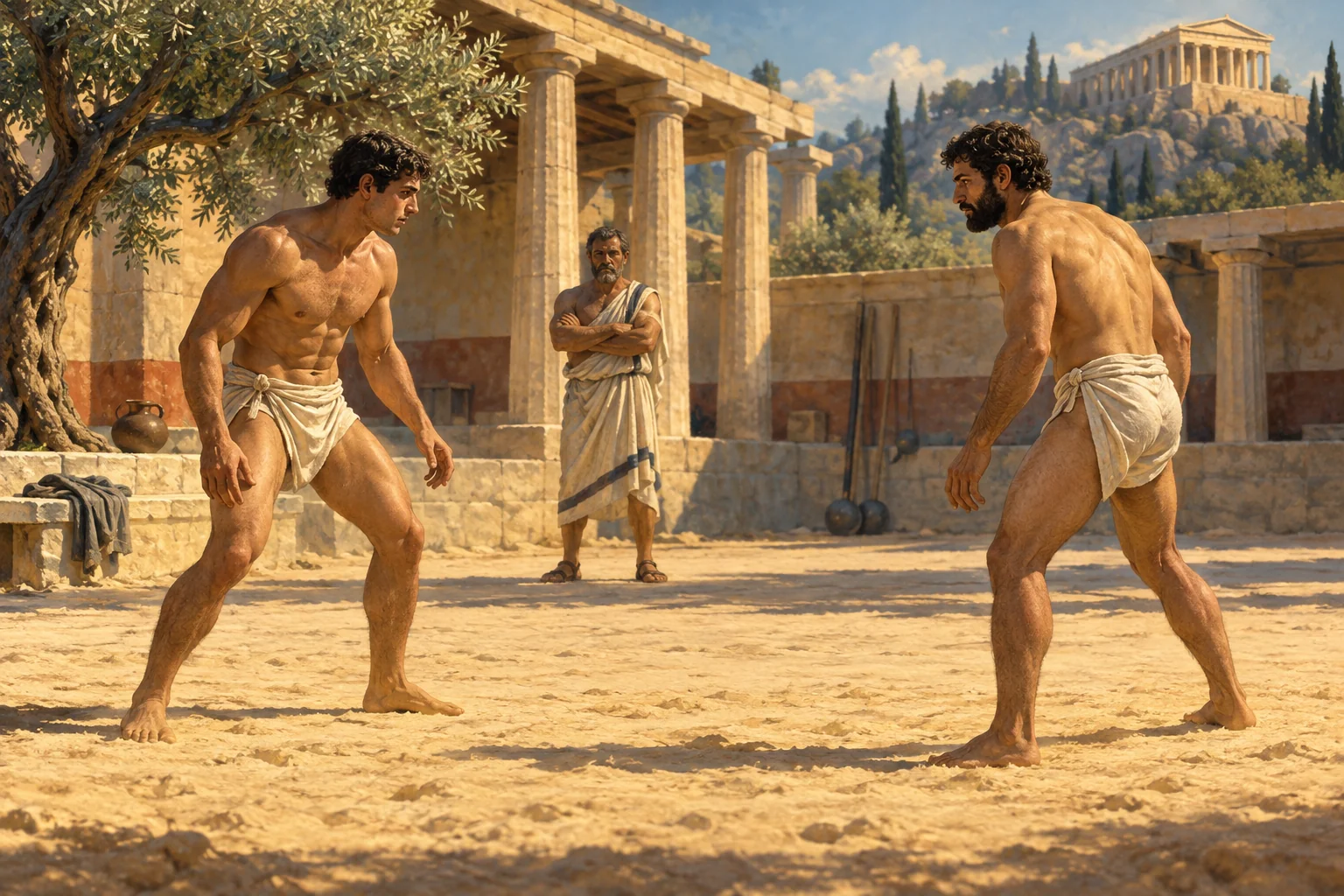
The illustration of this file is a contemporary imagination with dressed practicing athletes. It does not document antique competition clothing, specific historical training or real archaeological site. The sources, not the generated image, bear the historical explanation.
9. Does it look like modern MMA?
The comparison is obvious because several types of combat are combined. It can help as a first orientation, but it cannot be concluded that sports are institutionally identical or have been practiced in the same way without interruption.
Modern organisations lay down their own rules, security arrangements, categories and competition procedures. For a specific contemporary sport you have to read the rules of that organisation. The antique name gives no exemption from modern sporting responsibility.
A meaningful comparison is therefore about individual questions: what actions count, when does a party end and what risk is allowed? Only then can you name what really matches and which seems only superficially familiar.
10. A sports history with human consequences
Pankration shows that physical skill and physical vulnerability belong together. A culture can admire a winner and at the same time have a system in which serious damage is possible. One didn't get rid of the other.
For contemporary readers it is useful to look beyond two extremes: only see barbarism or only admire a heroic forerunner of modern sports. Both make history smaller. The event was part of a world of competition, honor, religion and stories that raises their own questions.
At a museum visit you can take those questions with you. Who made this monument? What audience was supposed to remember the name? Is a person depicted or an ideal of the athletic body? For example, one sport connects the competition floor with the wider Greek culture.
11. Frequently asked questions
Since when was pankration on the Olympic program?
The usual dating of the recording is 648 BC [1]
Was everything allowed?
No. The sources mention limitations, although the allowed space was much larger than in many modern sports.
Was Theseus the historical inventor?
That's a mythical connection of origin, not a proven historical invention.
Is pankration just an old name for MMA?
The combination of fighting forms offers a comparison, but does not make rules, institutions and history the same.
Sources and read on
Sources checked for this edition on 30 October 2026. Antique texts, later tradition, dictionaries and contemporary practical descriptions have different functions. Own calculation examples, listening questions and language examples are editorial effects.