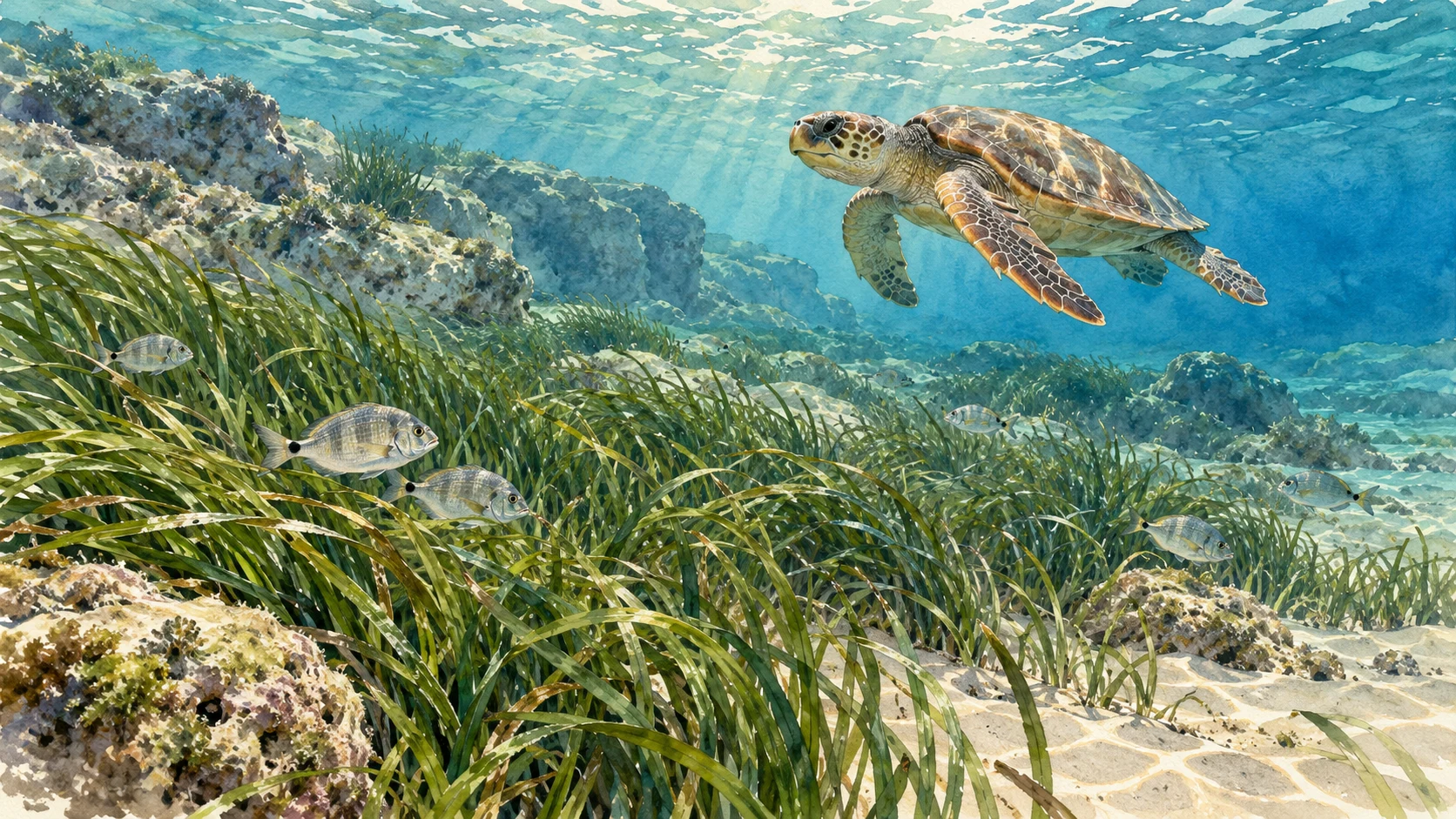
From sea grass and rocky coasts to turtles and open water: Learn to read the Mediterranean as a living landscape.
AI-Illustration · artistic impression, no exact representation of landscape, history or species.
01 · CRETE
One coastline, different habitats
From a terrace, the sea looks like one blue surface. Under the surface, sand, rock, plants, light and depth make different living environments. A rocky ridge with shade offers something other than an open sand floor. So look at the landscape before you try to finish a list of animals.
CRETAquarium organises its explanation about Mediterranean ecosystems. The approach is also useful outside: where is shelter, what moves with the current and what space does an animal use? An observation becomes more interesting when you note where something happened.
The illustration of this dossier combines recognizable Mediterranean elements. It is not a species map and does not prove that all the animals depicted occur in one place at the same time. Use information panels or expert explanation for identification.
Posidonia oceanica is a Mediterranean flowering seaplant. The long ribbon-shaped leaves form underwater meadows; it is not a tropical coral reef or simply a seaweed. The living field consists of more than the visible green: underground parts and the structure of the whole are important.
A seagrass field provides an environment where organisms can find shelter and food. Leaves that are washed up are part of the connection between sea and beach. Therefore, a brown strip of plant residues is not automatically a sign of pollution. HCMR information about Posidonia deals precisely with the connection between the meadow, washed up material and the coast.
Look from a permitted place at the variation of light sandy surfaces and dark vegetation. Only the colour from above is insufficient to determine a plant species. The pattern may raise an initial question about the soil and the habitat.
HCMR describes uncontrolled anchors as a pressure on Posidonia fields. An anchor not only hits a leaf, but can also damage the structure underneath it. In addition, the research on sea grass looks at changes due to high sea temperatures and marine heat waves.
These processes make it clear why protection is more than one beach clean. Use a boat excursion with a provider who respects local rules and fragile soil. Ask how the construction or anchor site is chosen. A beautiful blue surface does not tell what nature is underneath.
A visitor's act can be small: no planting, no collecting animals and no moving material for a photo. This way the attention remains on the landscape without having to adapt it to your perception.
The false carret turtle, Caretta caretta, connects the sea with sandy beaches where eggs are laid. ARCHELON follows and protects nests on Crete, including in the areas Chania, Rethymno and Messara. The presence of a nest beach is an important ecological function next to the recreational function of the coast.
Marked nests and protection structures are part of monitoring. They can change during a season. The employees collect data and give local clues; an old photo therefore does not show how the beach is decorated today.
In the Messara project, ARCHELON describes the relationship between protection and a wide sandy coast. Read such a project as a long-lasting effort, not as a promise that you will see a turtle on a certain beach day.
ARCHELON asks visitors to leave nest marks, cages and designated routes for young turtles. Do not dig out nests or touch the young animals. They must find their own way to the sea. Follow the local information about lighting, beach furniture and the use of the coast.
Watching an animal up close is not the purpose of protection. Do not make room by moving structures yourself and do not go after young animals in the sea. Ask an employee what is appropriate at that time.
If you want to know more, you can explore an announced public activity. ARCHELON publishes information and programs for this purpose. A nesting research by trained staff is a scientific act, not permission to open a nest itself.
A school of small fish, an animal that stays near a rock or a quick movement above sand tells something about space use. Start with behavior: swims an animal free, looks for shelter or follows a boundary between two soils? You can describe that without knowing a generic name.
The explanation of CRETAquarium shows the variation between coast, dark rocky spaces and open water. A collection of Mediterranean fish is no guarantee of what you will find during a short snorkeling trip. Time, light and conditions also play a part.
Write form, size approximate, colour pattern and place. If possible, take a photo without following or touching animals and then ask expert help with identification. An uncertain name does not have to make a good perception less valuable.
Choose an activity that fits in with experience and circumstances. Snorkeling, a boat trip, diving and an aquarium visit are different ways of looking. A natural text is not a swimming or diving advice. Use an appropriate qualified guide for an organized activity and follow local directions.
Our viewing command: search for three transitions, for example rock for sand, light for shade or vegetation for open soil. Describe what changes. Leave animals alone and don't feed them to get closer. The usual behavior is interesting information.
An aquarium can be a good preparation or an alternative. Ask for the original habitat of a species and then compare what you saw on the coast. A furnished basin is an educational representation and not the same as the entire ecosystem.
The POSEDON system of HCMR combines observations, models and information about the Greek seas. In the Cretan Sea, repeated measurement campaigns are carried out. By measuring more frequently in similar places, researchers can distinguish changes from a loose snapshot.
Temperature, water movement and biological processes are related, but not changing everywhere at the same time. A warm day on land therefore does not say enough about an entire sea area. A long-term average and a local expectation answer other questions.
For your travel book: note place, time, light and what you really saw. Compare that note with a second visit. The difference can be as educational as a special species. Thus, the sea becomes an environment to get to know better rather than just a beautiful background.
Editorial edition · 21 October 2026. Visit proposals and exercises are their own effects. Check current access, transport and local conditions with the official administrator.