GREEK MUSIC · DIVISION 20 / 20
Yannis Markopoulos: Cretan sounds in a new composition
Chroniko, Rizitika and Ithageenia: how different musical means work together.
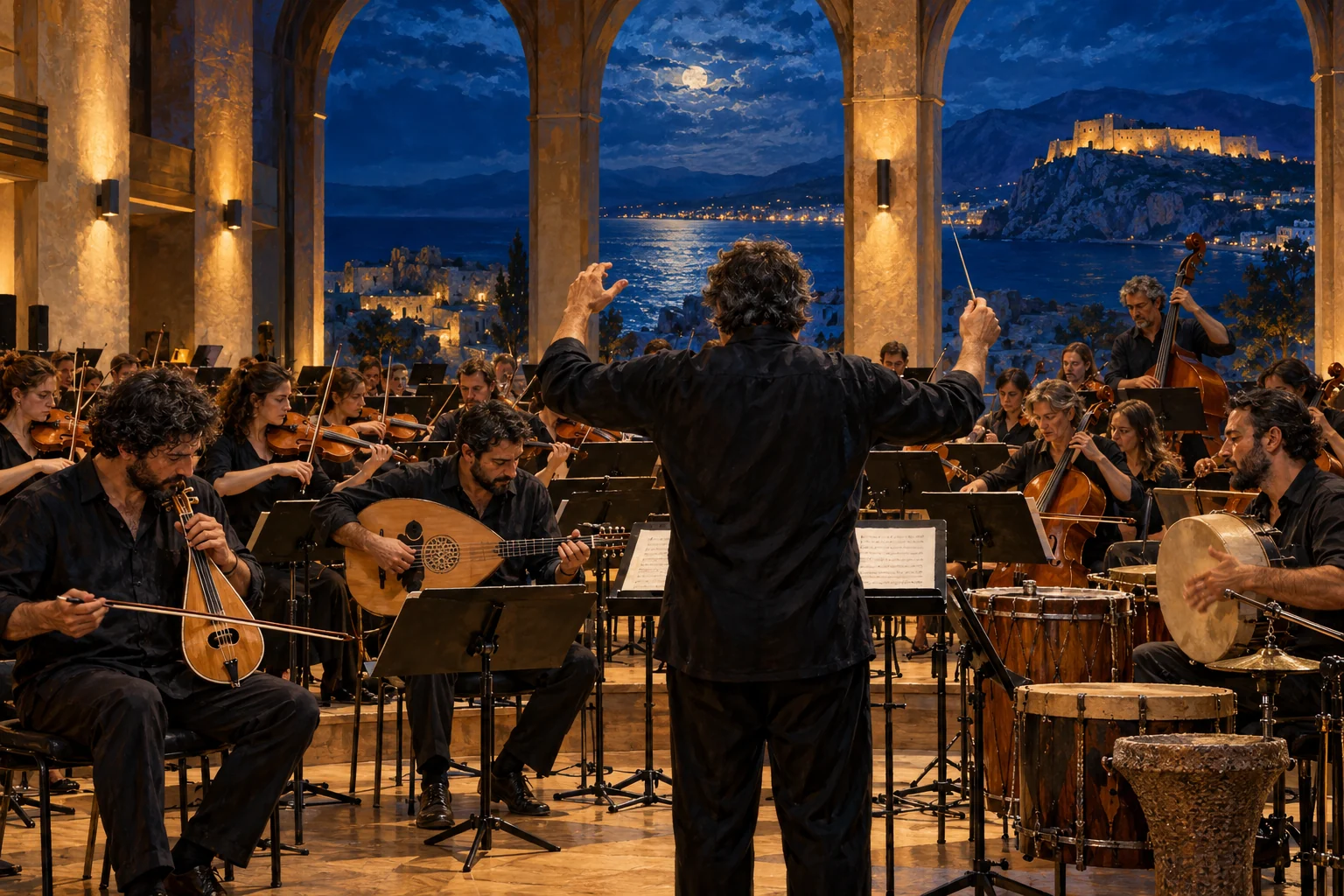
A traditional sound can get a different job within a new work. At Yannis Markopoulos this is a fruitful listening question: how do voice, local instruments and larger ensembles work together, and what happens when a melodic gesture changes the environment?
A composer with different fields of work
The Megaron in Athens describes Markopoulos' work as a connection of Cretan tradition with contemporary musical means. His oeuvre includes songs, symphonic works and music for theatre and film. Such a broad profile invites you to listen beyond one recognizable melody. A regional sound is a starting point, not a complete explanation of a composition. Ask how the work organises its material: what line becomes foreground, what returns and how does a voice get a place between other parties? This brings the attention to the concrete musical choices of the maker.
Chroniko: Who wears the story?
The broadcaster ERT documents Chroniko from 1970 with text by K. H. Myris and connect it with the voices of Nikos Xylouris and Maria Dimitriadi. Use those credits as a starting point for a listening round. First follow the sung line and then the parties that surround it. Is a rule prepared by an instrumental thought, or does an answer follow when the voice is silent? A story in music is not just words. Also the order of voices and changing the sound environment determine how a listener moves his attention through the work.
Rizitika: an operation has a position
ERT calls Rizitika out 1971 as Markopoulos' approach to traditional Cretan songs, with Xylouris in a prominent role. Compare a section with an archive recording of unaccompanied vocals. Describe what the new environment adds: a repetition, an instrumental layer, another duration or a sharper defined beginning. These are questions to the execution, not pre-filled results. An operation can make a familiar text stand out differently. By naming the choices in concrete terms, you avoid both the idea of a neutral packaging and the assumption that change should automatically mean loss.
Ithageneia and the coherence of a cycle
Ithageneia from 1972, also on the text of K. H. Myris, according to the ERT documentation, offers a next listening input. Take not only a loose favorite song, but also the transition between two parts. What expectations do you take and what are changed? A cycle can show kinship through sound, return or thematic tension. Examine what is really audible in the chosen example. The title and the explanatory notes help in the interpretation, but do not replace attention to the form in which music unfolds from moment to moment.
The oeuvre reaches beyond one record
The Megaron mentions Ana-gennisi, Crete between Venice and Constantinople, and the opera Erotokritos and Areti. Those titles open a route to other repertoire and larger forms. They also invite you to read the existing literary files on Crete. With such a connection make it clear what you compare: a text, a historical subject or a musical interpretation. A composition with a historical title is not automatically a literal account of an earlier world of sound. She remains a work in which a maker selects, combines and organises his own musical time.
Continue listening: follow one sound through the ensemble
Choose a short fragment and follow one recognizable instrument or one voice. When will it be at the front, when will it mix with others, and when will it disappear? Repeat the exercise with another work from the mentioned route. What changes the task of that sound? Finally, go to the existing file Who Pays the Ferryman? for another environment in which music is connected with Crete. The comparison leaves room for difference between song cycle, larger stagework and television memory. Markopoulos thus becomes an access to composition as consciously bringing together various musical possibilities.
Sources & Listen inputs
- Megaron "Yannis Markopoulos" ( 1939–2023 )
Institutional overview and own performance history, with larger works and Erotokritos and Areti.
- ERT 60 years Markopoulos
Own broadcasting documentation; Chroniko ( 1970 ), Rizitika ( 1971 ) and Ithageenia ( 1972 ), with lyricists and performers.
Sources checked for 29 October 2026. The listening questions are newly written exercises; they do not attribute a predetermined result to a recording. The external archive pages contain where available their own audio or video.