GASTRONOMY · WINES OF GREECE
Greek wines and dessert wines: from Crete to Samos and Naoussa
Detailed dossier on dry and sweet Greek wine: Crete, Santorini, Samos, Nemea, Mantonia, Naoussa, Kefalonia, Lemnos, Mavrodaphne and Malvasia.
Added: · approx. 17 minutes read
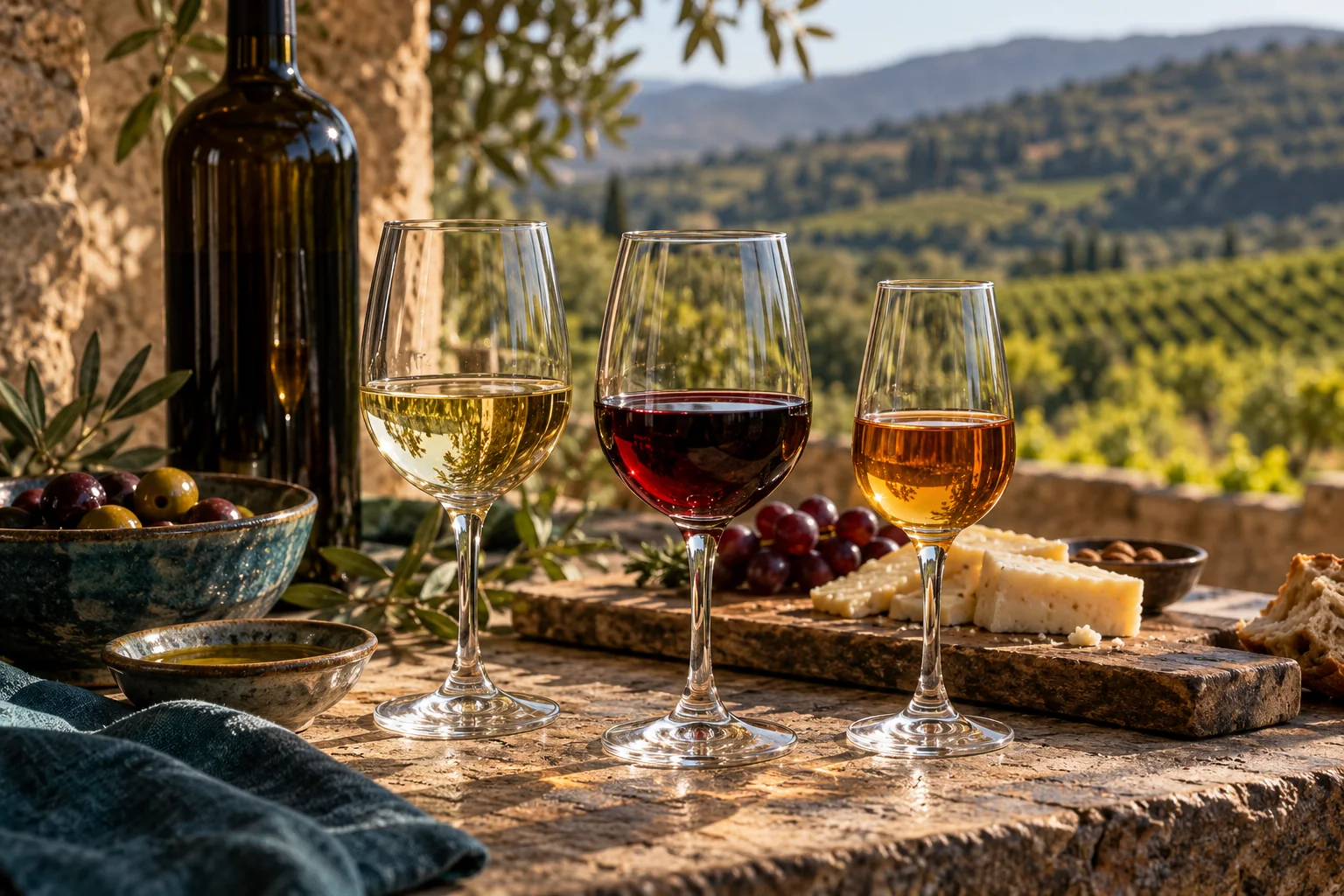
1. A wine country larger than one holiday glass
Who knows Greek wine only from a carafe in the taverna, sees only a small part of the landscape. There are dry and sweet wines, quiet and sparkling styles, familiar international grapes and local breeds with a distinct character. A holiday memory can be a nice starting point, but is not a summary of the whole country.
This file departs from Crete and looks at the Cyclades, the northern Aegean islands, the Peloponnese, the Ionian islands and Northern Greece. It's a reading and trial guide, not a ranking of producers. Names, production and styles are supported by sector and producer information; serving ideas are their own suggestions for comparison at home.
You don't have to memorize dozens of grape names right away. Start with three questions: where does the wine come from, which grape is it made of and is it dry or sweet? After that, details such as wood, ripening and preparation become much more understandable. The same name on two labels can still produce quite a different wine.
2. Map: island, altitude and region
The image of one warm, dry Greek wine climate is too simple. The location of a vineyard, altitude, wind and the choices of the wineboer can vary considerably. For example, Mantinia on the Peloponnese is described by Wines of Greece as one of the cooler protected wine zones in the country. That's a different environment than the stereotype of a glowing hot beach. [W01]
Use a regional name as a landmark. Santorini reminds you of Assyrtiko, Naoussa of Xinomavro and Nemea of Agiorgitiko. They're useful compounds, not prohibition of variation. A grape variety can also grow elsewhere and within one area different producers can make different choices.
A good first wine list therefore groups by region and style. A dry island wine and a sweet island wine do not automatically belong next to each other because the town name sounds familiar. Find out what really comes in the glass first; then use the landscape to give your curiosity direction.
3. Read the label without getting lost
PDO in Greek POP or ΠΟΠ, a protected designation of origin. GI, in Greek PGE or ΠΓΕ, refers to a protected geographical indication. They are origin categories with conditions, not a universal score where each PDO bottle is automatically tastier than any PCI bottle. The Greek sector organisation provides an overview of the areas and names. [W02]
Also read producer, harvest year, alcohol percentage and description of the style. A well-known region on the front does not replace that information. A year on a dessert wine can also have a different context than a ageing report or the name of a cuvée. In case of doubt, ask which year is meant exactly.
A practical purchase question is:..I'm looking for a dry, fresh white wine with little or no wood; which bottle fits in with it?... That gives a seller more direction than just. If you are looking for sweet, you can ask whether the wine is made from dried grapes, is reinforced or has otherwise preserved its residual sugar.
4. Six grapes as starting point
Assyrtiko is a white grape with a strong bond with Santorini, but is also grown elsewhere in Greece. It can give dry white wine with clear acidity and structure and also plays a role in sweet wine. A fragrance reminiscent of ripe fruit does not make a dry Assyrtiko sweet. [W03]
Moschifilero has colored peels, but is widely used for dry white and also sparkling wine. Flowery fragrance is a useful landmark, no guarantee for residual sugar. Vidiano is a Cretan white grape in which mouth feeling and stone fruit are often important topics of conversation. Producer and method remain important. [W04] [W05]
Agiorgitiko is connected to Nemea and can deliver different styles, from accessible fruity to firmer red. Xinomavro has an important place in Northern Greece and can give clear acids and tannin. Malagousia is another interesting white acquaintance, with a often aromatic profile. Use these names as starting points, not as a fixed taste guarantee for each bottle. [W06] [W07] [W08]
5. Crete: more than one red and one white
Vidiano, Vilana, Thrapsathiri, Kotsifali, Mandilari and Liatiko show how wide the Cretan grape world is. Wines of Crete describes the indigenous breeds and wine regions of the island. For a first comparison, one dry white next to one dry red is more useful than a long list that you finish without context. [W09]
Peza, Archanes, Dafnes and Sitia are important names to learn to recognize on labels. Dafnes is closely linked to Liatiko; that grape can give both dry and sweet wine. The name of the grape does not tell how much sugar you will taste on your own. [W10]
Sitia also offers variation. The sector description mentions Vilana with Thrapsathiri and with red Liatiko with Mandilaria. This makes the area interesting to understand mixtures: different varieties can play a role in one wine together. [W11]
The existing page about the Cretan vineyard remains a regional entrance. This new file puts that knowledge alongside other Greek regions. The goal is that you can place a Cretan bottle better, not that Crete disappears behind a national collective name.
6. Santorini: dry Assyrtiko and sweet Vinsanto
Santorini is a good place to learn the difference between grape, origin and wine style. A dry Assyrtiko and a sweet Vinsanto can both be connected to the same island, but provide a completely different experience at the table. The dry wine is centred on acid, structure and concentration. [W03]
The traditional basket-shaped pruning on the island is called kouloura. The sector organisation describes this in conjunction with the windy island landscape. A vineyard photo with such shapes is interesting, but no replacement for information about the specific bottle. [W12]
Try a dry Santorini with a simple fish dish or a flavor of olive oil. Give lemon separately, so you can notice what extra acid does with the combination. This is a trial proposal; not every wine from the area reacts identically and personal preference remains leading.
7. The Peloponnese: Nemea, Mantinia and Achaia
Nemea makes Agiorgitiko understandable. The grape can show red fruit and a smoother impression, but also yield firmer wine after other choices in vineyard and cellar. Therefore, it is too easy to describe any Nemea as a light domestic wine. [W06]
Mantinia offers a different starting point, with Moschifilero and a distinctly fresh, fragrant direction. Sparkling examples also fit in that world. You can discover different colours, textures and eating moments within the same large region. [W01] [W04]
Achaia, around Patras, is important for sweet wine. Names like Mavrodaphne or Patras, Muscat or Patras and Muscat or Rio Patras are included. They do not refer to a single uniform dessert wine. A red, dark fruity style and a white Muscat deserve separate attention. [W13]
8. Northern Greece: Xinomavro and its surroundings
Naoussa is strongly connected to dry red Xinomavro. In addition, the grape plays a role in among others Amynteo, Goumenissa and Rapsani, sometimes in a mixture with other breeds. The combination of a grape with a concrete place here is a useful way to learn further. [W07] [W14]
Tannine is the drying feeling that you can experience, for example, gums; it is something other than acid. A wine can have both clearly. Therefore, if the tannin is particularly visible, don't automatically call a young wine "cyanic acid'. Taste with a little bite of food and make what changes.
Compare, if you have an opportunity, a Xinomavro with an Agiorgitiko at the same stew or a vegetarian mushroom preparation. Do this with small trial quantities and without identifying a winner in advance. Recognizing difference is more instructive than giving a grade before you know what you like.
9. Ionian islands and other white directions
With Robola, Kefalonia has a recognizable white wine direction. The regional and national product information clearly links the grape to the island and its protected origin. That's a nice addition to an introduction that until then was only about Santorini and Crete. [W15]
The same island also has sweet wine names around Muscat and Mavrodaphne. So the colour or style of one well-known Kefalonian bottle cannot represent the whole island. The sector organisation treats these sweet names as separate parts of the wine world. [W13]
Rhodes, Lemnos and other islands also have their own connections between grape and wine style. Do not use an island map as a list to check out in one trip. Choose a style that you find interesting and compare two origins. This way the amount of information remains manageable.
10. Retsina: resin as a conscious taste
Retsina's not a grape variety. It is a traditional wine in which pine resin is used during fermentation to give odour; the resin is then removed. Savatiano and Roditis are important races in this tradition. [W16]
The resin smell can be explicit, but does not need to cover the fruit completely. Therefore judge a glass on balance rather than just on the question of whether you recognize pines. A less enjoyable holiday experience with one carafe does not say everything about all producers and styles.
Prefer to taste first without strong spiced food and then with a small meze. Note whether the combination makes the resin smell more pleasant, sharper or less striking. Retsina is also something other than a drink with mastic from Chios: both have a connection to resin, but raw material and product are different.
11. Sweetening: understand residual sugar
During fermentation, yeasts convert sugar into alcohol. When sugar is left, a wine can taste sweet. How a producer achieves it varies by style. Therefore, it is useful not to treat the synonyms of the sweet formulant, the sun-dried formulant and the strengthened formulant.
By drying in grapes, the starting material can become more concentrated. In the case of fortified wine, alcohol is added, often to stop fermentation and keep sugar. Not every sweet Greek wine is reinforced and not every wine of dried grapes has the same taste or alcohol content. The descriptions of Samos and Muscat of Limnos show that variation. [W17] [W18]
Also notice the words on the bottle. The French term vin doux naturel does not automatically mean an unreinforced wine. Find the product description. Using the word of course to compare all techniques does not help the buyer.
12. Vinsanto: Santorini after drying
Vinsanto is the sweet wine tradition of Santorini, made with sun-dried grapes and with Assyrtiko as an important base, among other permitted island breeds. Ageing and the combination of sweetness with acids are characteristic parts of the conversation about this wine. [W12] [W19]
You can think of dried fruit, nuts or caramel impressions in the glass, but such a description is not an ingredient list. There is no automatic addition of coffee or honey to a wine because someone recognizes that smell. Keep out of test words and production information.
Vinsanto is not necessarily the same wine as Italian Vin Santo. The similar name does not make both traditions identical. Ask for origin and production method instead of relying on the sound of the name.
A modest quantity next to a small nut cake can be a useful test. Compare also a drink without dessert. If the pastries are much sweeter or stronger than the wine, the combination may feel less balanced than either individually.
13. Samos: Muscat in different forms
Samos is strongly connected to the small-bunched white Muscat. The sector organisation describes fresher as well as dried and matured sweet styles. Thus, the island does not give any uniform "Samos" flavour. [W17]
For example, the cooperative of Samos presents Vin Doux as a fortified wine and distinguishes other products, including Nectar. Use such concrete product information to understand what you're buying; do not continue the process of one bottle to all the wine on the island. [W20]
For a first comparison you can choose two small, clearly different styles. Smell without food first. Then taste with a small piece of fruit pastry and then with a piece of salty cheese. These combinations are practice material, not mandatory serving instructions.
A floral or grape scent can clearly remain present in addition to ripening flavourings. Do not search for crampy all the words of a professional trial note.Fris fruit.Fris fruit..., dried fruit... and more wood impression... can be useful notes.
14. Lemnos, Rhodes, Patras and Kefalonia
The sweet white wine of PDO Muscat or Limnos uses Muscat or Alexandria. The sector description distinguishes wine from sun-dried grapes and fortified sweet wine. Limnos is another way of writing Lemnos; you don't have to remember them as two separate islands. [W18]
Rhodes, Patras, Rio Patras and Kefalonia also have Muscat traditions. The names deserve their own place next to the more famous Samos. A Muscat tasting can therefore be about technique and origin, rather than the question of which bottle is sweetest. [W13]
Make a comparison small and targeted. Two bottles next to the same simple tasting snack give more insight than six open bottles with six different desserts. Pre-write the style on the label; only then note your own scent and taste terms. This way you avoid unknowingly seeing the product description for your own perception.
15. Mavrodaphne: the red side of dessert wine
Mavrodaphne or Patras and Mavrodaphne of Kefalonia are part of the famous red sweet wine names of Greece. The regional information of Achaia describes the bond between the grape and these sweet styles. [W21]
However, the grape name alone does not guarantee that each bottle is sweet: there are also dry uses. Check the specific product description. A dark colour and the association with dessert wine can create expectations that are not right for another version.
For your own trial you can put a small amount next to a piece of not too sweet chocolate preparation. Taste without food, too. Note the ratio between fruit, sweetness, acid and possible wood impression. Do not automatically give a large glass because the colour looks like ordinary red table wine; look at the alcohol percentage and the intended serving moment.
16. Malvasia: name, history and different places
Malvasia is not a simple label for one grape or one kind of sweetness. In Greece there are several protected names, including Monemvasia-Malvasia, Malvasia Paros, Malvasia Sitia and Malvasia Handakas-Candia. Always read the full provenance name. [W02]
The description of Monemvasia-Malvasia mentions white sweet styles of sun-dried grapes, with and without reinforcement, and a specific composition of grape varieties. That is a concrete origin story; it must not be glued to every other Malvasia without control. [W22]
For Crete, Malvasia Sitia and Malvasia Handakas-Candia are important additions to the more famous dry wines. The sector information refers to composite grape bases and sweet, dried-up styles. [W23] [W24]
A seller can help when you ask which protected name is on the bottle and how the wine was made. ♪ Is this Malvasia? ♪ ♪ ♪ Is this less precise than ♪ ♪Is this from Sitia, what style is it and is the wine reinforced? ♪ This makes a historical name a useful purchase call.
17. Wine and food: start with the sauce
The colour of fish or meat is just a starting point. Lemon, tomato, spicy pepper, salt and sweetness of a sauce can strongly control the combination. A mild fish dish with olive oil requires a different consideration than the same fish in a sharp tomato preparation.
The ideas below are their own pilot proposals. They promise not a perfect combination for every producer or year. Put sauces aside if possible, take a small bite and then judge the sip. That makes the difference between an ingredient and a complete dish clearer.
| Trial bite | Wine direction to compare | Pay attention |
|---|---|---|
| Fava with onion and olive oil | Dry Assyrtiko or Robola | Does extra lemon change the freshness? |
| Toasted vegetables with tahin sauce | Dry Vidiano or any other fuller white | Does the sauce get heavy or softer? |
| Stove dish with tomato | Dry Agiorgitiko or Xinomavro | What do acid and tannin do with the bite? |
| Pastry in a small portion | Vinsanto or a matured sweet Muscat | Does the sweetness of the pastries prevail? |
| Fruity dessert | A fresher sweet Muscat style | Does the wine remain recognizable next to the fruit? |
| Salty cheese | Small trial of Samos or Vinsanto | Do you like the sweet-salt contrast? |
18. Serve and open bottle
First of all, follow the producer's advice on serving. A fresh white wine and a concentrated dessert wine do not need to be served at the same temperature. Too cold can hide smell; a warm glass can make alcohol seem more explicit. Start with a small amount and let it change in the glass.
A wine glass with enough room to smell is also useful for a small dessert wine tasting. A tiny liqueur glass is not required. In addition, look at bottle size: half a bottle of sweet wine has a different function at the table than a large carafe of dry house wine.
Close an open bottle and follow the advice of manufacturer or seller about cooling and storage time. There is no reliable general rule that every sweet wine stays good after opening months. Alcohol, sugar, style and the amount of air in the bottle play along. Note the opening date and buy an appropriate format.
19. A quiet trial route in six steps
Start at different times with a dry Cretan white and note mainly texture and freshness. Then choose a dry Assyrtiko from Santorini and see what you recognize now. Then compare Moschifilero with a white wine you already know. It's about learning to be distinguished, not fast drinking.
Then go to red: a dry Agiorgitiko and a dry Xinomavro, preferably with the same kind of meal. Another time close with a little tasting sweet Muscat and later Vinsanto. If you want to know more, add Mavrodaphne or a Malvasia origin.
Use small tasting quantities, water and a spit bowl if you wish. A trial route is not an order to drink all bottles in one evening. Those who do not want to drink alcohol can read and discuss the same areas and production processes; for participation in the Greek table wine is not a condition.
20. Six questions for shop or winery
Ask first which region and grapes belong on the bottle. Ask then if the wine is dry, semi-sweet or sweet; a fruity smell is not an answer to that question. With dessert wine, the follow-up demand for sun-dried grapes and possible reinforcement helps.
Then discuss the food and your own preference. For example, tell us that you like little wood or are looking for a mature, nutty style. Finally, ask how to serve the bottle and store it after opening. Those are concrete questions that really help you at home.
Prices, opening hours and assortments change. This file therefore does not give a current shopping ranking or permanent visit calendar. Check an appointment directly at the winery. During a visit also keep transport and trial quantities arranged in advance; someone who drives can skip tests.
21. Frequently asked questions
Is all Greek wine sweet?
No. There is a wide world of dry white, rosé and red wine alongside sweet styles. Check the specific bottle; land and grape smell do not determine the residual sugar.
Is Vinsanto the same as Vin Santo?
No. The similar names do not automatically refer to the same origin and production profile. This file deals with Vinsanto of Santorini.
Is all Samos reinforced?
No. Samos has different styles. Read the bottle manufacturer information; do not generalise the description of Vin Doux to each product.
Does vin doux naturel mean that no alcohol has been added?
No. That term could be part of fortified wine. Don't confuse him with the loose concept of natural wine.
Are grape flavourings or honey smells added ingredients?
Not necessarily. Test words describe an observation. The ingredients and production information tells us what has actually been used.
Can a Cretan Liatiko be dry and sweet?
Yes. Check the style and origin of the bottle. The grape name itself doesn't decide that.
Which dessert wine goes with baklava?
There's no mandatory choice. Try a small amount of an appropriate sweet style and make sure that the pastries do not exceed the wine completely. The table gives experimental suggestions.
Is older wine always better?
No. Suitability for ripening depends on wine, producer and preservation. A year is not a general quality score.
Sources and accountability
Consulted on 31 October 2026. Facts about origin and products are linked to these sources. Explanation, comparisons and trial suggestions are written editorially; recipe texts are not reproduced.
- W01 · Wines of Greece: PDO Mantonia
- W02 · Wines of Greece
- W03 · Wines of Greece
- W04 · Wines of Greece
- W05 · Wines of Greece
- W06 · Wines of Greece
- W07 · Wines of Greece
- W08 · Wines of Greece
- W09 · Wines of Crete grapes and vineyard satsumas
- W10 · Wines of Greece: PDO Dafnes
- W11 · Wines of Greece... PDO Sitia.
- W12 · Wines of Greece
- W13 · Wines of Greece: Dessert and other uncommon wines
- W14 · Wines of Greece PDO Naoussa
- W15 · Wines of Greece Robola
- W16 · Wines of Greece
- W17 · Wines of Greece
- W18 · Wines of Greece (PDO Muscat of Limnos)
- W19 · Wines of Greece: PDO Santorini
- W20 · Samos Wines. producer information Vin Doux, Nectar and other styles
- W21 · Wines of Greece, Mavrodaphne, dry and sweet styles
- W22 · Wines of Greece: PDO Monemvasia-Malvasia
- W23 · Wines of Greece PDO Malvasia Sitia
- W24 · Wines of Greece PDO Malvasia Handakas-Candia.