NARRATOR CHARGE · DIFFERENCE
The drachma: money, history and Greek memory
From antique unit of account to modern currency and the transition to the euro.
Added: · approx. 10 minutes read · 13 chapters
1. One name, different worlds
A drachma can summon an antique silver coin, but also a banknote from a holiday drawer. These two objects share a historical name and cultural references; they do not belong to a single uninterrupted currency system. The modern Greek state introduced the drachma 1833 In. The changeover to euro banknotes and coins was found in 2002 Place. [1]
The drachma thus opens several histories at the same time: that of antique trade and cityscapes, of modern state formation and inflation, and of daily payments before the euro. Those who keep these lines apart can read an old coin much more accurately.
This file is about currency history and culture. It doesn't give an estimate of found or inherited money. For an object, identification, authenticity, status and provenance are separate questions.
2. From a handful to a unit of account
The Archaeological Museum of Heraklion describes iron roast seeds, obels, as a precursor of coin money. According to the museum text, groups of six and old word associations support the theory of a drax, a handful, as the background of the drachma worth six oboles. The text also links the subject to early finds from Knossos. [2]
That's a nice Cretan entrance: money history doesn't just start with a shiny coin with a profile. Items may have a use function and a special value in exchange before a currency system is created.
The etymology is a historical explanation, not an image of a universal moment when someone called exactly six digs to the first coin. Archaeological clues, texts and subsequent currencies are different kinds of evidence.
3. The antique drachma was not a single euro
Antique poleis used different weight standards and coin images. The numismatic study The Hellenic World describes the drachma as a basic unit within systems that could differ by area. A tetradrachm represents four drachmas; in the well-known Attic system one drachma goes together with six oboles. [3]
The value indicated on a coin, the quantity of metal and the purchasing power must be distinguished. Two silver coins from different places can have a similar name without everything being identical to their use.
Displaying an antique daily wage directly as a modern euro amount is therefore misleading. You need to know from what time and place the comparison comes, what prices are known and what wages should be bought. A catchy conversion can easily eliminate these historical differences.
4. A coin is also an image
A coin usually has more to say than an amount. Look for inscription, portrait or symbol, metal and dimensions. Then ask who had the object made and where it could circulate. The image may express authority or recognizability, but the interpretation requires the specific issue.
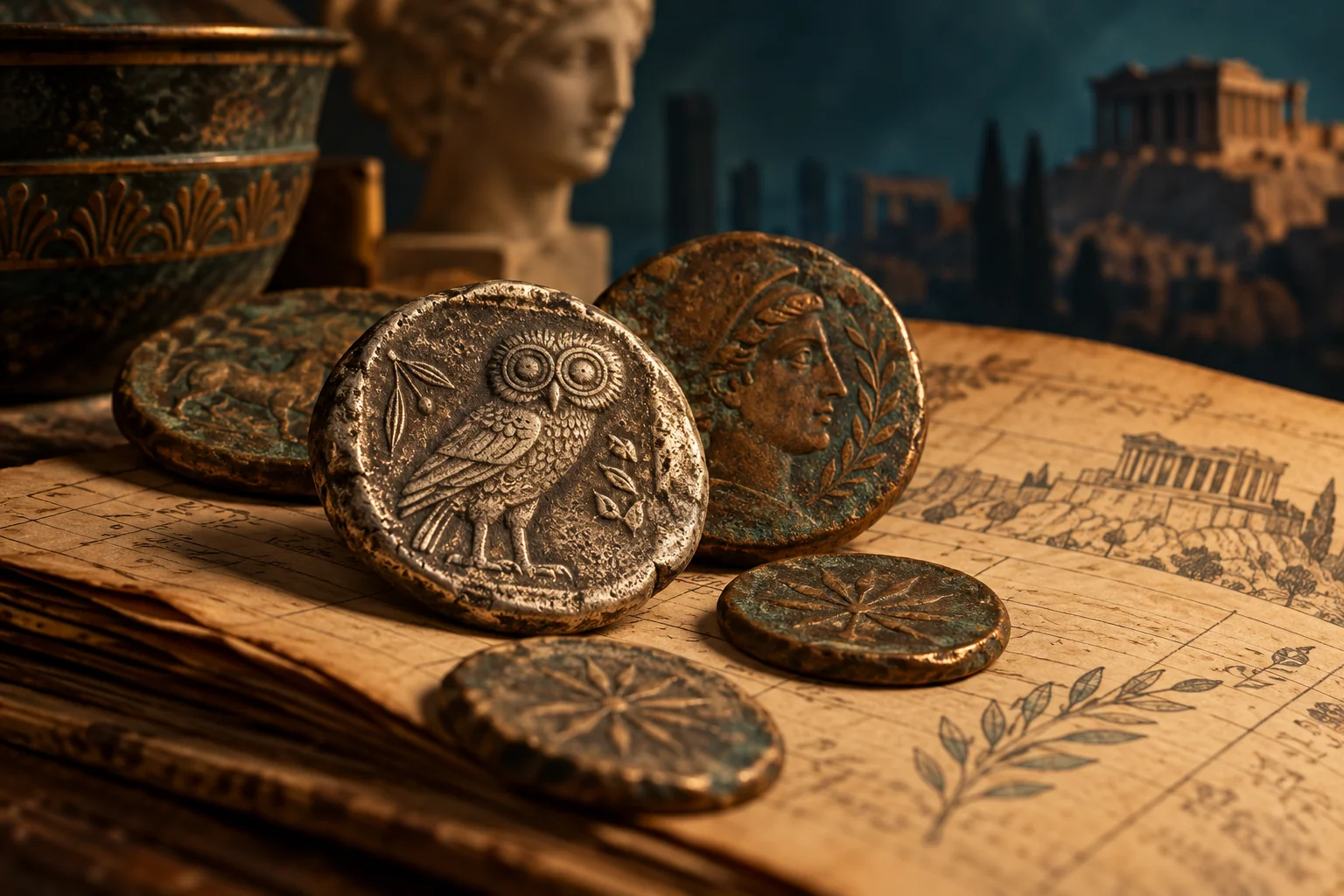
The owl motif connects money to Athens for many people. On the Greek euro coin of one euro is another owl, borrowed from an old Athenian currency. The ECB describes that national side. That is a reference to heritage within a new currency system, not a continuation of the antique silver standard. [4]
The atmospheric illustration of this article is clearly symbolic. The coin forms shown are not reliable examples for determination. Compare a real object with a museum catalogue or the issuing agency.
5. The modern state chooses an old name
In the nineteenth century modern Greece had its own coin history. The drachma of 1833 It is part of the state under King Otto and followed the phoenix from the early period of independence. Sophia Lazaretou's economic research describes this transition and the subsequent attempts to link the monetary system to international monetary links. [5]
The choice of an antique name fits the importance of historical recognition. However, we must not confuse symbolic continuity with an unchanged economic system. A modern tax payment and an antique silver transaction have a different institutional background.
A currency is therefore both computing money and a state image. It makes a political connection visible in something that changes hands every day. That helps explain why a missing currency can keep emotional meaning for a long time.
6. A timeline with clear fractions
| Period or date | What changes? | Which source is helping? |
|---|---|---|
| Antiquity | Different coin systems use drachmas and related units. | Museum and numismatic sources. |
| 1833 | Introduction of the modern drachma. | Bank of Greece and monetary historical research. |
| 1941–1944 | War and extreme inflation lead to very large banknote amounts. | The central bank's banknote collection. |
| 1954 | A new scale replaces a thousand old drachmas with one new one. | IMF reform documentation. |
| 1 January 2001 | Greece joins the euro area. | European and central banking sources. |
| January February 2002 | Euro cash and drachma cash temporarily circulate side by side. | Bank of Greece. |
| 1 March 2002 | The euro is the only legal means of payment after the changeover. | European information on the changeover. |
The timeline combines different sources. In particular, it prevents a note with many zeros from being treated automatically as if it belonged to the same scale as a holiday ticket from the 1990s. [1][3][5][6][7][8]
7. War, inflation and numbers losing their grip
The Bank of Greece describes the banknotes from the occupation period 1941–1944. Due to extreme inflation rising amounts appeared; the collection mentions as late issue a 100 billion drachma banknote of 5 November 1944. [6]
The impressive amount does not say that the owner was extremely rich. In the case of inflation, the unit of account loses purchasing power and larger figures may be needed for everyday transactions. The distinction between amount and value is indispensable here.
For reading a family story it helps to keep the year down. A reminder of millions of drachmas could be a very different economic reality than a later figure of several thousand. Without time, the story is unintentionally distorted.
8. The change in scale of 1954
The IMF documentation describes the reform whereby the drachma's ratio to the dollar of 30.000 to 30 was rescaled. The new drachma from 1954 It replaced a thousand old units. A change of scale is something different than making everyone a thousand times richer or poorer. [7]
A simple comparison makes that clear. As well as a price of 10.000 old units as a balance of 100.000 old units are divided by a thousand, they become 10 and 100 new units. The ratio between price and balance remains the same in that calculation example.
That example only describes the logic of a rescale. A real economy also has wages, debts, prices and expectations. So don't let an administratively shorter number replace the whole recovery story.
9. Banknotes as small culture windows
The central bank describes issues on subsequent drachma notes, such as shipping, education, agriculture, tourism and science and health. The money also showed a picture of Greece. [6]
With a bill, you can ask three questions. Who or what is depicted? How does this subject fit with the chosen issue? And which world of values or achievements is thus made visible? The answer may vary from one banknote to another.
Do not read an image separately from the entire object. A portrait on the front, a building on the back and a year can form a story together. Take sharp photos from both sides with your own collection and note the visible data without filling in missing information yourself.
10. The euro: 2001 and 2002 are both important
Greece took part 1 January 2001 to the euro area. The irrevocable conversion ratio was 1 euro = 340,750 drachmas. Euro banknotes and coins came up a year later 1 January 2002 In orbit. The central bank describes the dual circulation up to 28 February 2002. [8]
So the two years answer different questions: when did the euro become the monetary unit and when did the new money come into play? Summarize the previous start of euro cash in other stories as the whole of Europe stepped in simultaneously 1999 about, the Greek route would be misrepresented.
From March 2002 had ended the transitional use of the drachma. A souvenir with an old amount can be historically interesting, but is not a current price quotation or payment option.
11. A historical conversion, no purchasing power calculation
The European Commission mentions the same fixed ratio and describes the transition. This allows you to compare amounts from the last drachma period arithmetically with the euro unit. [9]
| Amount in last drachma unit | Shared by 340,750 | Completion at euro cents |
|---|---|---|
| 1.000 drachmas | 1.000 / 340,750 | € 2,93 |
| 5.000 drachmas | 5.000 / 340,750 | € 14,67 |
| 10.000 drachmas | 10.000 / 340,750 | € 29,35 |
This table doesn't tell you what you could buy with that money these days. This requires price development and the goods or services examined. Nor does she say anything about the collection value of the physical banknote. Arithmetic value, purchasing power and market value are three different questions.
12. Keep old drachmas
The official exchange periods for drachma cash have expired. The European Commission 1 March 2004 for coins and 1 March 2012 for banknotes. The ECB shall also provide information on former national currencies. [9][10]
An old banknote is therefore not automatically worthless as a reminder or collectible, but you cannot present the historical conversion as an enforceable payout. A trader assesses a different type of value than the central bank at the time of the conversion.
Keep items carefully and record their origin. Avoid aggressive cleaning based on any internet tip. Anyone who wishes to have something assessed will take clear data and photos to an expert and will not consider a asking price as a proven sales value.
13. Frequently asked questions
Is an antique drachma the same as before the euro?
No. They are different historical systems that share a name.
The euro was introduced in Greece. 2001 or 2002 Entered?
Accession to the euro area was 2001; euro cash was published in 2002.
Can I change old drachmas at the central bank?
The official exchange periods for coins and notes have expired. A possible collector's market is something else.
Is 10.000 drachmas now € 29,35 Worth it?
That is only the arithmetic equivalent at the fixed transitional price, not a current purchasing power or valuation of a banknote.
Sources and read on
Sources checked for this edition on 30 October 2026. Antique texts, later tradition, dictionaries and contemporary practical descriptions have different functions. Own calculation examples, listening questions and language examples are editorial effects.
- Bank of Greece · History of the drachma
- Archaeological Museum of Heraklion · Obels as for-mint units
- Numismatic Research · The Hellenistic World: denominational systems
- European Central Bank · National sides of Greek euro coins
- Sophia Lazaretou ( 2003 ) · The Adventures of the Drachma, Bank of Greece Working Paper 2; author's analysis
- Bank of Greece · Drachme bank notes and their theme "S'
- IMF ( 1954 ) · Greek monetary reform: legal documentation
- Bank of Greece · History of the euro and dual circulation
- European Commission · Greece and the euro: exchange rates and exchange dates
- European Central Bank · Former Greek national currency