On a mountaintop in Psiloritis, light from the universe is transformed into knowledge. Discover the history, telescopes, measurement methods and public activities of the observatory.
Αστεροσκοπείο Σκίνακα
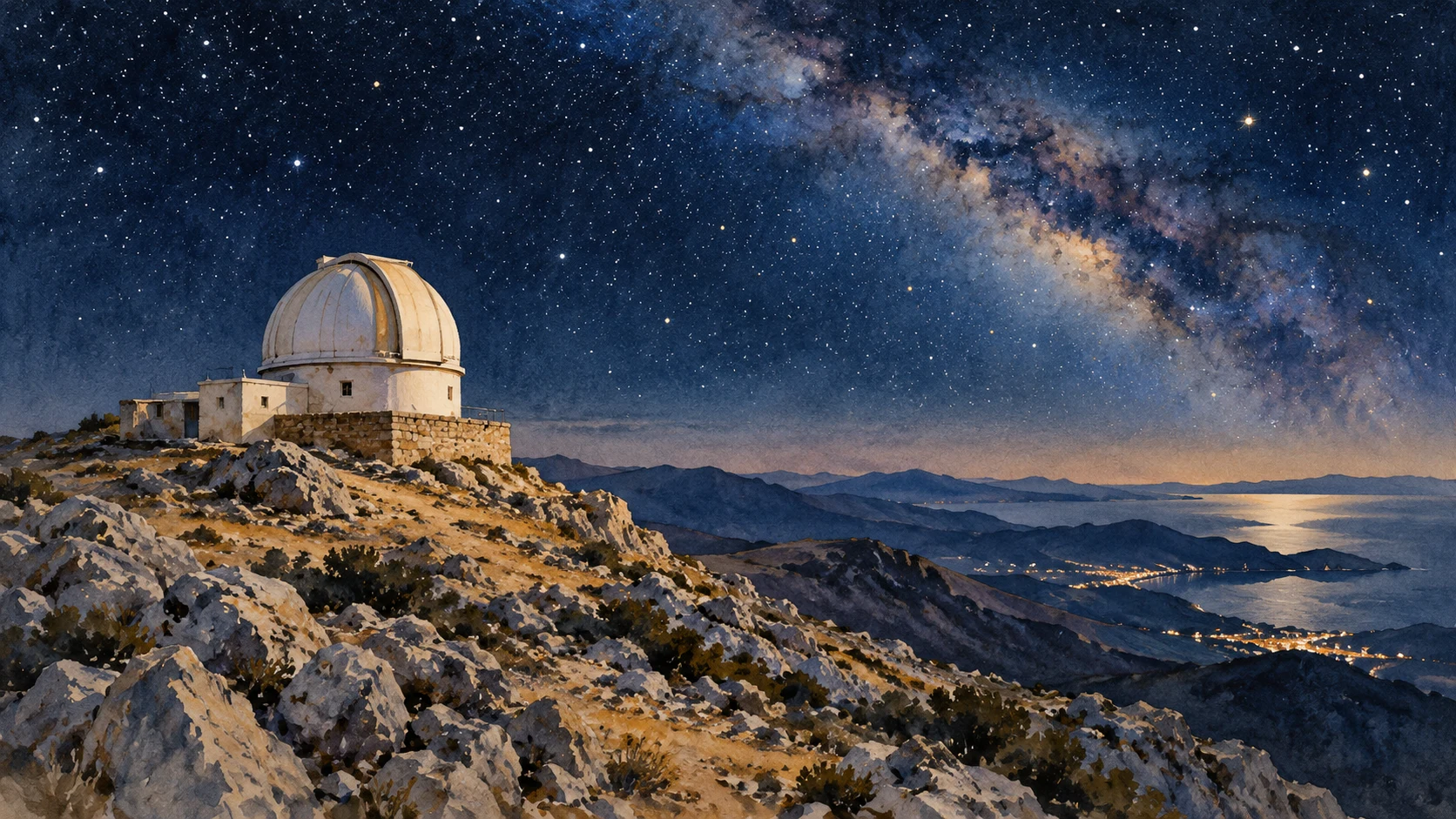
AI illustration · artistic impression, no photo, exact map or scientific reconstruction.
Location
Psiloritis · environment Anogeia
Height
Approximately 1,750 meters
Since
Inaugurated in 1986
Visits
Through confirmed official activities
01 · SKINAKAS
A mountaintop as a window on the universe
On the Skinakas in the Psiloritis Mountains there is a research site with a very different rhythm than the coast: here the night is about collecting, measuring and comparing light. The observatory is about 1,750 meters altitude. The bare mountain environment and the distant horizon make it understandable why an observatory seeks a suitable place outside the busy plain.
Skinakas is a joint research facility of the University of Crete and FORTH, the Greek Foundation for Research and Technology. Forth's Institute of Astrophysics and the university's Physics Department carry out the activities. Research and education are at the heart of the project; public activities also offer an introduction to the world.
Those who think of this as part of a journey can connect two stories: the mountain landscape of Psiloritis and the question of how people learn about objects that are inaccessible far away. The dome is only the visible beginning. The main result of a observation night is ultimately data that needs to be carefully processed.
The plan for an astronomical research site at Skinakas was created in the summer of 1984. The University of Crete, FORTH and the German Max-Planck Institute für extraterrestric Physik worked together on a telescope for training and research. The approach of Halley's Comet in 1986 gave the implementation a concrete timetable.
The observatory was inaugurated on April 12, 1986, with the first telescope opening at 0.3 metres. An electronic camera made it suitable for the observation of vast objects like the comet. In 1988, a guest house was opened where educational activities also took place.
The 1.3-meter telescope began to work in autumn 1995. This gave the place a larger instrument for systematic observations. This development shows that an observatory grows through collaboration between researchers, technicians and students. The image of one person who is lonely through a viewer is not enough for that organization.
The official website mentions four optical telescopes working in October 2026: the 1.3-meter telescope, a robotic 1.2-meter telescope dating from 2026, the robotic 1.0-meter telescope dating from 2024, and the instrument of 0.3-meter from 1986. As a result, older travel guides sometimes give an incomplete picture of the current facilities.
The indicator in meters is about the opening of the instrument, with the large reflectors the diameter of the main mirror. A larger opening can collect more light. Therefore, magnification alone is not a good measure for the scientific possibilities. Also detector, instrument, stability and available observation time determine what you can explore.
A robotic telescope performs programmed observational actions. This does not mean that science happens by itself: people determine the program, control quality and interpret the results. Compare it to a well-organized measurement campaign. Automation takes over recurring actions, while the question for which you measure remains the responsibility of researchers.
A telescope collects light, an instrument asks questions
A main mirror collects light and brings it to a focal point, where a detector can capture an image, but a scientific image is more than a beautiful picture: the numbers behind the pixels make measurements possible. By viewing the same source at different moments, you can follow changes in brightness.
Filters allow certain wavelength areas to pass through. This allows you to compare different parts of the light. Spectroscopy divides the light further into wavelengths; a polarimeter explores another property, polarization. Skinakas describes, among other things, on the instrument page, optical camera performances, filters, a near-infrared camera, a spectrograph and polarimetric instruments.
The choice of the instrument follows the research question. If you want to know how quickly a source changes, time resolution is important. If you want to capture a weak object, more collected light may be needed. If you want to know about the directional properties of the light, then a normal color photo is not enough. The observatory is rather a laboratory with different measurement methods than one exceptionally strong binocular.
RoboPol is a photo polarimeter designed specifically for the 1.3-meter telescope, which was developed in 2013 within an international collaboration. The original program focused on more than one hundred blazars with strong gamma radiation; later it was also used for research into magnetic fields in molecular clouds in our Milky Way.
Polarization describes a directional feature of the electromagnetic vibration of light. You can compare it with an additional layer of information on brightness and colour. The measurement of this helps researchers to test models of radiation and matter. It is not a direct image of a magnetic field line that you could see with the naked eye.
The official instrument description explains that RoboPol makes four images on the detector for one source, which calculates the linear polarization. That's a nice example of how the design of an instrument determines what question you can ask the universe. The appearance of a star photo doesn't in itself tell what measurement is the basis of it.
The research page of Skinakas collects publications and dissertations using data from the observatory. The list extends far beyond one type of celestial object. An observatory therefore also provides an archive of reusable measurements and a place where new researchers learn the subject.
A observation night starts with a plan: what source, what instrument and what times are needed? After that, researchers have to determine whether the measurements are usable. A change in the atmosphere or a technical effect should not be seen for a change in the source itself. Only after control and analysis data become a substantiated conclusion.
For the curious visitor, this is a good question to a researcher: what quality do you measure tonight and what would be an unexpected outcome? That conversation goes beyond the question of which object is most beautiful. It shows how a small series of measurements can contribute to a larger study involving multiple observatories.
The quality of a spot depends on more than clouds. The official information of Skinakas also discusses seeing: the extent to which turbulent air lubricates or causes a point source to move. A sky can seem bright to your eyes and yet give less sharp images.
The darkness of the sky also plays a part. The observatory refers to measurements of the night sky brightness and signals the influence of light from the direction of Heraklion. Strong wind and dust from the south can also change conditions. These factors explain why a suitable climate does not guarantee each individual night.
Keep three things apart for a visit: the long-term suitability of a location, the weather on the chosen date and the actual decision of the organisation to allow an activity to continue. Use for the last two current information. The coastal averages from our climate guide do not replace mountain expectations or a message from the observatory.
Skinakas organises public activities to introduce visitors to astronomy and research. An announced activity may include lectures, explanations or a observational part, depending on the program and the circumstances. A visit to a research site therefore requires a different planning than a freely accessible view stop.
Important for consultation on 21 October 2026: the official agenda reported that the remaining evenings of August and September 2026 had been moved to The Shepherd's Land in the municipality of Anogeia because of work and security at large visitors' numbers. These announced dates are now over. This is not a new invitation nor confirmation that the domes are now freely accessible.
Use the current official calendar for a subsequent activity and check the date, assembly site, language and any conditions. The explanation for the nights moved mentioned Greek as a language for lectures, with possible English explanation at stargazing. Do not assume that an older travel report describes the current program.
When an activity takes place on the mountain, the journey is part of the preparation. Ask the organisation which route and access are used on the chosen date and what the parking options are. Plan the return route as carefully as the way out and take into account darkness.
Bring warm layers and sturdy shoes. Stand still looking at the sky feels different than walking through a village during the day. Keep food, drink and necessary items within easy reach. Use lightly restrained and follow the directions of guides so that you do not interfere with others and any measurements.
Our suggestion: make Anogeia and the surrounding mountain country a separate part of the journey and let a confirmed public activity be the anchor point. Plan a meal and plenty of rest before the evening. Thus, the excursion remains a meeting with landscape and science, rather than a late ride to a possible closed area.
Even without a confirmed open evening, you can take interest in the night sky with you on your journey. Choose a permitted, securely accessible place to stay after dark. Please check in advance which bright objects are visible on your date and time and keep a simple star map at hand.
Start with an overview of the sky before you try to find details. Let your eyes get used to less light and put away a bright phone screen. Binoculars can help with some goals, but is not a condition to learn to recognize patterns and movements. Do not go on your own initiative on the observatory site.
For your travel book: first describe what you really see and then look for the name. Also note the conditions, such as clouds, moonlight and nearby lighting. The difference between perception and explanation makes the viewing more attentive. The AI illustration in this guide shows the atmosphere; it does not predict star status or visible Milky Way on your visit evening.
Map · Skinakas and Anogeia
Map for orientation. Search links are not a controlled walking route or confirmation of access.
Consulted on 21 October 2026. Actual background is based on the sources below. Visiting proposals and viewing questions are editorial suggestions. The AI illustration is an artistic interpretation and does not provide any evidence of terrain, architecture or visible sky at a given date. Information about the telescopes and public evenings describes the situation in consultation; new program performances may deviate from this.