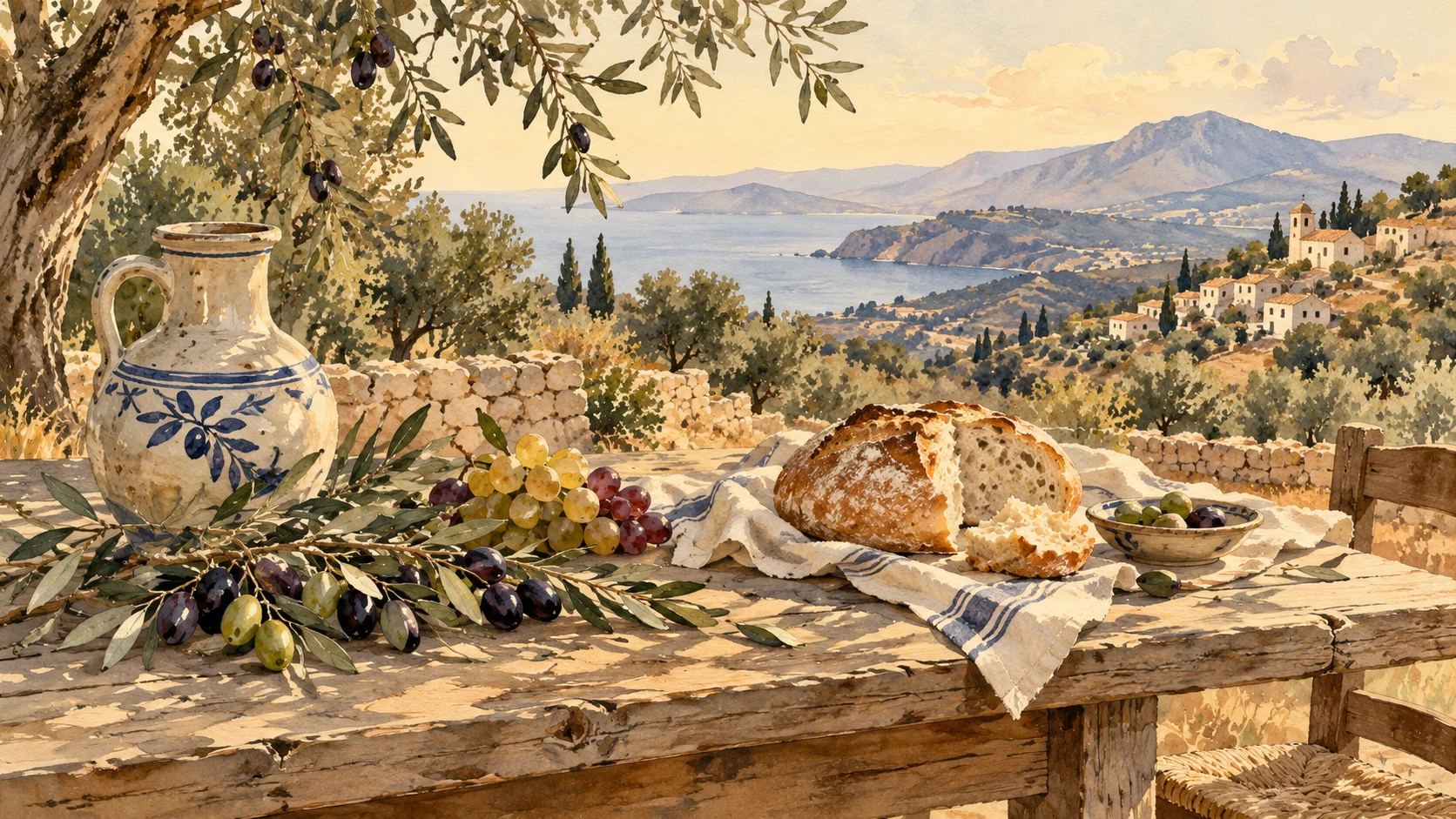
Twelve month windows, with olives, grapes, raki, Easter, music and daily life between seasons.
AI-Illustration · artistic impression, no exact representation of landscape, history or species.
01 · CRETE
January · another rhythm
Ιανουάριος
Start the year with a city, museum and a meal. In the villages you can see how shops, cafes and workshops function outside the busy holiday season. Not every visitor company is open.
Our assignment: Ask what is being prepared today and write down one difference with a summer visit. Do not use the month as a weather promise: coast, inland and altitude each require their own current expectations.
02 · CRETE
February · materials and crafts
Φεβρουάριος
Choose a potter, weaver or museum collection as a common thread. Ask about the material, the editing and the use. An appointment is often more useful than assuming that every workshop receives visitors.
Connect a walk to the village when the weather is right. The content of the day does not have to depend on a long mountain route or beach afternoon.
03 · CRETE
March · look at the outer area
Μάρτιος
The transition to spring is a reason to look carefully at the agricultural landscape. What is written on a field and where is working? Seasons do not start on each plot at once.
Edible wild plants have a place in Cretan cuisine. Get to know them only with reliable local guidance; an illustration or superficial resemblance is no basis for picking or eating anything.
Orthodox Easter does not fall on the same date every year and can also be in May. This month is therefore a window on tradition, not a fixed party agenda. Read in advance about the meaning of the days and ask which local activities visitors can attend.
A divine service is not a performance. Please take into account the believers and the instructions on the spot. The eating culture around the party gets its own explanation further down the road.
05 · KRETA
May · connect village and landscape
Μάιος
Combine a village with one well-prepared walk. This shows how buildings, fields and routes are connected. An old watercourse or path can help you understand why a place was created right there.
Our assignment: choose a meal and ask for an ingredient from the area. Note what you have tasted and what you have heard about the origin.
06 · CRETE
June · Learn to read the sea
Ιούνιος
Also use a beach day to look at the coast as a habitat. Note rock, sand, vegetation and possible nest marks. Follow information from administrators and leave plants and animals alone.
Choose a quiet program with time for shade and a meal. A long-term climate average helps with general expectations; current circumstances determine the chosen day.
07 · CRETE
July · music and meeting
Ιούλιος
Explore the local cultural agenda: a concert, village festival or exhibition can give an entrance to the life of today. Events change per year and place, so check organizer, date and location.
Listen first and ask for the name of an instrument or song. A brief conversation about music does not need to be an assessment of how traditional something is to become.
08 · CRETE
August · party and summer life
Αύγουστος
The holiday of 15 August is an important religious date. The exact way of celebrating varies from community to community and not every event is a freely accessible village party.
The first grape harvests can start in late summer, depending on race and location. Ask what really happens at that time instead of expecting a fixed harvest scene.
The regional agricultural guide describes September as an important period for the grape harvest. Timing varies by variety, weather and parcel. A wine company can explain why exactly that moment is chosen.
Plan a visit by appointment. Harvest time is work, even when visitors find it festive. Ask which parts you can see and arrange transportation when tasted.
Autumn offers an entrance to the culture around tsikoudia and the rakokazana, where distillation and meeting come together. The start and duration vary per place and year. An open day or visit requires confirmation.
Also look at the table: nuts, fruit, small dishes and conversations connect the product with hospitality. You don't have to drink alcohol to get to know the meaning of the meeting.
Use olives and olive oil as a theme for an autumn visit. Harvesting time is not a fixed calendar date for the whole island: variety, height, ripeness and company choices matter. Ask in advance if a producer receives visitors.
Our olive oil dossier explains processing and testing. Compare what you read there with the producer's explanation and keep the origin of a specific oil in your test notes.
12 · CRETE
December · reminder and winter table
Δεκέμβριος
A museum, city and quiet meal are a good winter reading route. See an object about daily life and then find out what action you can still see in the area.
Make your own seasonal menu with recipes from the guide. It is an editorial menu, not a claim that every Cretan family eats the same in this month.
13 · CRETE
Easter · from preparation to party
Πάσχα
Orthodox Easter is one of the great religious celebrations in Greece. The date is mobile. In Crete, the celebration of worship, family visits and dishes connects with its own place in the tradition. The national tourist guide describes the Cretan Easter table as an important expression of local cuisine.
Fasting, preparation and party are different moments. Ask for the use of a dish and take into account differences between households. A menu is not a full account of religious practice.
Our proposal: first read the story, only visit an appropriate public activity and then talk about one dish. This creates a connection between meaning and taste, without the party becoming a list of attractions.
Grape harvest and autumn raki meetings are linked to agriculture and hospitality. The regional guide calls the late summer and September for the grapes and autumn for rakokazana. They are spacious seasonal windows, not a reservation calendar.
Ask a producer what you can see on your date. Processing and distillation are work processes with equipment and own conditions for visits. This guide does not give instructions to burn alcohol yourself.
Taste a small dish, ask about the ingredient used and record who gave the explanation. That makes a visit more personal and precise than a general story about what everyone on Crete always does.
First, choose the goal: walking, art, sea, agriculture or a party. Then find a suitable season and the current possibilities. One month is a tool to plan, no guarantee that an activity is open.
Combine this guide with the climate dashboard and the regional table of contents. Keep enough space for weather, a closed door or a good conversation. A year in Crete consists of work and change, not twelve unchanging postcards.
The monthly windows are editorial ideas. They do not form a fixed harvest calendar or current event guide. Check with the manufacturer or organizer what is possible on your date.
Editorial edition · 21 October 2026. Visiting proposals and exercises have their own effects. Check current access, transport and local conditions with the official administrator. Party dates, harvest and opening vary per year and place. The monthly layout helps you choose; it does not predict a program.