GASTRONOMY · INGREDIENTS & LANDSHIP
Greek honey: landscape, species and taste of Crete
From thyme and pine to crystallization, beekeeping, tasting and cooking.
Added: · approx. 13 minutes read
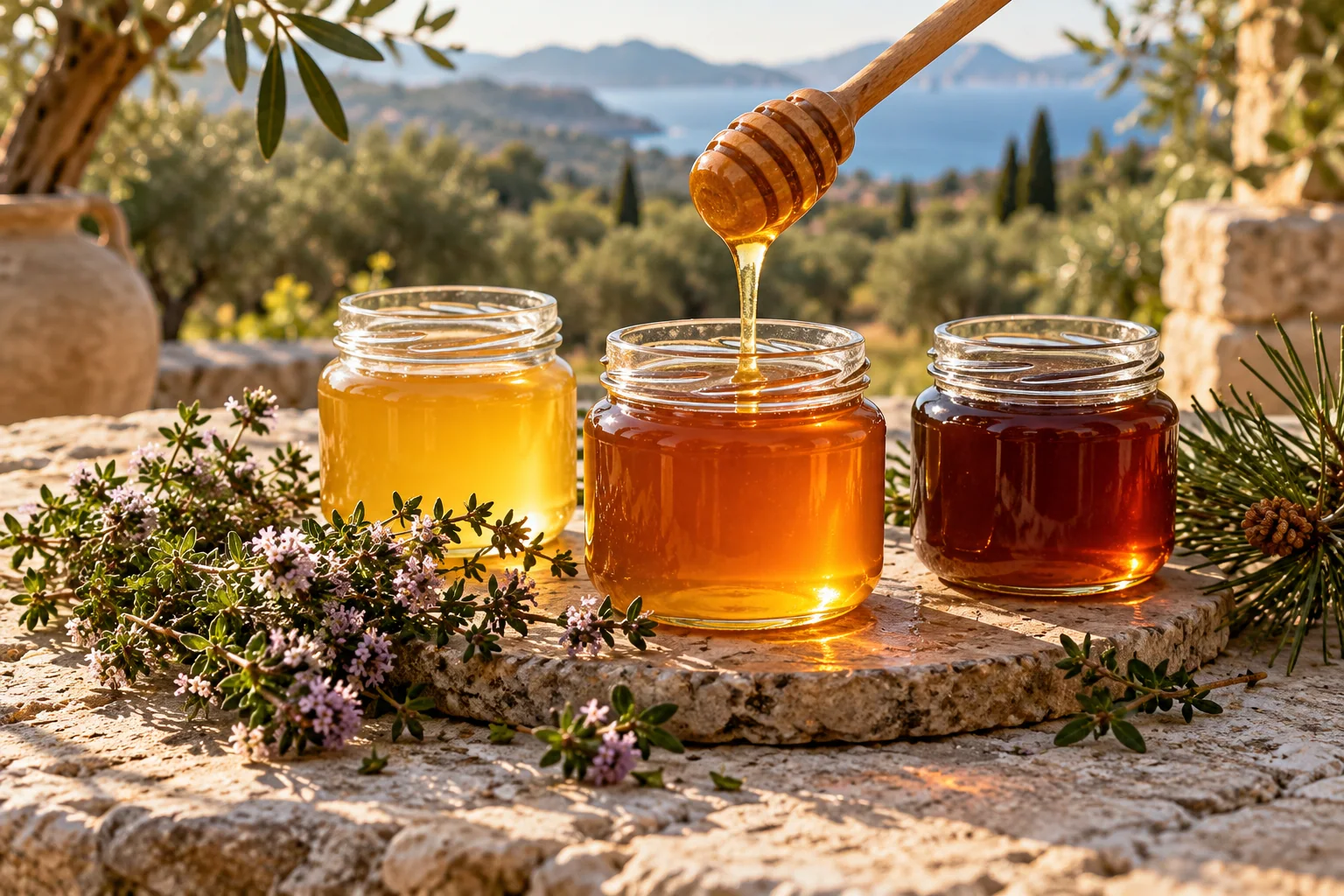
1. A landscape in a pot
Greek honey is a beautiful way to look at a landscape differently. A pot can make you curious about thyme on dry slopes, citrus blossom in an orchard or pine forests where bees collect food. The taste doesn't tell the whole story on its own: you also need information from the beekeeper and the label.
The Greek tourist agency mentions, among other things, thyme, orange blossom, heather, chestnut, pine and spruce honey. These are different entrances to the same product world. So, Greek honey pomace is no flavor and no guarantee that all pots have been produced in the same way. [1]
This file helps you choose, taste and cook. It does not give a ranking in which the darkest, most expensive or strongest fragrant honey automatically wins. A honey that is beautiful with old cheese can dominate the smell of a light yogurt preparation. The best choice often starts with the question of what to do with it.
2. Of nectar or honey dew
Flower honey starts with nectar. Bees collect that, process hair and store the product in bars. In honey dew honey, the starting material is different: sweet secretions that become available on plants, inter alia, via insects. Pine honey is therefore not simply pine honey. [3]
In the kitchen you can use this distinction as a starting point, but not as a hard taste rule. A pot with a certain botanical indication remains influenced by place, season and the collection of bees. Ask a producer what the name means in this particular case.
Moreover, "Time honey' does not mean that bees visit only one type of plant or that a producer has itself stirred thyme with honey. Botanical origin and a flavored product are different things. Therefore, in addition to the big name on the front, read the product description and ingredients information.
3. Getting to know species
The above types are found in Greek product descriptions. The following combinations are their own trial suggestions. Do not expect every honey from a category to smell exactly the same or have the same colour. [1]
| Name | What you can watch | Try it. |
|---|---|---|
| Tree honey · thymarisio meli | The spicy and floral impression of your pot | Yogurt, fresh cheese or cheese pita |
| Pine honey · pefkomelo | The smell and aftertaste, next to the sweetness | Whole yogurt, nuts or bread |
| Spruce honey · elatomelo | Structure and difference with pine honey | Cheese and a simple sandwich |
| Orange blossom honey | Whether you recognize a light blossom scent | Fruit and mild yoghurt |
| Heather honey | Intensity and possible bitterness | Nuts or a small cheese tasting |
| Chestnut honey | The ratio between sweet and bitter | Fruited cheese, in measure |
| Flower honey · anthamolo | The interplay of different smells | Daily use and a first tasting |
Also taste one type of two pots next to each other. Then it is more striking how much difference there can be than when you make one pot the measure for an entire region.
4. Honey in Crete
The official tourist website of Crete describes a landscape including thyme, sage, oregano, citrus and pines. She also tells how beekeepers move cabinets to follow different flowering periods. This makes it clear why the Crete site does not automatically mean a single place of employment or a single place of employment. [2]
The same regional page contains production figures from 2004. We don't use them here as actual numbers. That distinction is important: an old figure on an accessible website is not new because you read it today.
Those who buy honey in Crete can ask which area and harvest the pot comes from. The answer can give a more concrete picture than a beautiful label with a mountain, a monastery or a bee. Also a tourist shop can sell good honey; the place of sale alone does not prove the origin of the content.
5. The beekeeper and the season
A honey pot is the result of a lot of work that you don't see at the breakfast table. The regional description of movable cabinets shows one part of it: the pursuit of flowering and suitable assembly sites. Behind such a choice are practical questions about accessibility, weather and the condition of the bee people. [2]
Harvesting and processing also requires choices. The FAO describes, among other things, the removal of bones, the removal of the wax cover and the winning and the screening of honey. The goal is not that every product looks identical afterwards. A label or producer may explain how the lot concerned has been treated. [6]
As a visitor, don't just ask if the honey is pure. Also ask when was harvested, how the lot was processed and what the producer himself likes to have tasted the product. Concrete questions usually raise more than a question to which almost every seller will answer...
6. Tasting without haste
Use small, clean spoons and start with a small amount. First look at the color, then smell and taste. Let the honey pass over your tongue for a moment and pay attention to what lingers when the first sweetness decreases.
You don't need to know a fixed list of professional fragrance words. "Bloomy', "bloomy', 'bloomy', "light bitter', "warm' or "bloomy' may be enough. Write down what you perceive, without pretending the name on the label prescribes a taste.
Taste a second spoon on neutral bread or a little bit of yogurt. A product can appear very powerful in itself and become balanced in a combination. Drink water in between. Two or three honeys are enough for a first comparison.
7. Crystalization: grains are not automatically a defect
Honey can crystallize. The FAO describes how the ratio between sugars and water and the conditions in which honey is stored plays a role. Crystalization is not in itself evidence of deterioration or conclusive proof of authenticity. Some honey is deliberately offered fine crystal. [3]
Therefore, do not judge only whether a pot is liquid. A highly cooled or otherwise preserved pot may behave differently than a second pot from the same batch. Also, all real honey crystallizes within a fixed period of time.
If you don't like the structure, you can opt for another application. For example, crystallised honey is easy to lubricate on bread. For a dressing you can gently dissolve a small measured amount; you do not immediately have to liquidate the entire pot again.
8. Store and heat gently
Keep the jar tightly closed, dry and out of direct sunlight. Use a clean, dry spoon. Honey can absorb moisture; it is therefore wise not to leave water, yogurt or crumbs in the storage jar. The FAO discusses moisture, fermentation and the influence of heating as important quality factors. [6]
If you want to make honey more liquid, work quietly with a small part in a lukewarm water bath. Avoid direct, strong heating. A cooking pan is not necessary to mix a spoon more easily.
Also distinguish between storage and cooking. In a dish honey can be heated for culinary reasons, for example for colour or a sauce. That doesn't automatically make such a dish worthless. It is different from the desire to preserve the original aroma of a special honey as much as possible.
9. Label: Origin is something other than packaging
The European Commission describes provenance labelling as part of the rules for honey. The rules on mixtures have been revised: countries of origin are given more emphasis, with indications of their share and scope for national impact. In case of a concrete pot, check the current entry and ask the seller if it is unclear. [4]
For a buyer, the distinction is particularly practical: "Packed in Greece' and "Packed' honey harvested in Greece' are not equivalent statements. An address of a Greek company tells where that company is located, but does not independently determine the origin of all honey in the pot.
Please also note the name of producer or responsible company, batch number and shelf life information. When making a special purchase, keep a picture of the full label. Then you can later recognize the same party or ask a specific question.
10. Reality: no reliable trick with a glass of water
A drop in water, a match or the pace at which honey runs from a spoon does not give a conclusive answer to the question whether honey has been falsified. The Joint Research Centre describes research into suspicious honey using laboratory methods. That complexity does not fit one decisive home test. [7]
Therefore, do not be persuaded by a demonstration that promises spectacular certainty. Thickness, temperature, moisture content and composition influence what you see. A traditional look, a high price or a jar with a bramble doesn't automatically prove everything about the product.
Practically help a recognizable producer, a clear provenance and a good explanation about the lot. That's not an absolute guarantee, but it's more useful than a trick that can't prove what he's saying.
11. Honey is food, not miracle cure.
Honey fits in a varied kitchen, but remains a source of sugars. The WHO calculates the sugars in honey as free sugars.Of course, therefore, it is no reason to treat each quantity as insignificant. [8]
Use a pronounced honey comfortably in a small amount when that is enough for the dish. Just a consciously chosen taste can add more than always a larger spoon.
Make no medical promise from food descriptions. This dossier does not recommend honey treatment for diseases. Those who taste honey because of the landscape, the work of the beekeeper or the combination with cheese do not have to make up a health claim.
12. No honey for children under one year of age
Don't give honey to children under 12 months of age. The CDC warns of infantile botulism and also calls adding honey to food, drink or teat. For this age, a special, organic or locally purchased honey is no exception. [5]
Set honey aside for adults during a joint breakfast, so that it is clear what it is in. The age limit is not a value assessment of the beekeeper: it is part of the product and vulnerability of young children.
13. Honey on the Greek table
The Greek tourist agency mentions honey among loukoumades and various sweet preparations. On Kreta Kroniek you can continue to Sfakiani pita, xerotigana, loukoumades and melomakarona. Not every syrup with a Greek pastry consists exclusively of honey; look at the separate recipe. [1]
A simple start is a small spoon about yogurt, with some nuts separately. Have a taste without honey. Then you better judge if you need half a spoon or a whole spoon.
Comparing cheese works well: take the same cheese with two different types of honey. Leave out other tastemakers first. You will discover which combination you yourself find attractive than when nuts, fruit and herbs have already taken over all the differences.
14. Cooking with honey
Use honey as a separate ingredient with its own function. In a dressing you can start with one teaspoon of honey, one tablespoon of lemon juice and two tablespoons of olive oil. Stir, taste and adjust. This is a separate starting ratio, not a fixed Greek basic recipe.
Honey can quickly get dark in a hot pan. Therefore, add a honey-containing glaze rather late or reduce the heat. With fish you want to be able to color the outside without the sauce turning black before the fish meat is cooked.
Do not replace sugar in a baking recipe without thought one by one. In addition to the sweetness, you also change the amount of moisture and the behaviour of the batter. Choose an existing honey recipe or change a small test portion first and note what you have adapted.
15. A little honey tasting at home
Take three pots whose origin and description are clear, for example a thyme, a pine and a flower honey. Temporarily give them letters A, B and C, so that the packaging sends your first impression less.
Create a simple sheet with four columns: smell, mouth sensation, aftertaste and favorite application. Write it down individually and then compare it. The goal is not for everyone to choose the same description.
Then taste each honey on the same piece of bread or with the same yoghurt. See if the preference changes. Save your notes with a picture of the label and the date you tasted. For example, your own taste memory grows without the need for a ranking of best honey in the world.
16. Buy from a beekeeper or shop
Ask a few concrete questions: which region does this honey come from, when has the lot been harvested, what does the botanical name mean and how can I use this pot best? A tasting is useful, but you don't have to bring a large stock right away.
A bottle or jar that leaks, closes badly or has no understandable product information is awkward to travel with. Choose an appropriate package and take into account the transport rules that apply to your trip. This dossier does not give any actual baggage limits.
Think of a purchase as a conversation about a product. You don't have to understand the whole Greek beekeeping from one meeting. One well documented pot can already form a nice connection between landscape, craftsmanship and your own kitchen.
17. Frequently asked questions
Is thyme honey always completely made of thyme?
A botanical indication is not a promise that a bee has visited only one plant. Ask for the party and the justification of the producer. Moreover, a honey to which thyme has been added is something other than honey with a botanical thyme origin.
Has crystallized honey been corrupted?
Not by crystallization alone. The formation of crystals is part of the properties of honey. Do not judge the pot with a single appearance. [3]
Is dark honey better than light honey?
Color is not a general quality ranking. Choose origin information, condition and the taste you are looking for. Taste different pots next to each other where possible.
Can a baby get honey if it comes from a trustworthy beekeeper?
No. Do not give honey under 12 months, regardless of origin or mode of production. [5]
Does a glass-water test prove honey is real?
No. Research into counterfeiting requires suitable methods of analysis; a simple kitchen test does not provide conclusive evidence. [7]
Where can I find recipes with honey on this site?
Check out the sweet recipes, including Sfakiani pita, xerotigana, loukoumades and melomakarona. The reading links under this file will take you to the existing maps.
Sources and read on
Directly consulted on 30 October 2026. Old production numbers have not been taken over as current figures. Test questions and combinations are their own editorial suggestions; product quality and medical operation are different topics.
- Greek Tourist Office (Greek honey)
- Region Crete / Incredible Crete honey and beekeeping
- FAO feline properties and composition of honey enoate
- European Commission honey, quality and origin marking...."
- No honey for children under 12 months of age
- FAO harvest, processing and quality factors
- Joint Research Centre - Research on the authenticity of honey...
- WHO Healthy diet and free sugars