Thirty portraits of trees, shrubs, herbs and flower plants. Search by name, habitat or botanical characteristic and see what is endemic.
Atmosphere at the flora of Crete · AI illustration, no determination photo or proof of an observation.
The plant and animal images are AI illustrations. The scientific source supports the text. Creta pine not only means that the species can occur naturally elsewhere; it does not mean that the species has been introduced. An endemic subspecies and the species as a whole can have a different distribution area.
30 portraits
No portraits found. Choose larger filters or show everything.
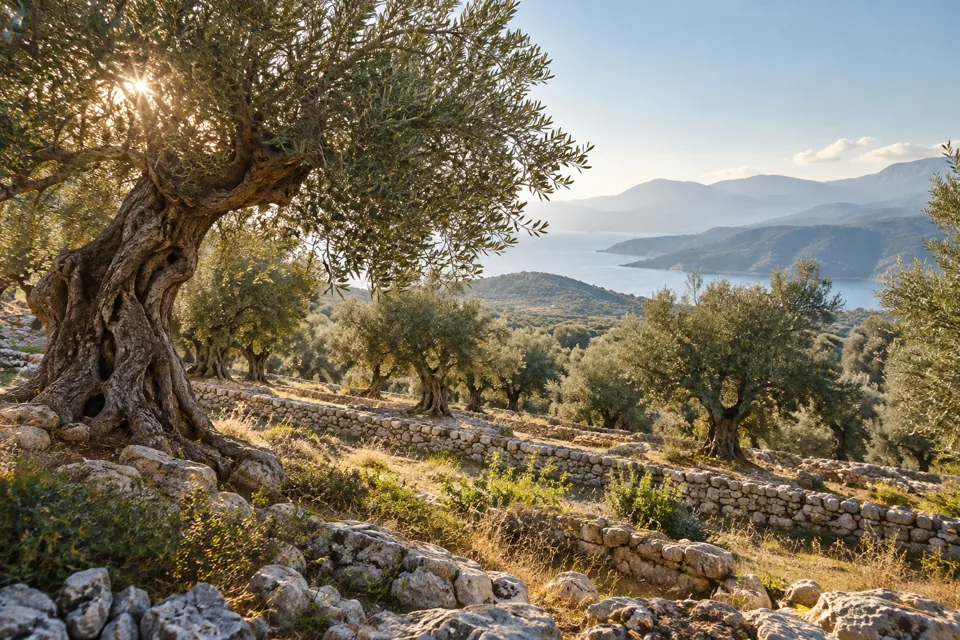
Illustration at Olive Tree · AI illustration, no determination photo or evidence of an observation.
Trees
Olive tree
Olea europaea
Not only CreteOlive groves & cultural landRocks & gorgesVillages & Gardens
The olive tree connects agriculture and of course shrubland. On Crete you can see planted orchards as well as wild or wild forms. The evergreen leaves have a light underside; in the wind the colour of the crown changes. A whimsical stem tells you that a tree has experienced a lot, but does not prove in itself any precise age.
That's how you look.
Look at the same crown with and against the light. Look for opposite leaves, the silvery bottom and the transition between young twigs and weathered wood.
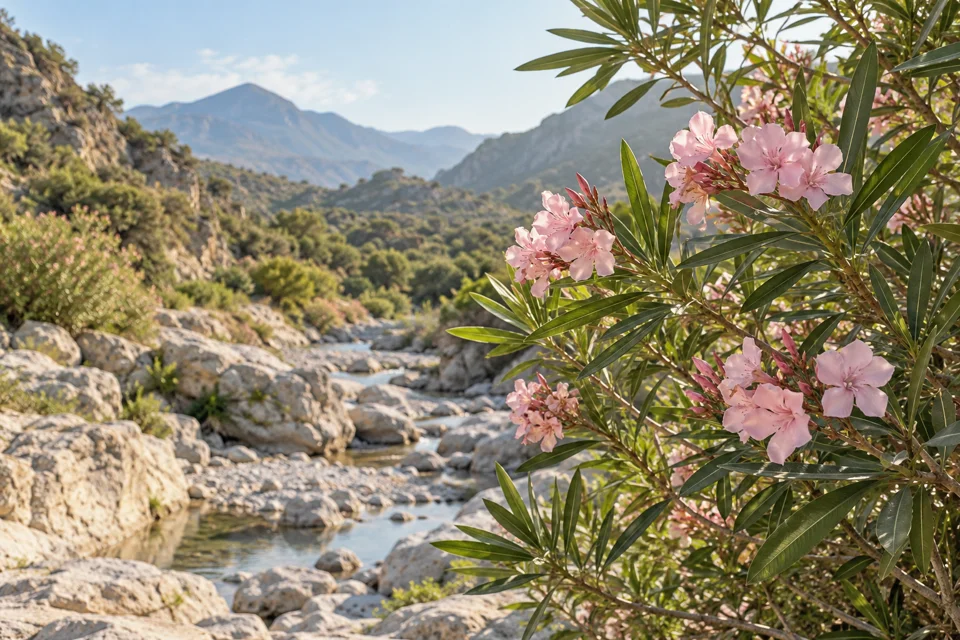
Illustration at Oleander · AI illustration, no determination photo or evidence of an observation.
Shrimps
Oleander
Nerium oleander
Not only CreteSources & wetlandsVillages & Gardens
Oleanders are not only part of hotel terraces. Wild plants also grow along watercourses that are dry part of the year. The narrow, leathery leaves remain green; the flowers are in striking groups.Cultivated shapes have more colors and sometimes filled flowers. All parts are very toxic when absorbed: no branches are used for barbecue, spears or tea.
That's how you look.
Compare a flowering shrub in a stream valley with a planted hedge. Look at the narrow leaves and the five flower slips without picking.
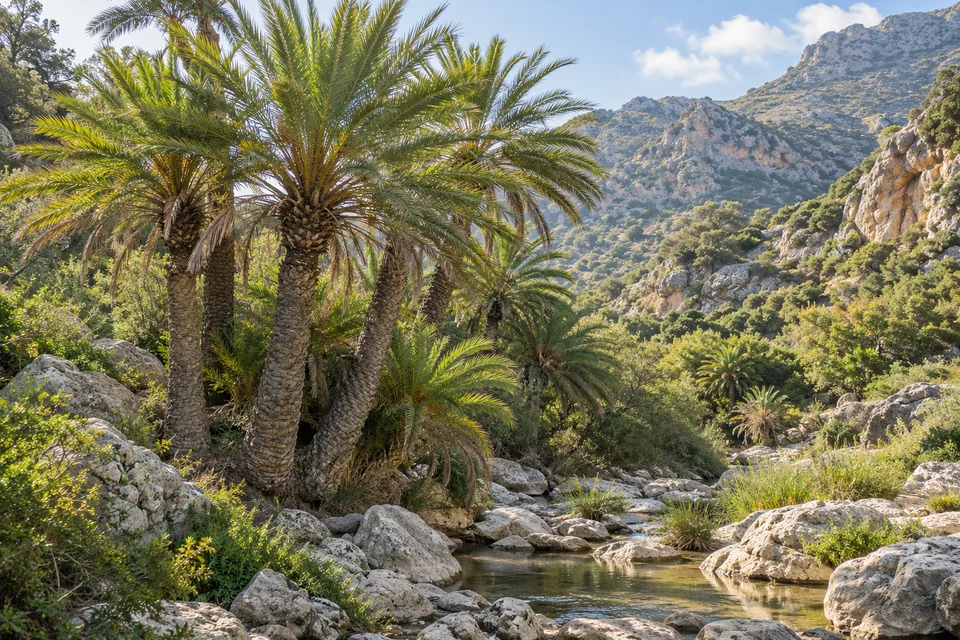
Illustration at Cretan date palm · AI illustration, no determination photo or evidence of a sighting.
Trees
Cretan date palm
Phoenix theophrasti
Not only CreteDunes & CoastSources & wetlands
This palm is part of the natural flora of Crete and the south-west of Turkey. So, the name does not mean that the species only occurs in Crete. The stiff, feathered leaves give a very different silhouette than deciduous trees. In a palm grove, the moist soil, undergrowth and young palm trees also count: the landscape is more than a collection of photogenic stems.
That's how you look.
Search from the path for leaf feathers and for multiple stems or young foothills. Compare the pattern with a planted ornamental palm in a village.
Not only CreteOlive groves & cultural landForest & shrublandVillages & Gardens
The johannes bread tree is an evergreen Mediterranean tree with firm, complex leaves and long pods. It fits the warm lowland and forms a recognizable link between orchard and shrub vegetation. The dark brown pods have their own place in the food culture. For a nature walk is especially interesting how different its broad, dark crown looks next to a silvery olive tree.
That's how you look.
Follow one leaf stem and count the round leaves. Then look for hanging pods; they are botanical something other than the separate leaves next to them.
Not only CreteSources & wetlandsVillages & Gardens
Where water is available, a plane tree can show a completely different Crete: wide leaf, deep shade and a light, spotted trunk. The eastern plane tree is naturally present on the island. On a village square such a tree can be a planted meeting place at the same time. The relationship with water is ecologically more important than the romantic impression that every old plane tree is always wild.
That's how you look.
Look at the deeply cut leaf lobes and the scaling bark. Compare the shade under the crown with the open, dry slope outside the village.
Not only CreteMountains & high plainsForest & shrublandVillages & Gardens
In Crete, the cypress is not only a planted column at a monastery. The species also belongs to the natural tree flora. Besides narrow garden-like shapes there are trees with a much wider branched crown. The fine scaled leaves and the woody, round cones betray the conifers, even when the circumference hardly resembles the well-known pencil silhouette.
That's how you look.
Compare a narrow cypress when growing with a broad branched tree. Look for round cones and scaled twigs without pulling branches down.
Not only CreteForest & shrublandRocks & gorgesMountains & high plains
This evergreen oak can grow as a low dense shrub, but also form a tree. The small, stiff leaves often have spiney edges and at first glance remind of holly. Assholes make the family relation clear. The species shows beautifully why a species list alone is not enough: the same name can represent very different growth forms in the landscape.
That's how you look.
View leaf edge, leaf size and any acorns together. Compare layer of strowel with a higher specimen and pay attention to how much shelter the dense branches give.
Not only CreteForest & shrublandMountains & high plains
Pinus brutia belongs to the eastern Mediterranean and occurs naturally on Crete. Long needles and woody cones determine his appearance. Under a pine crown, the light falls in narrow orbits on the bottom, very different from under a plane tree. Therefore, don't just look up: the open spaces and undergrowth help to understand a pine forest as a habitat.
That's how you look.
From the path, observe needle bundles, cones and reddish-brown bark. A conifer is not automatically a cypress: compare both tree types in the same landscape.
Endemic: CreteMountains & high plainsForest & shrubland
Abelitsia is a true Cretan endame. In the mountains there are both larger trees as well as strongly squeezed specimens. Research shows how grazing reduces growth; also drought and other disturbances play along. Protected test subjects help to follow recovery. A low tree is not just a small bush here, but can be part of a particularly vulnerable tree population.
That's how you look.
Look at small, sawn leaves and the dense branch. Respect fences: just the difference between grazing and protected vegetation makes the research visible.
The strawberry tree is not a strawberry on a stem. It belongs to the heather family and carries leathery leaves, small bell-shaped flowers and round fruits with a bumpy surface. The Mediterranean distribution area includes Crete. In dense shrubland it does not always stand out, until colourful fruits or light blooms appear between the dark green leaves.
That's how you look.
Look for the contrast between shiny leaves, small hanging flowers and rough round fruits. Look at the details of the plant; collecting is not necessary.
Not only CreteForest & shrublandRocks & gorgesDunes & Coast
Lentisk is an important evergreen shrub of the Mediterranean shrub. Its composite leaves consist of small, sturdy petals. The plant also occurs on Crete, but that does not make Chios' famous mastic production a general Cretan craft. For hikers, its share in dense, low vegetation is particularly interesting: a landscape that looks like even green from a distance, contains many different shrubs.
That's how you look.
Follow a full leaf stem and see the pairs of partial leaves. Compare the plant with a white spirit tree; pay attention to leaf structure and whether the leaf is preserved.
The white-tree is related to lentisk, but is devoid of leaves. Its composite leaves usually have a final leaf, a useful difference to study quietly. It can grow as a shrub or small tree and is part of the Mediterranean flora of Crete. The two Pistacia species show how a seemingly uniform green slope botanically disintegrates as soon as you look at one branch accurately.
That's how you look.
Search the end page without damaging it and compare a whole leaf with lentisk. A single leaf photo is less informative than a complete branch.
This juniper berry belongs to the Mediterranean coastal flora and is also registered for Crete. It has stiff, coniferous leaves and striking, berry-like cones. On the coast wind and sand can strongly determine the growth form. Not every local 'cederbos' consists of this one species: popular landscape names are not reliable botanical determination. The exact species requires more attention than a volatile beach photo.
That's how you look.
Watch the needles and the berry-like cones from an existing path. Note roots and young plants in the sand; do not walk between the bushes.
Despite the species name, this rock rose is also found outside Crete. The pink flowers with their yellow stamens give dry shrubland a very different look than in summer. The leaf is firmer and less spectacular than the flower, but also belongs to the portrait. Look at the whole shrubs and their neighbours: one pink flower does not yet tell how a Mediterranean slope is built.
That's how you look.
Look for the wrinkled impression of the pink petals and the yellow flower core. Also photograph leaves and growth form to make the perception more complete.
This Cretan endame is a low flowering plant, not a tropical ebony tree. The grey-haired, compound leaves and dense pink blooms stand out between limestone and low shrubland. The Greek botanical association calls flowering from April to early June, depending on height and location. On suitable slopes the plant can form large groups; it is not only a resident of unreachable rock walls.
That's how you look.
Look at the soft, silvery impression of the composite leaf and the compact pink flower bunches. Look for differences between buds, open flowers and bloomed parts.
Tree-wolf milk makes round, highly branched shrubs on warm Mediterranean slopes. The yellow-green inflorescences can almost resemble small lights from a distance. The species is found on Crete, but is not island-bound. The name 'tree' says something about the woody character. Assess the plant as part of the shrubland; the decorative form is not an invitation to break down twigs.
That's how you look.
Notice the round circumference and branches that split again and again. Look at the yellow green tips from the path and leave stalks intact.
Not only CreteRocks & gorgesVillages & GardensDunes & Coast
The hairdressing bush shows how much life a crack can carry in a wall. The long shoots have rounded leaves and large, light flowers with lots of long stamens. This taxon is also known under the older name Capparis orientalis. The culinary capers are flower buds, not fruits; watching the plant is something other than treating it as a wild picking product.
That's how you look.
Look at an open flower next to a closed button and follow the long stamens. Compare round leaves with the angular stones that the shoots hang over.
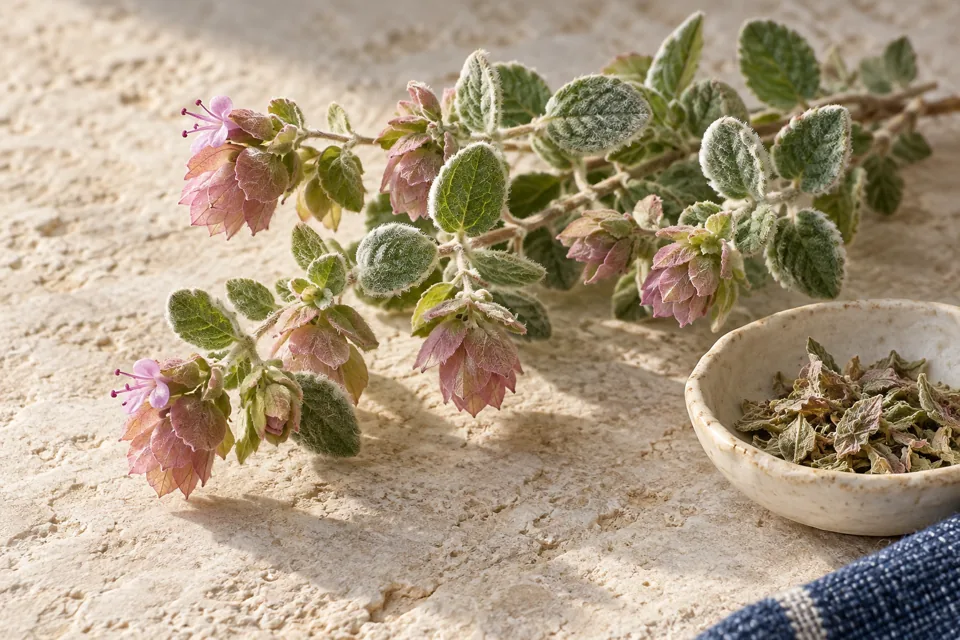
Illustration at Diktamos · erontas · AI illustration, no determination photo or evidence of an observation.
Herbs
Diktamos · erontas
Origanum diktamnus
Endemic: CreteRocks & gorgesMountains & high plains
Diktamos is a Cretan endaem that is connected to rock walls and gorges. The densely hairy leaves and the graceful inflorescences give him an almost velvet look. His cultural fame as herbal tea does not make wild plants less vulnerable. Look at them remotely; buy easily grown products for culinary use. The stories surrounding this herb are part of his cultural history, not proven healing power.
That's how you look.
Search from a safe path for the round, woolly leaves and overhanging inflorescences. Do not climb to plants in crevices and take no material with you.
Illustration at Malotira · Cretan mountain tea · AI illustration, no determination photo or evidence of an observation.
Herbs
Malotira · Cretan mountain tea
Sideritis syriaca abroad
Endemic: CreteMountains & high plainsRocks & gorges
The full name is important for malotira: the subspecies syriaca is a local Cretan endame, while the species as a whole has a wider distribution area. The plant is connected to mountain land and recognizable by the hairy, grayish appearance and the flower crowns along the stem. Research into cultivation and preservation emphasizes that a well-known tea herb also represents a wild nature value.
That's how you look.
View the woolly surface and floors of the inflorescence. Compare wild plants remotely with dried, grown mountain tea offered in shops.
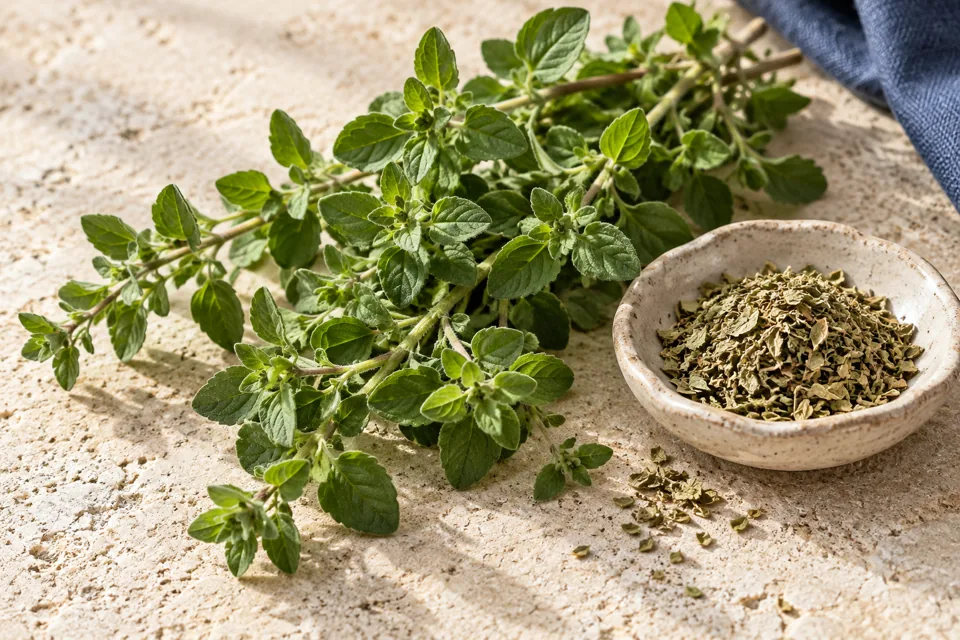
Illustration in Greek oregano · AI illustration, no determination photo or evidence of an observation.
Herbs
Greek oregano
Origanum vulgare subsp. hirtum
Not only CreteRocks & gorgesMountains & high plainsOlive groves & cultural land
Greek oregano is one concrete taxon within the much wider world of herbs called "oregano'. The subspecies also occurs on Crete, but not exclusively there. The small leaves and branched inflorescences are at least as interesting for a natural observation as the smell. A name on a herbal pot does not automatically tell which wild plant you see along the path.
That's how you look.
View leaf stand, stem and complete inflorescence together. Do not rely on smell alone when recognised; leave the plant and capture several features on photo.
This low woody plant is often called thyme, but belongs botanically to the genus Thymbra. The compact flowering heads and narrow leaves fit the low shrub of dry Mediterranean slopes. It also occurs on Crete. By standing still with a flowering plant, you see more than a herbal name: shape, open space and flower visit together make a small piece of landscape visible.
That's how you look.
Look for dense pink to purple flower heads on low branches. Stand still and watch any flower visitors without touching flowers or insects.
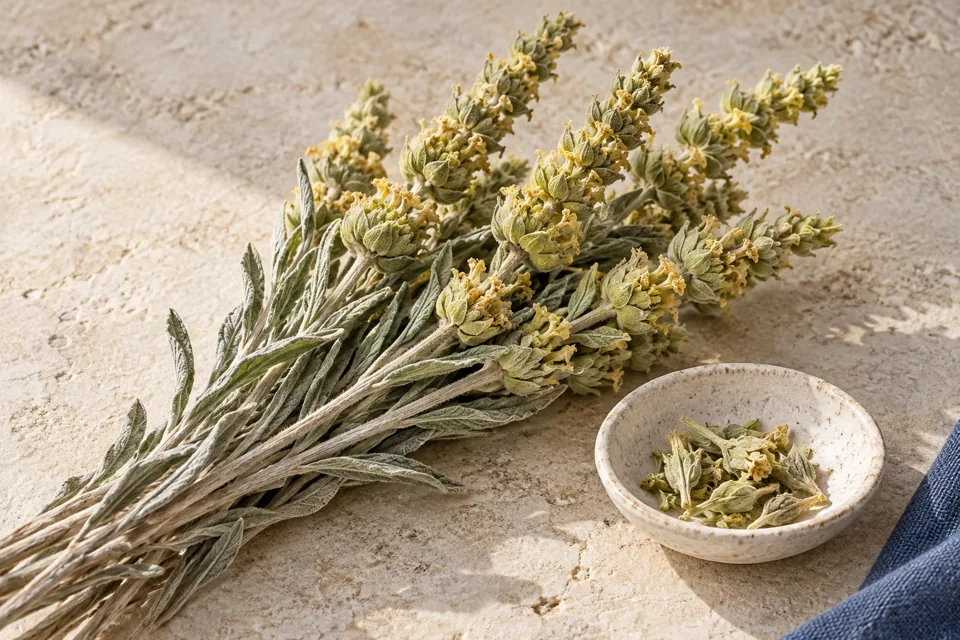
Greek sage is a woody aromatic crop of the eastern Mediterranean, with Crete within its natural distribution. The gray green leaves and lip flowers provide hold on to the look, but 'salie' includes several species. Not every herb from a Greek mountain village is therefore the same plant. Look at the flower shape and the leaf as a whole instead of just mentioning a fragrance.
That's how you look.
Notice the greyish leaves and the lip flowers placed on top of each other. Also look at leaf lobes and branching; these details help more than one close-up of the flower.
Petromarula is a Cretan endame from the bell family. It grows in rocky situations, among others; Crete University of Technology calls it a characteristic plant of its gorge habitat. The leaf structure and the loose blue-like flowers give it its own appearance. The Dutch nickname rock lettuce is only a name in this overview and no indication to eat the plant.
That's how you look.
View the cut leaves at the bottom and the loose flowers higher on the stem. Find the plant where you can safely stay on a path.
This wild cyclam belongs to Crete and Karpathos; only 'endemic on Crete' would be too narrow. The flowers are usually white, with also pale pink shapes, and stand above heart-shaped leaves. It is a tuberous plant, not a reappearing plant. The modest height demands attention for the bottom layer, where a walk suddenly gets a completely different scale.
That's how you look.
Look at the backstorm petals and the leaf pattern without removing the litter. Photograph low from the path instead of kneeling between plants.
Not only CreteRocks & gorgesOlive groves & cultural landForest & shrubland
The name sounds exclusive of Cretan, but Kew also counts parts of Southeast Greece and the eastern Aegean islands as the distribution area. The striking flower lip makes this orchid popular with photographers. Within Oprys there are differences between specialists; a photograph therefore does not have to lead to a definite species name. A careful observation with place, date and multiple characteristics is more valuable than feigning security.
That's how you look.
View flower lip, drawing, calyx leaves and the whole stem. Stay away from other rosettes; plants are easy to miss and trample before flowering.
Not only CreteRocks & gorgesForest & shrublandOlive groves & cultural land
Dragon's root is a dramatic appearance with a dark cover around a long bulb. What seems to be one huge flower is a botanical inflorescence with small flowers. It is found on Crete and elsewhere around the Mediterranean. Its appearance makes it a good lesson in looking: colour and size stand out immediately, but the actual flower structure requires a second look.
That's how you look.
Check out the ratio between the dark red to purple cover and the long flask. Keep distance and photograph the leaves to keep the complete portrait.
Not only CreteOlive groves & cultural landRocks & gorges
Kroonanemones add bright colours to open Mediterranean vegetation. The species has a wide distribution area in which Crete falls. The flowers and the finely distributed leaves are easier to understand when you look at an entire plant instead of just the colour surface. A field zoom or clearing can be as interesting as a famous nature reserve, provided you look at the vegetation quietly.
That's how you look.
Compare the flower colour, dark stamens and the distributed leaf. Photograph from the edge and also leave a bit of growing place in the picture for context.
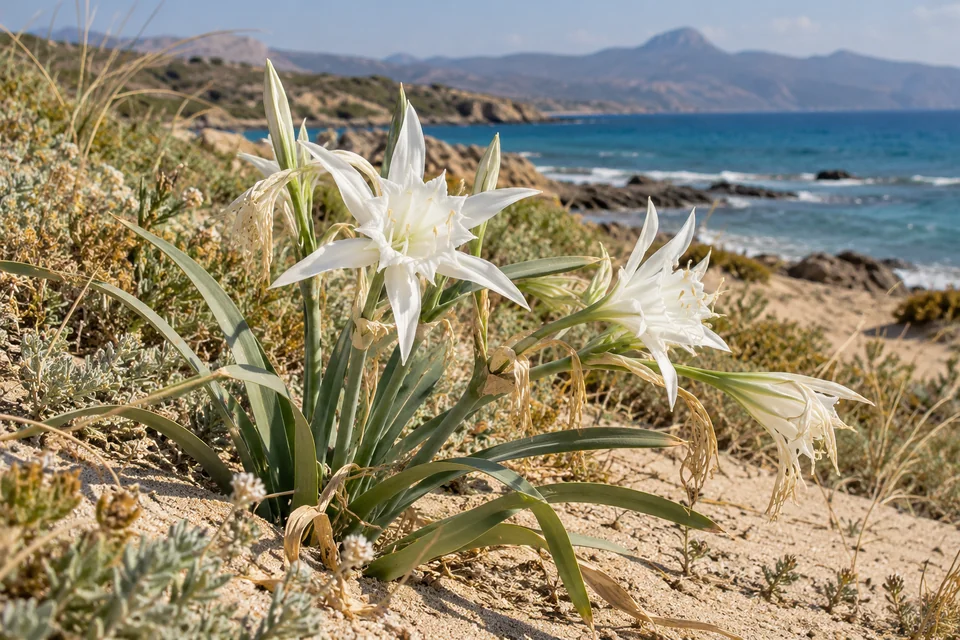
Illustration at Strandnarcis · AI illustration, no determination photo or evidence of an observation.
Flower plants
Strandnarcis
Pancratium maritimum
Not only CreteDunes & Coast
The beach narcis is a bulb of Mediterranean sandy coasts, also in Crete. The white flowers have long, narrow flower covers and a striking central crown. The soft beach image hides a fragile growing place: under the sand there are living parts, even when there is little to see above ground. A beach without flowers is not automatically a place without vegetation.
That's how you look.
Watch the white central crown and the long, narrow parts around it. Stay outside overgrown dunes and look for bulbs under the sand.
Endemic: CreteRocks & gorgesMountains & high plains
Tulipa cretica is a Cretan endaem and a different image than the large garden bulbs from Dutch borders. The low growth, narrow leaves and light flowers fit a much smaller viewing distance. The species is not the same as any wild tulip that occurs on Crete. Note the full plant and growing site; only an open flower does not always make a determination.
That's how you look.
Compare the light inside with the outside of the flower and look at the narrow leaves. Leave the bulbs and the bottom alone and photograph from the path.
Not only CreteRocks & gorgesOlive groves & cultural landDunes & Coast
The branched affodil combines long ground leaves with tall, branched flower stems. The light flowers have dark mid stripes, a nice detail that disappears from a distance. The species occurs in a large part of the Mediterranean area, including Crete. It temporarily gives open terrain a very different height and structure: between low vegetation small white beacons arise above the lawn.
That's how you look.
Follow one stem of the ground leaves to the branched inflorescence. Look at the dark stripe in the flower covers and compare open flowers with still closed buds.
Sources consulted on October 17, 2026. The guide combines scientific and local natural resources with their own viewing assignments. The selection has been extended, but not a full list of Crete species. An AI illustration supports the story and is not suitable to assess a plant for edible or to identify a species with certainty. Dissemination, names and knowledge can change; the source per profile gives the context.