01 · Olive tree
The olive tree: a live plant
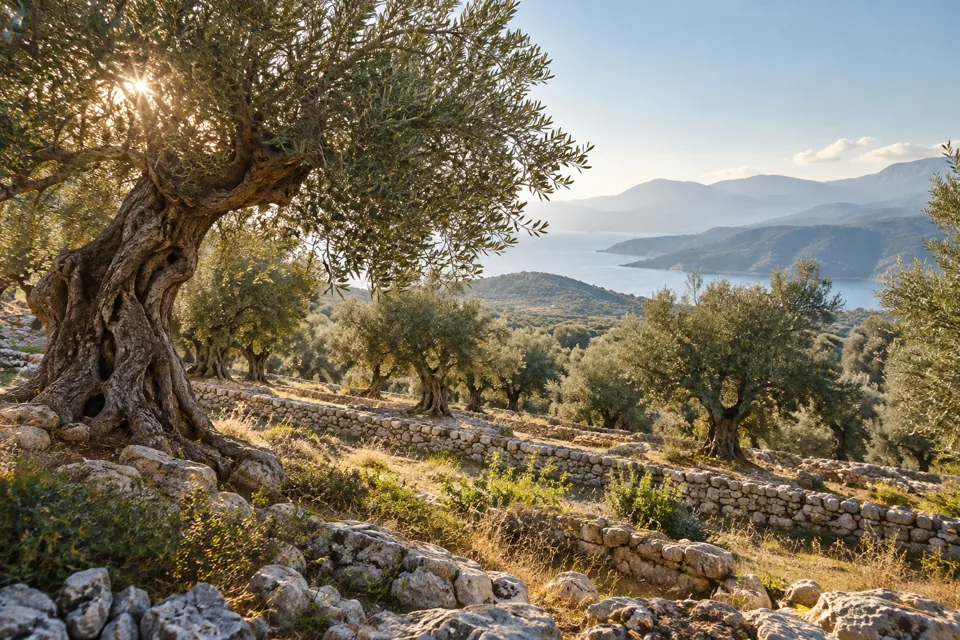
The olive tree, Olea europaea, belongs to the olive family, the Oleaceae. It is an evergreen woody plant that can grow as a tree or as a multi-stemmed form. The cultivated olive is inextricably linked to the Mediterranean landscape, but an olive grove is also the result of human work and choices about multiplication and management.
So start a tree portrait with two questions: what does the plant do on its own and what has a grower changed its shape? A trunk, a pruning wound and a young shoot tell different stories. You don't need to know the age or breed immediately to see much. First describe the form and then look for a substantiated explanation.
Kew · Olea europaea .
02 · Olive tree
The silver of the leaf
Olive leaves are narrow, sturdy and evergreen. The top side is greener and the bottom side has a silvery appearance. When the wind passes through a crown, the surfaces alternate. An olive grove gives the shine that is so recognizable in Crete's photos.
Watch a low-hanging branch without picking leaves. Note the leaf position, the narrow shape and the difference between light and shadow. If necessary, make two photos of the same tree in other light. A grey-green image is not only a characteristic of the species: direction, wind and moment of the day change what you see.
RHS · Olea europaea .
03 · Olive tree
A year before flowering
Growth, flower development, fruiting and oil production together form an annual cycle. The preparation of a flowering season does not begin until the flowers are visible. Conditions and fruit load from a previous year also work through. Therefore, the yield may vary between years, even with the same tree.
Use the seasonal overview in this guide as a reading support, not as a prediction of a particular harvest date. Note what is visible when you visit: new shoots, flower buds, small fruit or harvest nets. Ask a grower what is different for that year. You learn to understand a cycle without capturing the landscape on one perfect calendar.
International Olive Council · Biology and physiology of the olive .
04 · Olive tree
Small flowers, an important role for the wind
Olive flowers are much less striking than oleander flowers. They appear as small, light flowers in bunches. The olive is mainly a wind pollinator: pollen is mainly moved by the air. The fact that insects can be seen in a tree does not automatically make them the most important pollinators of the olive.
During flowering, look at the scale of the whole. A single flower may seem insignificant, while a crown full of flowers represents a large reproductive effort. Counting flowers is not yet a measure of yield. Not every flower becomes a fruit; ask for the difference between exuberant flowering and successful fruiting.
Annals of Botany · Wind pollination in olive .
05 · Olive tree
From green fruit to ripening
An olive is a stone fruit: around the hard stone is flesh. The colour changes during ripening, depending on race and conditions. Therefore, green and dark are not easily two separate tree species. The processing also affects how table olives eventually look.
Compare with a market stall variety, harvest stage and method of preparation as three separate questions.The colour on the plate does not tell the complete production story.Tasting a fruit directly from an unknown tree is also not a good taste test for the final table product.For dining olives the preparation is at least as decisive as the appearance of the branch.
International Olive Council · Table olives
06 · Olive tree
Koroneiki and Tsounati: names with meaning
Koroneiki and Tsounati are important names in the olive cultivation of Crete. They are cultivars within the world of olive, not different plant genera. The international catalogue of varieties describes characteristics that are important for cultivation. The place where a tree stands does not in itself tell which breed you see.
Ask a producer which varieties grow in a plot and why. Then search on a bottle or the name is mentioned. Do not try to determine a breed based on one picture of a leaf: reliable recognition requires more characteristics and context. An unknown breed may simply remain an open question in your travel book.
International Olive Council · World Catalogue of Olive Varieties
07 · Olive tree
Harvesting is a choice in a continuous cycle
A grower chooses a harvest moment and method within the possibilities of breed and season. Pamako's example shows how a producer describes his orchards via Tsounati and Koroneiki. That is concrete business information, not a general rule for all growers in Crete.
If you take a guided tour of the tree shape, accessibility and work, how do you get to the fruits, what is kept separate and how is the harvest transported? Ask which choices make the plot more difficult or easier. The image of a romantic old tree tells little about the work that makes a harvest possible.
Pamako · Tsounati & Koroneiki .
08 · Olive tree
Table olives and olive oil: two routes from the tree
Table olives are processed to reduce their strong natural bitterness and make the product suitable for eating. For olive oil, a different route is followed: fruits are processed to release and separate the oil. The same plant species is thus at the beginning of different products.
When visiting, ask first which end product is central. For a table olives its shape and bite other questions than for an oil you smell and taste. This guide remains with the tree and the landscape. The olive oil guide in the guide continues with the mill, quality, tasting and use at the table.
International Olive Council · Table olives
09 · Olive tree
An old stem is a monument, not a year counter
The monumental olive tree of Vouves is one of the well-known living heritage sites of Crete. Regional tourist information connects it with a very high age and with the lasting significance of olive cultivation. Exact age claims must be recognised as estimates, not as a direct readable date of birth.
Look at the trunk as a landscape in itself: cavities, ribs, shadow and the relationship to the crown. Admiring does not require climbing or entering protected root zones. Note in your travel book what age calls an information board and who gives that dating. Thus, the impression of age remains connected to the source of the story.
Region of Crete · Olive oil routes & Vouves
10 · Olive tree
Athena's gift: a tree in mythology
In the story of the battle between Athena and Poseidon for Athens Athena gives the olive tree. The Acropolis Museum connects the sacred tree with the complex of the Erechtheion. The tree is a cultural and religious sign here, not a scientific explanation for the origin of the species.
Ask what a useful tree in a myth can represent: food, light, work, continuity or care for a community. These are reading questions that allow you to explore the story. The same tree can be a biological organism and a meaningful symbol at the same time. Keep the types of explanation recognizable side by side.
Acropolis Museum · The Erechtheion .
11 · Olive tree
An olive grove is also a landscape of people
UNESCO describes Mediterranean food culture as knowledge and habits about cultivation, harvesting, preserving, cooking and eating together. This helps to read an olive grove as more than a collection of trees. Landscape and cuisine are linked by work, transfer of knowledge and product sharing.
Our viewing assignment is to look at the space next to the trees. Do you see herbs, stones, bare soil, terraces or paths? Describe what is present without deciding directly which management is more traditional or better. Ask why a grower uses the plot like this. A comparison becomes stronger when your perception and judgment are kept apart.
UNESCO · Mediterranean food culture . .
12 · Olive tree
An olive tree in a Dutch garden or cockpit
For an olive tree a sunny, sheltered pitch and good drainage are important. An established tree in the ground reacts differently to drought than a plant in a pot. In a cooler, wetter climate, long wetness and winter cold require attention. A Mediterranean origin is no guarantee that every Dutch pitch is suitable.
Check the moisture of the potting soil and the drainage, instead of following a fixed weekly schedule. Keep pruning and adjust winter protection to the plant and local conditions. The RHS provides an extensive cultivation guide. If you keep a ornamental tree, you don't need to measure a successful olive harvest.
RHS · Olive trees provide . .
13 · Oleander
Oleander: another family, another role
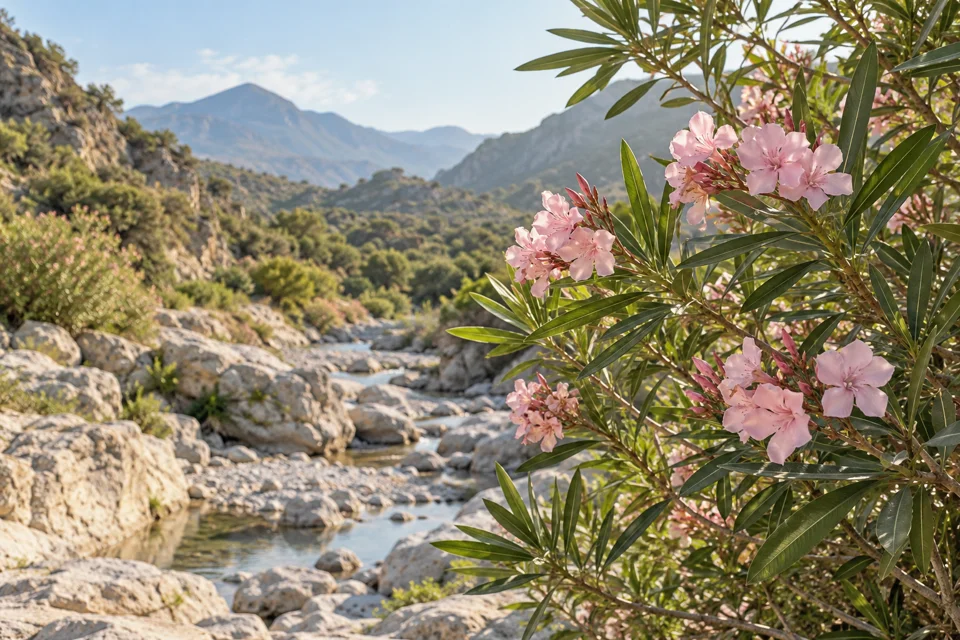
Oleander is scientifically called Nerium oleander and belongs to the Apocynaceae, the virgin palm family. So it is not an olive tree and not a culinary bay leaf. It grows as a green shrub or small tree and has a wide natural spread of the Mediterranean to further Asia.
Use the scientific name when looking up information. Common names can resemble one another and be used differently in several languages. Moreover, a bush in a garden can be a selected culture form. In this guide we describe characteristics to look more closely; the text or an AI image does not provide any certainty for eating or a full determination.
Kew · Nerium oleander
14 · Oleander
Long leaves and the position on the branch
Oleander has long, narrow, leathery leaves. They can be opposite each other or arranged in wreaths to a branch. This creates repeated leaf groups that can stand out when looking. However, only a narrow leaf is insufficient to name a plant reliably.
View a full branch of distance and watch how leaves and branches are associated. Combine this with growth mode and, when present, flowers or fruits. Do not pick or bruise the plant for that. If you want to know a generic name, photos of several characteristics can be shown to an expert. Keep an unknown plant unknown when the information is insufficient.
NC State Extension · Oleander .
15 · Oleander
Flower bunches, five petals and cultural forms
For single-flowered oleanders, five petals are recognizable around a tubular base. The flowers are in groups at the tips of the shoots. There are pink, white and reddish shapes, as well as double-flowered cultivars. The flowering time is related to climate, location and care.
Do not just look at the colour. Compare an open flower with a button and see how the flower group stands above the leaf. Double flowers make counting petals less easy. Therefore, a garden plant that differs from a standard description is not a different species. Always use several characteristics together for recognition.
NC State Extension · Oleander .
16 · Oleander
After the flowers: long fruits and floating seeds
After successful fruiting, oleander can form long, narrow, paired tube fruit. When opened, seeds are released with a hair plume that supports wind-spreading. The fruits may look like pods, but that resemblance does not make them edible beans or any other food product.
A shrub without flowers can therefore still provide an interesting observation. Take a picture of the fruits on the branch and compare a reliable botanical image later. Leave fruit and seeds. Flowering and fruiting are different parts of the same life cycle; not every shrub is equally visible.
NC State Extension · Oleander .
17 · Oleander
A dry bed can mean more water than you think
Oleander is connected in Mediterranean landscapes, among other things, to banks and watercourses. A bed that seems dry during your visit can feed water in another season or offer moisture at depth. Seeing the plant in a sunny, stony setting is therefore not proof that it grows without water.
Read the surroundings: a lower location, a worn-out trench and a line of vegetation can tell something about water movement. This is a viewing assignment, not a method to determine the safety of a route or crossing. Stay at an accessible viewing spot and let seasonal differences be part of your description.
Kew · Nerium oleander
18 · Oleander
From natural growth site to hedge and village edge
The oleander is widely used as a ornamental bush, screen or hedge. Its long flowering, evergreen character and fitness for warm conditions make it visible in gardens and public space. A row of uniform shrubs usually also tells something about planting and maintenance, not just about spontaneous nature.
Compare a freely growing shrub with a tightly maintained specimen. Where are the flowers and how much space does the leaf get? Also note the relationship to a wall, square or road. Make photos only from a safe place. The plant is no reason to stand by traffic or enter a private garden.
Clemson University · Oleander in the garden .
19 · Oleander
Toxic in all parts: nice to view
All parts of oleander are toxic by heartglycosides. The plant is not suitable for tea, herbal mixtures or other food preparations. Also a small intake can be serious; the consequences depend, among other things, on the amount and the victim. Therefore, do not use the plant to taste anything or test an alleged home application.
If you are suspected to be taking this medicine, seek medical help immediately and do not wait for any clear complaints. Leave the assessment to a doctor or poisoning centre. If you are likely to be taken by an animal, contact a veterinarian immediately. This information is intended to look at the plant safely; the guide does not provide home treatment or quantities where intake would be safe.
Belgian Antitoxin Centre · Oleander .
20 · Oleander
Pruning, juice and fire
The RHS warns that smoke from burning oleander is harmful and advises protection when handling it. So do not use branches as spears, stir sticks or firewood for a boil fire. Also, pruned material should not end up between herbs, food or animal feed.
When you need to take care of the food, you use gloves and prevent contact of juice with skin and eyes. Keep children and animals away from work and spacious pruning directly according to the local waste instructions. If you want to view the plant alone during a walk, you don't have to pick or touch anything to see the main characteristics.
RHS · Nerium oleander
21 · Oleander
Oleander as a cockpit plant: light, water and space
An oleander in a pot requires a lot of light, a suitable sunny place and well-drained soil. During active growth, sufficient water must be available without the roots standing in a saturated pot for a long time. A warm garden plant and a plant that hibernates indoors have different conditions.
Therefore check the pot and the growth, not just the calendar. See if water runs away properly and if the plant really makes new shoots. Tune food and any pruning to a reliable cultivation manual and the culture form chosen. The information in this guide is a general orientation; a fixed dose for each pot would be misleading.
RHS · Nerium oleander
22 · Oleander
Overwintering is more than looking for a warm room
In colder climates, an oleander can be kept in a movable pot and go to a protected place during winter. The conditions must fit a greening plant: light, temperature and water remain important together. Frost damage can affect leaves and branches.
Before the cold season determine where the pot can stand and how to move it. A dark, warm space is not a good solution. Adjust the water gift to the growth and temperature and check for problems. Compare your situation with the horticultural source, which writes from its own climate; do not take over a foreign calendar literally.
Clemson University · Oleander in the garden .
23 · Landscape & Watch
Two plants, two ways to read a landscape
An olive grove often reveals the relationship with agriculture and processing. An oleanderhaag or bank shrub raises other questions: decor, water, bloom and maintenance. Both can evoke a familiar image of Greece, while they vary biologically and in use.
Our own comparison consists of four notes: where does the plant stand, how is the growth method, what traces of management do you see and what season is visible? Write down observation and explanation separately. Thus, a walk becomes a small landscape survey, without having to collect plants or stick a definitive species name on one photo.
UNESCO · Mediterranean food culture . .
24 · Landscape & Watch
A plant story for your travel book
Olive trees and oleanders can form their own chapter in a travel report. An olive oil route or an accessible garden provides context, but a careful observation along a public path can also be enough. For a tree on private grounds or a working orchard you ask permission when you want to enter the grounds.
Save place, date, overview photo and one detail. Note whether the name has been provided by an information board, an owner or a personal suspicion. Add a question that is still open. This simple editorial method keeps the personal story alive and later clarifies what information you actually had.
Region of Crete · Olive oil routes & Vouves