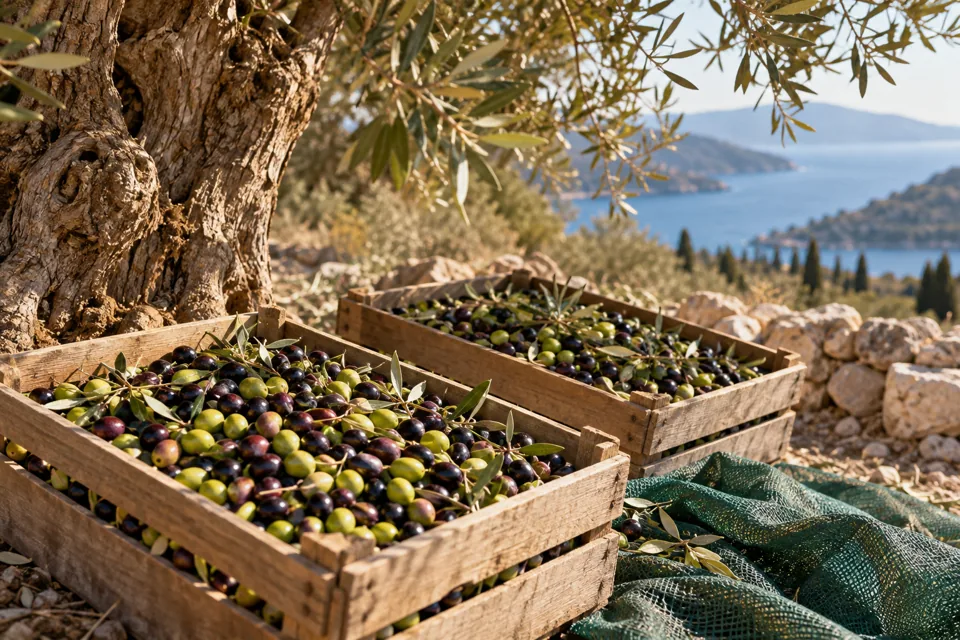
Four windows on the history of food, from Minoan storerooms to Venetian wine trade: discover the wells and make your own tasting evening for home.
A contemporary Greek table · AI illustration
The opening photo is a contemporary AI image. Epochs are separate windows, not a full timeline or proof of one unchanged Greek cuisine. All menu below are own modern interpretations.
I
Bronze time · focus on Knossos
The Minoan table
Read the table through what was left: a pot, a seed, a bone. Each object shows a different part of a meal.
SOURCE & RESEARCH
What we can support
The Ashmolean connects research at Knossos to food residues and utensils. A house from the bronze age at Gypsades contained stored plants, including legumes. Finds of shells and remains of animals complement the image. Storage, cooking and eating together are different parts of the same story.
A stock does not prove a complete dish. Also discoveries from the Neolithic under Knossos should not be presented as Minoan. Dinner's modern museum meal is an interpretation based on research, not an recovered party menu.
OWN MODERN INTERPRETATION
A tasting menu for home
No recipe or authentic reconstruction provided; the combination below has been compiled by us for this guide.
A simple puree of boiled yellow split peas, with olive oil.
Boiled grains of cereals with softly stewed vegetables, served separately.
Grapes or figs as a contemporary conclusion to this performance.
The conversation at the table
Put the puree and grain in different bowls. Discuss what an archaeologist would find later: pottery remains more visible than smell or hospitality. That is a conversation exercise, not a reconstructed ritual.
Not only the food, who could join also defined the meaning of a table. A famous drinking company is not a cross section of a whole society.
SOURCE & RESEARCH
What we can support
The Met describes the symposium as a meeting of men from the elite, with conversation, music and wine. A crater was used to mix wine and water. Drinking cups and mixers make this practice tangible. These objects show a social environment, not a universal Greek daily menu.
A symposium and an ordinary household meal are different subjects. The source explains the drinking company in particular. Our dishes below are not from this museum text and do not form a literal Athens menu.
OWN MODERN INTERPRETATION
A tasting menu for home
No recipe or authentic reconstruction provided; the combination below has been compiled by us for this guide.
Bread and a small dish of olives to share.
A contemporary lentil dish with onion, water and olive oil, without tomato.
Fresh fruit and a small piece of cheese as your own menu proposal.
The conversation at the table
Ask each place a question: when does a meal taste better by the company? Let everyone speak. This inclusive form is our own choice for home; it does not reflect the social exclusion of then.
6th December 15th century · Community research in Greece
The Byzantine table
A large empire does not fit on one plate. Therefore, the most interesting question is: what people, what place and what century are we talking about?
SOURCE & RESEARCH
What we can support
Bourbou and co-workers compared carbon and nitrogen isotopes from eight Greek Byzantine populations. Such analyses help large dietary patterns to investigate. The study also points to the importance of animal and marine food sources, with differences between the groups studied.
Bottom chemistry doesn't produce an ingredient list or herbation, nor do the research sites represent every household in the Byzantine Empire. So our plant-based meal is not a conclusion that everyone eats vegetable.
OWN MODERN INTERPRETATION
A tasting menu for home
No recipe or authentic reconstruction provided; the combination below has been compiled by us for this guide.
Bread next to a bowl of slowly boiled lentils.
Leaf vegetables with oil and a little vinegar, to your own taste.
A small bowl of dried fruit for a sweet rounding.
The conversation at the table
Serve the three parts separately. Think about what an average over many years does and doesn't say about one party evening. Compare two modern households: how different can their daily tables be?
13th January 17th century · focus on trade and wine
The table of Venetian Crete
Look from the table to the port: a barrel of wine also tells about land, work, ships and distant customers.
SOURCE & RESEARCH
What we can support
The digital wine route of the municipality of Heraklion describes how the demand for Cretan sweet wine increased the vineyards in the fifteenth century. Wine left the island via trade routes. The port of Chandax, the current Heraklion, thus connects the landscape with a larger market.
A story about exports does not describe a daily meal for all islanders. It does not prove the exact taste of a wine at the time. A bottle of today can be a reason for conversation, but is not a liquid time machine.
OWN MODERN INTERPRETATION
A tasting menu for home
No recipe or authentic reconstruction provided; the combination below has been compiled by us for this guide.
A bowl of legumes and bread as your own, simple base.
Stewed vegetables with olive oil, according to the current season.
Grapes and raisins side by side; wine, or grape juice, if necessary.
The conversation at the table
Put grapes and raisins on the same plate. Talk about saving, transporting and value: what changes if a product is made for sale by sea? This test is our editorial exercise, not a historical serve.