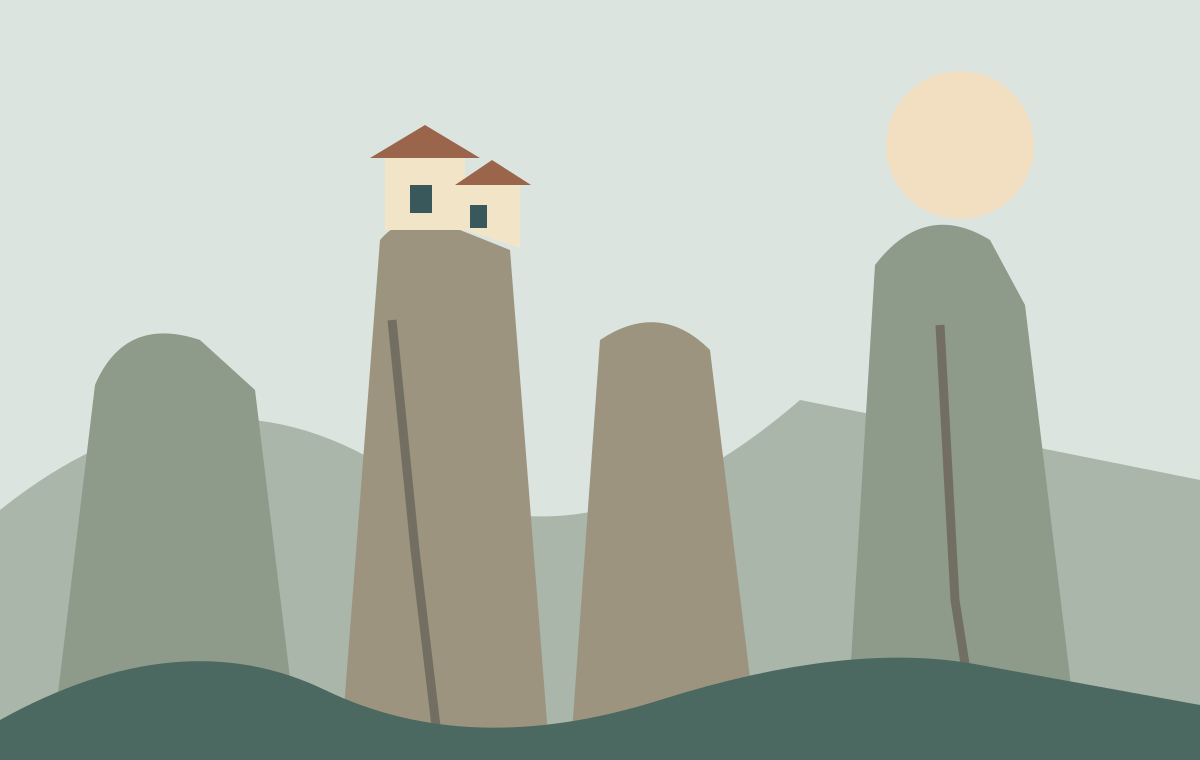
A world of stone towers and monasteries above the plain. Discover the landscape, the six monasteries and the people who made this unusual place habitable.
Μετέωρα · Καλαμπάκα · Καστράκι
Editorial illustration · no topographical representation or photo of a specific monastery.
Location
Thessaly · Greek mainland
Outfall Bases
Kalambaka & Kastraki
World Heritage
Since 1988 · nature & culture
Monasteries
Six known main complexes
01 · METEORA
A landscape between earth and sky
Meteora is located on the Greek mainland, in Thessaly, near Kalambaka and the village Kastraki. Above the plain are rocks that do not feel like one mountain range, but as separate towers, walls and narrow passages. On some peaks are monasteries. From below they almost seem to come loose from the earth; closer you see just how carefully buildings are joining the available rock.
The name is often translated as floating or hanging in the sky. That image fits a first look, but it pays to look slower afterwards. A monastery is more than a roof above a cliff: it consists of passageways, workspaces, church, storage and places for a community. The construction makes an almost impossible place to use.
For our guide, Meteora is a destination under the Greek mainland. It is not a trip in Crete. It is better to plan it as a private travel part, with time to connect landscape, buildings and life at the foot of the rocks.
The rock world is made up of deposits, including sandstone and conglomerate: rocks in which smaller stones and gravel are combined by a finer mass. UNESCO geopark places these deposits in the history of the Meso-Hellenic basin. Removal and fractures changed the location; weathering and erosion then continued to work on the forms.
Therefore, one simple story about water that would have worn out the monastery rocks in a short time is insufficient. Different processes and long time scales work together. The monasteries are only the most recent visible layer in a much older development.
An editorial viewing command: from a permitted place, look at a rock wall with coarse components and then a further silhouette. Up close you can read material, from afar. Do not touch vulnerable surfaces and do not take stones. A photo with a description of what you really see is a better memory than a broken fragment.
The first ascetics probably settled in the rock world from the 11th century onwards. They sought seclusion in caves and difficult to reach places. Around Doupiani an early religious center arose. Groot Meteoron's own history tells how this world of hermits was later supplemented with organized communities.
In the fourteenth century, Athanasios de Meteorite played a decisive role in the common monastery life. Great Meteoron was founded shortly before the middle of that century. In the fifteenth and sixteenth centuries, the network continued to grow. The choice for high rocks connected isolation with the practical question of how people could live in a restless environment and practice their faith.
The seclusion remained dependent on cooperation. Food, water, building materials and knowledge had to be collected, stored and transported. So the story is also about labor and organization. Who only asks how someone ever came up, misses the bigger question: how could a community live there for years?
Meteora has been on the World Heritage List since 1988 as a mixed heritage because of both cultural and natural values. The combination is essential: the buildings are not randomly placed in a beautiful landscape. Their scale, access and decoration correspond to the rocks on which they stand.
UNESCO also emphasizes the significance of the sixteenth century murals. Theophanes de Cretan painted in 1527 in Agios Nikolaos Anapafsas. This creates a special connection with Crete: artists and image traditions traveled beyond the boundaries of the island.
The current protection also includes restoration and the landscape. A world-famous view can give visitors the impression that everything is decorated with their presence. However, prayer and daily life remain the core for the monastery communities. A good visit leaves room for that function, even when a door remains closed or a space cannot be photographed.
Great Meteoron, also called Megalo Meteoro or the Monastery of Transfiguration, is the largest and oldest of the six well-known monasteries that determine the current visitor landscape. Athanasios is the first founder; his successor Ioasaph further shaped the community.
The municipal description points to the simple residence of Athanasios in a natural rock crevice. The contrast with the extensive complex helps to understand the development of isolation by community. The tradition of the first habitation and the still visible building remains are various types of information.
When visiting, take time for the relationship between church and daily spaces. What should lie close together? Where could one store food or eat together? You don't have to finish every space to understand the organization of the place. Read the explanation in museum spaces as an addition to the building, not as a replacement for looking carefully.
Varlaam is located in the rock world between Roussanou and Great Meteoron. According to tradition, the name refers to the ascetic Varlaam. The brothers Theophanis and Nektarios from Ioannina are named as founders of the later monastery community. The monastery is dedicated to All Saints.
From an allowed lookout you can see the distinction between rock base, rise and building. These three parts make the place together. The question of how goods came up is interesting, but only tells a complete story when you also think about storage, maintenance and the work of successive generations.
A visitor's question: which part seems most obvious to belong to the rock, and where do you see a structural intervention? Note that difference before reading an information board. Then you can compare what the explanation adds to your observation.
Roussanou, also written Rousanou, is located on the road from Kastraki between Agios Nikolaos Anapafsas and Varlaam. The building uses the available top so completely that the building from a distance seems to be a continuation of the stone.
The municipal guide describes how the former access with rope ladders was replaced by bridge connections and stairs. Since 1982, the restored complex functions as a women's monastery. There are several explanations about the origin of the name; the source does not mention it definitively established.
This place is suitable for slow comparison: first look at the silhouette and then at a window, roof line or passage. You don't have to walk closer to an edge to see the connection. A quiet observation from the allowed path often says more than a photo for which you disturb the safety or rest of others.
Agios Nikolaos Anapafsas · painting in little space
At Kastraki lies Agios Nikolaos Anapafsas. The narrow rock upper side allowed little extension in the width. The rooms were therefore organized over different levels. This monastery makes a clear example of architecture that has to be added to the site.
The church is also connected to the fresco pavilions of Theophanes de Cretan from 1527. View the paintings as a connection of space, stories and use. A wall here is not a single painting carrier: placement and sequence of performances belong to the religious environment.
An editorial way of looking: choose one performance, read the available explanation and then look where it is in the church. What relationship does the image have with the rest of the space? Always respect the instructions about photography and silence. This guide does not allow you to photograph in a religious space.
Agia Triada is the monastery of the Holy Trinity. It stands on a striking rock, with Kalambaka and the valley below. The municipal description emphasizes that the approach requires a descent and then a climb again. So the distance you see in a photo does not tell how much effort the entrance costs.
A rope ladder and a lifting net were used in the past; in 1925 a carved staircase was built. The building seems sometimes easy to reach from a viewing point, but for a visit the complete access must fit your possibilities.
Therefore, do not just choose the famous silhouette. Take the time for the way back and forth, the temperature and the hustle and bustle on the stairs. If you want to experience the landscape, you can also enjoy a view of the monastery. An outdoor view is a full part of a visit.
Agios Stefanos is located on the southeastern side of the monastery, above Kalambaka. The approach via a small bridge distinguishes it from monasteries with long access steps. Since 1961 it is a women's monastery.
The more accessible approach makes it an important possibility to examine in advance if stairs are a restriction. Do not confuse this with a general guarantee of full wheelchair accessibility: ask the monastery for the full route, thresholds, facilities and possible support.
Here too, the view of the plain is part of the experience. See how city, river landscape and rock relate. The altitude creates distance, but the visible habitation below reminds us that the monastery area is not an isolated world outside society.
The six monasteries have their own opening hours and closing days. Seasons, public holidays, activities and decisions of the communities can make changes. Therefore, for your visit, use the official page of the chosen monastery and the contact information of the municipal tourist office. This guide does not knowingly contain fixed prices or timetables that can quickly age.
You dress according to the rules of the monasteries. For example, large Meteoron mentions that men do not wear shorts or sleeveless outer garments and that women are not allowed with trousers or sleeveless tops. Take appropriate clothing and check the requirements of each chosen place in advance. Do not count on loan clothing without asking.
Take water and shoes with grip, plan breaks and keep in mind stairs and waiting times. Follow directions at churches and museums. Stop a phone and do not ask for an exception to a photo restriction. For many visitors, the visit becomes stronger when there is room left to look without a camera.
An editorial proposal for one day: start with an overview of the landscape, visit one pre-selected and confirmed open monastery and then take a real break. Then choose whether a second monastery still fits. By limiting the number of visits inside, time remains to compare the buildings.
With two days you can divide the accents. Use the first day for a monastery and the rock world, the second for another monastery and Kalambaka or Kastraki. Move between places in a way that suits weather and condition. A road distance is not a measured walking route; do not follow an unknown path because a map shows it as a short connection.
For walking or climbing, the local rules, the weather and your experience are decisive. Ask a competent local guide to find an appropriate route if you don't know the terrain. Find a view from permitted places, without standing on walls or outside deposits. Save enough time to return quietly at dusk.
13 · METEORA
Kalambaka, Kastraki and the larger time scale
Kalambaka is located at the foot of the rocky world, in the northwest of the Thessalian plain. The city is a practical starting point, but also deserves attention as an inhabited place: look at the transition between ordinary streets, rock face and the routes up. Kastraki is another recognizable access to Meteora.
The larger Meteora pyli UNESCO Global Geopark received its recognition in 2024. It's not the same as the smaller World Heritage Site: the geopark connects more landscapes, geology and communities, so these two labels describe different scales.
If you have more time, you can also explore Theopetra and the prehistoric habitation of the region. Check the current visit options separately. For example, your perspective of the centuries of monastery building shifts to a much longer history of human presence. Choose one well-prepared extension rather than several hasty stops.
Consulted on 21 October 2026. Based on UNESCO, the monastery community of Groot Meteoron and the municipal tourist office. Day plans and viewing questions are editorial suggestions. Opening hours, access and rates may change; please consult the official visit information before your date.