GREEK MUSIC · CINEMA & FILMMUSIC
Greek cinema: history, film music and creators
From the studio film and Zorba to Angelopoulos and the Greek Weird Wave. A history to view and listen to.
Added: · approx. 23 minutes read · 25 chapters
1. More than a sunny decor
Those who think of Greek cinema may first hear a melody: the song from Never on Sunday, the music of Zorba the Greek Or a quiet passage by Eleni Karaindrou. That's a nice entrance. But behind these sounds lies a film culture with comedies, melodramas, historical research, political thrillers, documentaries and disruptive family dramas.
This file follows different routes through that world. Sometimes the cinema is a meeting place, sometimes the power of a family, sometimes a society that cannot leave its past behind. The coherence lies in questions: who is allowed to speak, who is included, how is memory passed on and what does music do with an image?
The film choice is an editorial exploration, not a full national canon. An Oscar winner is not automatically more important than a local documentary. An internationally known director does not represent all Greek makers. Use the overview to look more curious, even outside the titles mentioned here.
2. What makes a movie Greek?
There is no characteristic that all Greek films share. You can look at language, production country, financing, hometown of the maker, subject and the audience for which a film is made. Those answers don't always coincide.
Dogtooth is in the Cannes archive as a Greek production. Z is registered as French in the Cannes reference consulted; the Oscars won the film for Algeria. The background of Costa-Gavras and the political connection with Greece do not disappear. On the other hand, a beach shot does not make a foreign production into Greek cinema. [6][7][12]
Therefore, read three things separately with a title: who made the film, how did the production come about and which world shows the story? This prevents a maker's biography, a national entry and a recording location from getting mixed up. It also makes it understandable why an internationally working filmmaker belongs on this page without any film by that maker being referred to as Greek national production.
3. Early years: film as new window
The Thessaloniki Film Museum begins its historical story with early recordings of the Manakia brothers in the early 20th century. The pastoral drama and the romantic comedy will follow. This museum route reminds us that film was initially also a technical miracle and a new way of recording. [1]
For a contemporary viewer, an old recording can seem to tell little: people leave a building, a street is crossed, someone looks right into the camera. Yet such images change the relationship to the past. Stuff, clothing and movement become visible without a later narrator having to explain everything.
In the case of early film, always ask who served the camera, who was allowed to come into the picture and what remained outside the frame. A recording preserves a real moment, but also chooses a position. That distinction is as useful in an old chronicle as in a contemporary documentary.
4. Studios, stars and the fun of popular film
The history of Finos Film describes a production period of 1943 to 1977. The company was part of a film world in which stars, technical professionals, screenplays and audience expectations had to connect. On her own website, she explicitly presents her history as a cultural heritage; that is a valuable source of producers, with a recognizable own perspective. [2]
Comedy and melodrama deserve as much attention as the famous author film. The question of who can marry whom, who can pay the rent or how someone lives in a changing city can tell a lot. Notice differences between public courtesy and private conversations, between the head of the family and the younger generation, between neat clothing and an uncertain income.
Film stars like Aliki Vougiuklaki are part of this public culture. Their meaning is not only in acting performance, but also in recognition: a voice, gesture or face can carry an entire film experience. The historical position of such stars is different from the contemporary judgment of social role patterns in their films. [2]
5. When the movie starts singing
A musical doesn't necessarily interrupt the story when someone sings. A song can just say what a character in an ordinary conversation cannot say. It can make temptation, ambition, group feeling or discomfort audible.
An example from the Finos catalog is Oi thalassies oi chantres off 1967, directed by Giannis Dalianidis and music by Mimis Plessas. The production page makes the collaboration between film and music concrete: a film has not only a director and protagonist, but also a musical designer. [23]
Look what changes when a song starts. Is space getting bigger, people suddenly moving together, looking at each other or directly at the spectator? Then try the scene without remembering her melody. What remains helps you understand how much the music has added.
6. Stella: a voice that won't get stuck
In Stella off 1955 Michael Cacoyannis brings a story to the screen where Melina Mercouri is central. The official Cannes credits call Manos Hadjidakis for the music. Here the actress, the filmmaker and the composer meet in one early internationally visible work. [3]
The film offers an entrance to the question of how much freedom someone really has within a social environment. When looking at the distance between personal desires and the expectations that other people express. Who can desire, who must explain and who decides what is honorable?
A useful listening question is whether music gives the character space or shows how much that character is viewed. Music can make a performance a moment of self-determination, while the same space is also controlled by the glances of others. That's a possible viewing direction, not a mandatory explanation of every scene.
7. Melina Mercouri and Never on Sunday
Never on Sunday off 1960 connects Jules Dassin, Melina Mercouri and Manos Hadjidakis. Mercouri shared the women's actress award in Cannes. Hadjidakis won at the Oscar ceremony of 1961 the price for the song Never on Sunday. So the film year and the year of the award ceremony are different. [24][4]
The international fame of such a song can give a movie a second life. People recognize the melody without seeing the story, or connect it with their own memory. For example, film music travels beyond the original cinema.
Anyone watching the film can watch the relationship between an outsider and the world he's trying to understand. Does curiosity become a sincere encounter, or does it change the need to improve someone else? That question is also useful when we travel through Greece ourselves and think we already know what a place means.
8. Zorba, Kazantzakis and the statue of Crete
Zorba the Greek off 1964 is an important link for Kreta Kroniek. The filming of Kazantzakis' novel, directed by Cacoyannis, connects literature, acting and the music of Mikis Theodorakis. By the Oscars of 1965 The film won three awards: for Lila Kedrova as a female support role, for black and white photography and for black and white management. [5][26]
The fame of the film can be clarified and narrowed simultaneously. A powerful film experience can lead you to a writer and an island. But when one character becomes the measure for all residents, recognition turns into a cliché.
Read not only the exuberant gesture, but also the vulnerability, the balance of power and the moments when pleasure and hardness co-exist. A movie is a made world. His emotional power of persuasion does not yet make him a complete description of daily life in Crete.
For an in-depth evening, put a fragment, a passage from Kazantzakis and a piece of music next to each other. Don't just ask what remained the same. Research precisely what the film had to change in order to be able to tell with faces, spaces, time and sound.
9. Another look: Koundouros and the city
In addition to the internationally recognizable Greek landscape, there is a darker cinematic city. O Drakos off 1956, by Nikos Koundouros, is an important entrance. The confusion surrounding the identity of an ordinary man gives room for questions about prestige, fear and group behavior. [8]
When looking at the city hall, use it as the second leading player. Where can someone disappear and where is someone being watched? Are streets liberating, threatening or both? How does a face change when other people think they know who's standing before them?
A light source above a table can make a conversation feel very different from the same conversation in the sun. As a result, a film does not need to use an explanation voice to raise uncertainty. Cadres, shadows, distance and sound can do the job. That makes cinema more than an illustrated scenario.
10. Political, censorship and the years of the junta
The military dictatorship of 1967 to 1974 is an indispensable historical background. The constitutional history of the Greek Parliament describes the coup d'état and the restoration of democracy. Such an institutional timeline helps define political periods; it does not replace an analysis of each individual film. [25]
For viewing political cinema it is useful to distinguish three moments: when does the story play, when was the film made and when could an audience see it? A later film about a former war has a double historical position. He depicts the past from the questions of his own production time.
Don't look everywhere for a secret code. A family, party or parade can have political significance, but not every silence automatically stands for censorship. First Formulate what you really see and hear. Then look for production history and statements from the creators. That gives an interpretation more guidance.
11. Costa-Gavras: the political thriller as research
Z, usually dated on his release year 1969, is about the murder of a progressive politician and the investigation into the involvement of power organs. The Cannes record consulted states: 1968 as a production year. By the Oscars of 1970 won Z for installation and submission of Algeria for foreign-language film. [6][7]
The thriller offers a special form for political questions. A spectator gets information piece by piece. Testimonies clash, seemingly small details become important and institutions appear to be made up of people with interests.
See who gets to name an event. Is it an incident, a crime, a conspiracy, an accident? The battle for words can be part of the struggle for power. Music, editing and repetition can enhance the feeling that an investigation is in a hurry. Ask yourself when tension helps to understand and when it makes a complex history seem simpler.
12. Angelopoulos: History gets the time
With Theo Angelopoulos, attention shifts to duration, space and memory. The Travelling Players off 1975 Following a travelling theatre company through an eventful period in Greek history. The stage, the travel and the political environment become interwoven. [8]
Those who are used to quick explanations may first wonder when something is going to happen. Try to look different. Which people are entering the statue? What event is shown by the camera's waiting? What changes when a character is not immediately isolated in a close-up?
A long shot also makes you dependent on the film's time. You can't always quickly capture the world in a judgment. That can create distance, but also release attention for people at the edge of the image. It's a way of looking that you don't have to control before you start.
13. Eternity and a Day: meeting with transience
Eternity and a DayGreek Mia eoniotita ke mia mera, won in 1998 The Golden Palm. The official credits include Bruno Ganz as actor and Eleni Karaindrou as composer. This makes the film a clear starting point for the connection between this cinema and the music section. [9][10]
Don't reward yourself at first encounter with the obligation to explain everything. Prefer to record an image, a sound and a question that stays with you. Look again at the corresponding fragment later. Sometimes you notice that the music didn't answer, but made room for something that the characters themselves didn't directly say.
The environment also deserves attention. A coastline, street or departure can be a concrete place and a bearer of memory at the same time. It helps to keep both possibilities open. Not every landscape is just a symbol; not every silent image is just a decor.
14. Eleni Karaindrou: music that can linger
ECM documents Karaindrou's long-term cooperation with Angelopoulos, including The Suspended Step of the Stork, Ulysses... Gaze, Eternity and a Day and The Weeping Meadow. The albums also make her music accessible separately from the film. Album year and film year may differ; do not automatically take them from each other. [11]
A meaningful listening exercise consists of three rounds. First listen without a picture and describe the character of the music with plain words. Then view an accompanying fragment. Finally, listen again without an image. Has the music changed, or has your imagination changed?
Avoid the thought that each slow theme evokes the same feeling. Note the use of an instrument, the space between two phrases and the difference between return and repetition. The same melody can sound different after an event, because the spectator now carries something that was missing from the first effort.
15. Hadjidakis, Theodorakis and the significance of film music
The band between Greek cinema and music consists of different methods. Hadjidakis assists Stella in the credits and got an Oscar for a movie song. Finos mentions Theodorakis in Electra off 1962. A song, an instrumental passage and music in a tragedy film do not require the same form. [3][4][22]
Music can come from the world of the story: someone turns on a radio, a singer performs or plays a company. She can also be heard only by the spectator. The difference is important. A character can respond to a song in the room, but not automatically to the orchestral music that the viewer hears.
Watch the silence, too. If after a musical fragment only footsteps, wind or breathing remain, that can shift the focus. You don't need to know what key something is in to hear that the relationship between people and their environment is changing.
16. Rembetiko: when a musical world becomes a film
Rembetiko off 1983, from Costas Ferris, offers a direct transition from our existing music page. The film uses a fictional effect of a singer's life against a broader historical background. It is therefore wiser to look at him as a musical drama than as a literal life record of one artist. [8]
A film about music can be heard and forgotten at the same time. The performance attracts your attention, while production work, rehearsal, income and mutual relationships can disappear outside the best known song. In such a film don't just ask which song is beautiful. Also look who gets the room to perform and under what conditions there is singing.
Anyone who wants to go on after that can put the film next to our rebetiko file. A film experience and a historical overview complement each other, but also control each other. Where does the dramatic compaction begin, and what image of an entire musical culture comes from?
17. Dogtooth and the name Greek Weird Wave
DogtoothGreek Kynodontas, off 2009 shows a family in which parents control access to the outside world. The film won the Un Certain Regard award in Cannes and was nominated for the Oscar Award. 2011. The screenplay is by Yorgos Lanthimos and Efthimis Filippou. [12][13][14]
The name Greek Weird Wave is a label for a discussed trend, not a passport for all recent Greek films. Rather look at the method: how are bodies placed, how does a conversation sound, what rules apply within a closed world?
A useful question at Dogtooth is what happens when someone not only determines your movements, but also the meaning of words. That connects language and power. At the same time, this film contains explicit and violent scenes; it is not a light acquaintance for any company.
Do not only try to treat the film as a rebus with one national solution. A family can think of broader power relations without each character representing exactly one political figure.
18. Athina Rachel Tsangari: people observe
Athina Rachel Tsangari deserves a place of her own in this story. In Attenberg off 2010 is a young woman who deals with friendship, physicality and her father's illness. The distributor also describes the role of nature documentaries and pop music in her world. [15]
Chevalier off 2015 Takes another situation: six men on a yacht turn their fellowship into a match of comparison and judgment. The official distributors' credits mention Tsangari and Efthimis Filippou as screenwriters. [16]
The editorial viewing question for both films is how behavior gets a rule. Someone does something for; others imitate it; the group decides if it is normal. That can be comical, but it can also be uncomfortable. Watch the moments when people don't seem to understand their own behavior.
These films also remind us that film history needs more voices than a succession of famous male directors. For every production, look at the entire team: writing, producing, acting, mounting, sound and photography.
19. A Greek maker in the international film world
Lanthimos' international career makes the boundaries of a national film history visible. Poor Things off 2023 received at the Oscar ceremony of 2024 Four prizes: actress Emma Stone, costumes, makeup and hair, and production design. He didn't win the prize for directing. [17]
Such an international production belongs in a story about the career of a Greek filmmaker, but is not automatically a Greek-language film about Greece. The same distinction helps actors, composers and camera people who work in different countries.
Also look beyond the idea of one all-enabled author. A style is created by collaboration, financial possibilities, locations, executions and technical choices. The names in the final credits are not an administrative annex: they show how many different professions have worked on one seemingly self-evident picture.
20. Documentaries, short films and the next generation
An overview that only mentions long movies is missing a lot. The Thessaloniki festival has a separate documentary branch; Drama focuses on short film and also presents activities for young makers and students. Such institutions show that a film culture is more than its most famous export titles. [19][20]
A short film doesn't have to be an immature feature film. The limited duration can force a form in which one encounter, sound or action is central. Afterwards, try to name exactly what the film delineated before asking why it didn't last anymore.
In documentaries, the demand for trust is indispensable. Who chose what we see? What voices are missing? Is archive material dated? Do you hear your own memory, a controllable document or a reconstruction? Those categories may appear side by side, but they have different forms of proof.
21. Crete is watching: film culture in Chania
Crete also has an active place in today's film culture. The Chania Film Festival presents film screenings, workshops and an extensive educational program. This makes film on the island not only a matter of recognizable locations from old productions, but also of watching together and learning how to make yourself. [21]
For a visit you can choose a show that at first sight has little to do with tourist expectations. It's only then that you may meet a different subject or audience than you had sought on your own. Check the official festival website each time the language, subtitles, location and any booking conditions.
Those who make their own travel film with a phone can try a small documentary exercise. Film an act with the consent of the persons concerned. Then choose what you want to tell them. Also keep the ambient sound: that can show more about a place than any music underneath.
22. Open-air cinema, archive and restoration
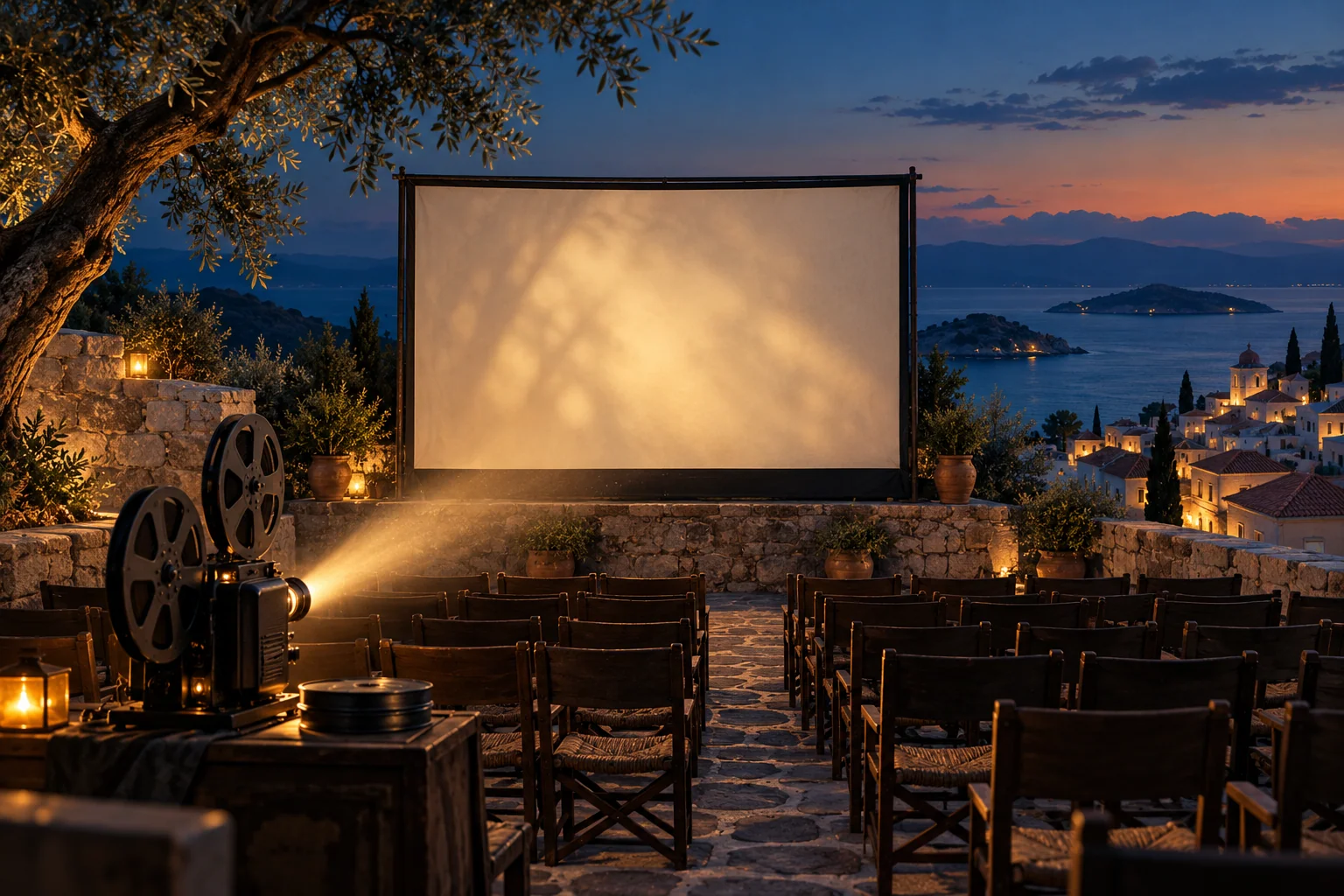
An open-air cinema makes it palpable that watching film is a place-bound experience. You might hear the surroundings next to the sound tape. Darkness doesn't fall everywhere at the same time. An image suddenly exists at the same time on a screen and in a real evening.
Keeping that film culture requires another job. Finos Film describes how original image and sound materials are scanned and digitally restored. The film museum also stores equipment, posters, photocopiers and film material. Film history is therefore not exclusively in the final title on a streaming platform. [18][1]
An old copy can have scratches, dull sound or a different aspect ratio. It doesn't automatically tell what the creators wanted. If possible, search for a publication with information on the source used and restoration. Moreover, the label "Restored' does not mean that an old film should change into a modern film without traces of old age.
23. A viewing route in twelve films
This route is an invitation, not a ranking. Years refer to the usual film or release year dating; awards can follow later. The last column contains your own viewing questions. The credits and historical links come from the aforementioned sources. [2][3][5][7][8][9][12][15][16][17][22][23]
| Movie | Year | Creator | Take this question with you |
|---|---|---|---|
| Stella | 1955 | Michael Cacoyannis | Who gets to choose their own life? |
| O Drakos | 1956 | Nikos Koundouros | What does an imposed identity do? |
| Never on Sunday | 1960 | Jules Dassin | Who decides what someone else needs? |
| Electra | 1962 | Michael Cacoyannis | How do voice and space get dramatic power? |
| Zorba the Greek | 1964 | Michael Cacoyannis | What do you remember besides the most famous gesture? |
| Oi thalassies oi chantres | 1967 | Giannis Dalianidis | What changes once the music starts? |
| Z | 1969 | Costa Gavras | Who controls the story of an event? |
| The Travelling Players | 1975 | Theo Angelopoulos | What do you see when the camera keeps waiting? |
| Eternity and a Day | 1998 | Theo Angelopoulos | What does a recurring musical motive do? |
| Dogtooth | 2009 | Yorgos Lanthimos | Who controls the meaning of words? |
| Attenberg | 2010 | Athina Rachel Tsangari | How are we taught how to do things? |
| Chevalier | 2015 | Athina Rachel Tsangari | When does being together become a contest? |
Don't necessarily start with the oldest film. Pick a question that appeals to you. For music you can Stella or Eternity and a Day for language and rules Dogtooth; for group behaviour Chevalier. Then find a movie that does something completely different with the same theme.
24. This is how you organize your own Greek movie night
Don't fill up the night. One film, a short introduction and room for conversation are often sufficient. Tell us in advance what it takes to look, without explaining the experience. For example, write down director, year and one historical context sentence.
Afterwards, talk about a concrete moment. What scene stayed with you, and what caused it? Let different answers exist. Someone may have looked at a face while another heard the music. Only then will it make sense to discuss a greater interpretation.
Put a second evening around one maker or composer. A recurring employee can form a link that is less self-evident than the production country. Make your own route through this file and the related music pages.
Find films through official distributors, libraries, festivals and legal expenses. Subtitles, image quality and availability vary by country and change. This file therefore makes no promise that a mentioned film can be seen today at a certain Dutch service.
25. Frequently asked questions
Where do I start if I don't know Greek movies?
First, choose a topic that appeals to you. Music offers an entrance via Stella or Never on Sunday; a quieter, contemplative film evening can be Eternity and a Day Begin. The viewing route is meant to help choose, not to impose a mandatory order.
Is the Greek Weird Wave the same as all modern Greek cinema?
No. It is a name for a discussed trend, not a summary of all contemporary comedies, documentaries, children's films and other productions. Look at the separate film and its staff.
Dogtooth won an Oscar?
No. The film was nominated for the Oscar Award of 2011. He won in Cannes. 2009 The Un Certain Regard Prize. A nomination and a victory are different entries. [13][14]
Is every Greek director's film a Greek production?
No. Background of the creator, production country, language and national festival entries are different data. The registrations of Z Let's see that right. [6][7]
Why is this file with Greek music?
Because songs, composers, sound worlds and performances are important entrances here. The file continues to link with literature, language, history, diaspora and Crete.
Is Zorba a documentary about Crete?
No. It's a movie to a novel. The film may generate interest in Crete, but one image story does not describe all inhabitants, customs and experiences on the island.
Can I watch the children's movies?
Rate that by title and publication. Especially Dogtooth calls for attention because of explicit and violent content. Check an age classification and content description; the placement in a cultural viewing route is not age advice.
Are the viewing questions official statements of the creators?
No. The questions and suggestions are their own editorial tools. Historical data, credits and price listings are provided with sources. An invitation to look differently is something other than a proven intention of a director.
Sources and read on
Sources directly consulted on 30 October 2026. Festivalarchieven and the Academy underpin credits and price listings; producers and distributors document their own productions. The BFI contribution is a signed historical-critical essay. Watch questions and listening exercises are their own editorial effects, not statements by the creators. Year of production, year of release, year of album and year of prize are distinguished where necessary.
- Thessaloniki Cinema Museum: History and Collections
- Finos Film.. history of the production company...
- Festival de Cannes Stella ( 1955 ), credits
- Academy Oscar Awards 1961 ↗
- Academy Oscar Awards 1965 ↗
- Festival de Cannes, restored presentation
- Academy Oscar Awards 1970 ↗
- BFI / Christina Newland. 10 great Greek films ( 2016 ) ↗
- Festival de Cannes - Eternity and a Day, credits -
- Festival de Cannes Price archive 1998 ↗
- ECM Records... ♪ Eleni Karaindrou.
- Festival de Cannes Dogtooth, credits and synopsis.
- Festival de Cannes Price archive 2009 ↗
- Academy Oscar Awards 2011 ↗
- Beach Releasing... Attenberg, credits and synopsis
- Beach Releasing.. Chevalier, credits and synopsis
- Academy Oscar Awards 2024 ↗
- Finos Film.. digital restoration.....
- Thessaloniki Film Festival
- Drama International Short Film Festival
- Chania Film Festival showcasing and film education
- Finos Film и Electra ( 1962 ), production data
- Finos Film "Oi thalassies oi chantres" ( 1967 ) ↗
- Festival de Cannes Price archive 1960 ↗
- Hellen Parliament... Constitutional history..
- Nikos Kazantzakis Museum и Zorba, novel and movies