Thirty animal portraits, from mountain birds and reptiles to insects and marine life, with ecology, spreading nuance and quiet viewing assignments.
Atmosphere at the fauna of Crete · AI illustration, no determination photo or evidence of an observation.
The plant and animal images are AI illustrations. The scientific source supports the text. Creta pine not only means that the species can occur naturally elsewhere; it does not mean that the species has been introduced. An endemic subspecies and the species as a whole can have a different distribution area.
30 portraits
No portraits found. Choose larger filters or show everything.
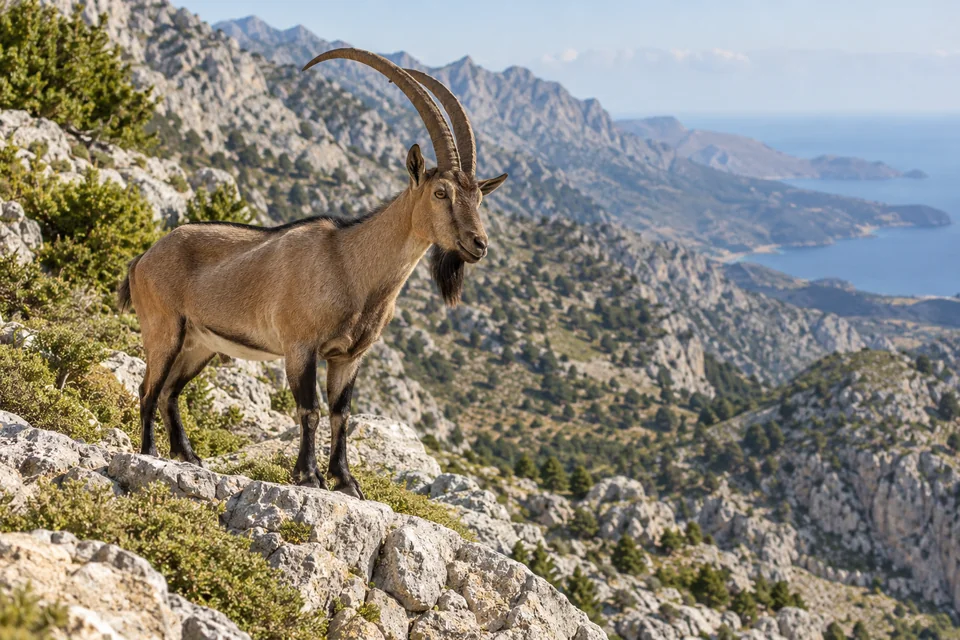
Illustration at Kri-kri · agrimi · AI illustration, no determination photo or evidence of an observation.
Voorkomen: Locally in the Lefka Ori; elsewhere there are spread island populations.
This agile goat is a symbol of Samaria: backwards curved horns, a dark backline and great certainty on steep rocks. Its origin requires nuance. Genetic research connects the agrimi with goats that people brought into prehistoric times. Therefore, the traditional subspecies name does not mean that this is an undisputedly distinct, originally wild endemic species.
That's how you look.
Watch an animal with binoculars from the path. Watch how it puts down its hooves; never feed it and do not automatically change grazing domestic goats with agrimia.
Not only CreteForest & shrublandOlive groves & cultural landVillages & Gardens
Voorkomen: Present in Crete, but especially in dusk and night active.
The black and white head makes the tie recognizable; the body is usually hidden during the day. It looks for various food on and around the ground. Trees, rough edges and soils in which it can dig belong to its world of life. The local name arkalos refers to a well-known Cretan animal, not to a distinct endemic species.
That's how you look.
Do not look up a castle. An accidental sighting from a quiet road or terrace is sufficient; keep your distance and let the animal continue its route.
Not only CreteOlive groves & cultural landMountains & high plains
Voorkomen: Spread present; shy and often only visible around the twilight.
The long ears with dark points, large hind legs and amber eyes distinguish the hare from a tame rabbit. It rests in a shallow place between the vegetation and lives in open ground with nearby coverage. The mosaic of fields, shrubs and stone plot edges in Crete can offer such hiding places.
That's how you look.
Look from an existing path along quiet field edges. Stay at a meeting; chasing to provoke a jump or photo disturbs the animal.
Not only CreteOlive groves & cultural landForest & shrublandVillages & Gardens
Voorkomen: Present on the island; a nightly encounter remains coincidental.
A low silhouette, short snout and spineback betray a hedgehog that looks for small invertebrates in litter. Genetic studies include a recognizable Cretan population of Erinaceus romanicus. Older island sources sometimes use Erinaceus concolor. These name differences deserve attention: a local population or ancient subspecies name is not necessarily a separate endemic species.
That's how you look.
Watch a hedgehog remotely in low light. Avoid flashing and picking up; rather note the time and the environment in which you happened to see it.
Group profileForest & shrublandSources & wetlandsVillages & GardensRocks & gorges
Voorkomen: Several species; visibility and activity vary considerably from place to season.
The bats of Crete are not a single species, but a community of nocturnal bug hunters. Some use caves, other buildings or trees. Their echolocation helps to find prey and obstacles. A fast silhouette above a village square is not enough to name a kind of reliable; for that researchers use sound recordings and specialist features.
That's how you look.
Look at flight routes in the dusk from a square or waterfront. Do not enter a place of residence or turn a lamp on a sleeping colony.
Not only CreteForest & shrublandOlive groves & cultural landVillages & GardensRocks & gorges
Voorkomen: Present in Crete; usually hidden and nightly.
The stone mart is a slim predator with a long tail and a light throat spot. He can climb and use various shelters in a landscape of rocks, trees and buildings. Besides small animals, plant food can also play a role. Cretan literature calls the local form bunites; here the recognition remains conscious at species level.
That's how you look.
A short encounter is already special. Note silhouette, tail and walking without following the animal or laying down food for a second visit.
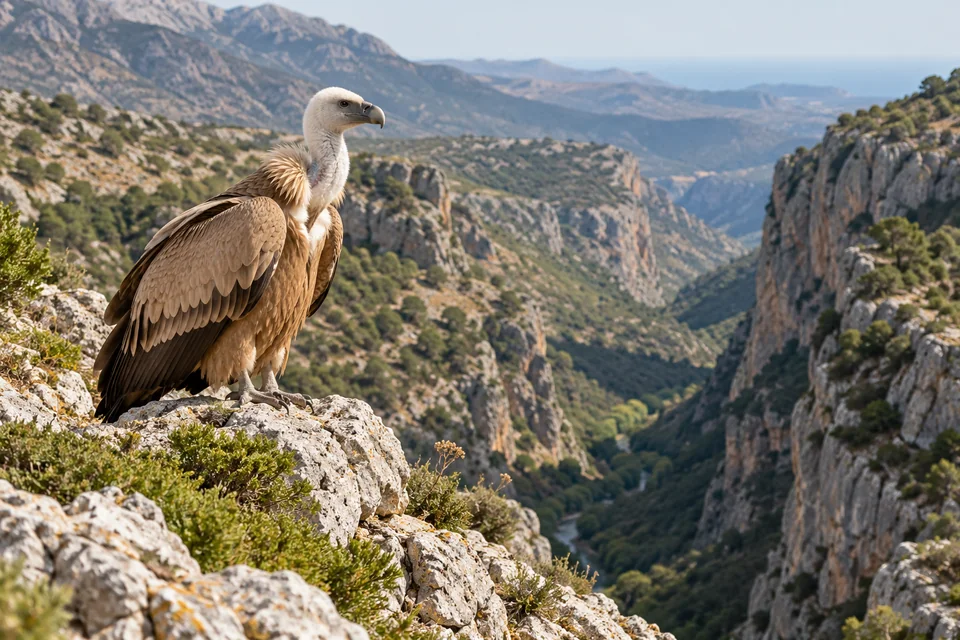
Illustration at Vale vulture · AI illustration, no determination photo or evidence of an observation.
Birds
Vale vulture
Gyps fulvus
Not only CreteMountains & high plainsRocks & gorgesOlive groves & cultural land
Voorkomen: Standbird; above mountain and gorge landscapes regularly seen.
The vulture floats on wide wings with scattered handpins and a short tail. A pale neck collar contrasts with brown feathers. As scavenger, it cleans up carcasses: an important link between livestock farming and mountain nature. Thermical allows groups without many wing strokes to gain altitude; wind and temperature determine where they become visible.
That's how you look.
From a viewing point follow one circling bird with binoculars. Stay far from cliffs with resting birds and don't look up a nest for a photo.
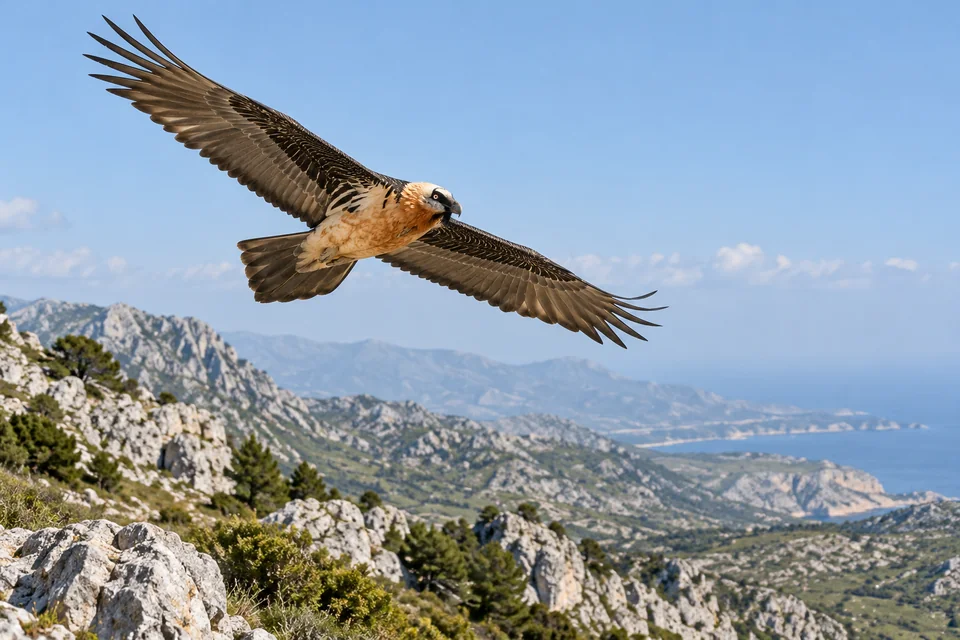
Illustration at Lammergier · AI illustration, no determination photo or evidence of an observation.
Birds
Lammergier
Gypaetus barbatus
Not only CreteMountains & high plainsRocks & gorges
Voorkomen: Very rare bird of the Cretan mountains.
The long wedge-shaped tail and relatively narrow wings give this vulture a different silhouette than the vale vulture. Adult birds carry a dark beard drawing. Bones form a large part of the food; large pieces can be broken on rocks. Orange shades in the breast feathers are caused by contact with iron-containing material, not simply by age.
That's how you look.
Consider any accidental sighting as an opportunity. Look at the silhouette at a long distance; do not publish a precise nesting location and do not lure the bird with food.
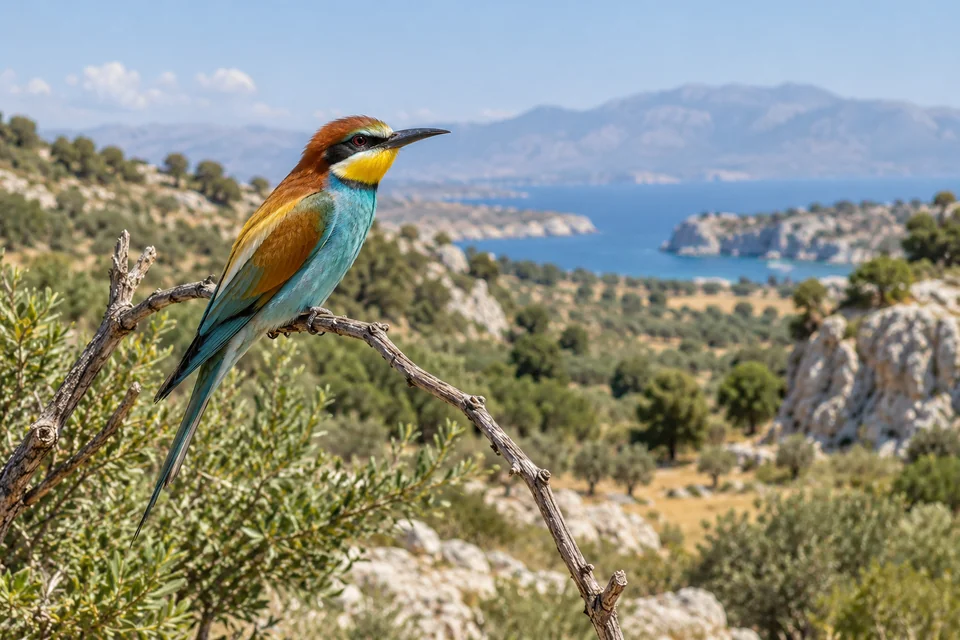
Illustration at Bee Eater · AI illustration, no determination photo or evidence of an observation.
Birds
Bee-eater
Merops apiaster
Not only CreteOlive groves & cultural landDunes & CoastSources & wetlands
Voorkomen: Especially a migratory bird; groups may appear briefly during migration.
Turquoise, chestnut-brown and yellow make the bee-eater remarkably colourful. It catches flying insects from the sky or from a viewpoint. The beak and pointed wings help in recognition. Crete is on a migratory route; a group above a valley does not need to breed there and may be gone the next day.
That's how you look.
Listen to a quiet walk above your head. Look at a group where you stand; do not follow birds to a breeding wall or use a played decoy.
Not only CreteOlive groves & cultural landVillages & Gardens
Voorkomen: Present in Cretan agricultural landscape; especially nightly.
The heart-shaped face and the pale underside give the church owl an almost shining appearance in the dusk. It mainly hunts small mammals in open terrain. Bramble balls tell researchers which prey occur in a region. Old buildings can offer resting places, but a suitable opening doesn't mean that there really is an owl.
That's how you look.
Look from a quiet public place when the evening falls. Do not appear in holes or buildings and do not disturb sleeping or brooding owls.
Not only CreteOlive groves & cultural landRocks & gorgesMountains & high plainsVillages & Gardens
Voorkomen: One of the more easily detected falcons in Crete.
A falcon that stays still against the wind over a field can be a tower falcon. This prayer helps him search the bottom. The long tail and narrow wings are useful features. Akkerland and rocky slopes offer food and views; other small falcons sometimes make a volatile determination more difficult.
That's how you look.
Watch the prayer and the subsequent dive from a safe place outside the lane. Note wing shape and tail instead of just color.
Not only CreteMountains & high plainsRocks & gorgesOlive groves & cultural land
Voorkomen: Stand bird, including in mountain and gorge landscapes.
The raven is a large black crow-like with a heavy beak and a wedge-shaped tail in the flight. His deep call can fill a gap before you see it. As an opportunistic eater, it uses various food sources. High above rocks, its glide can remind you of a bird of prey; the silhouette helps to distinguish.
That's how you look.
Listen to the cry first, and then look along the rocky edges. Observe movements between yourselves without offering food or approaching a resting place.
Voorkomen: Locally in wet areas, including Lake Agia; numbers change.
This slim white heron usually has a black beak, dark legs and striking yellow feet. He looks for small aquatic animals in shallow water and can walk lively. Moorraces, lagoons and quiet shores provide food. A white bird at a distance is not automatically this species: posture, size and beak colour are part of the comparison.
That's how you look.
Stay on the path, and use a viewer by the shore. Let a hunting bird continue to forage; do not go nearer to the yellow feet.
Not only CreteOlive groves & cultural landVillages & Gardens
Voorkomen: Seasonal and local; also visible during migration.
A fan crest, a long curved beak and black-and-white tied wings make the hop characteristic. With the beak it searches for invertebrates in soft soil. Trees and open spaces with short vegetation fit that food. Usually the crest lies backwards; the striking range is only set up occasionally.
That's how you look.
Watch a foraging hop where he appears himself. Wait for behavior instead of letting the bird fly and do not inspect a possible nest cavity.
Not only CreteMountains & high plainsRocks & gorges
Voorkomen: Locally in mountains and other suitable rocky terrains.
The chukar has a light throat with a dark outline, a red beak and striking striped flanks. It is agile between stones and low bushes and can remain invisible for a long time. It is a ground bird of open, rocky terrain. Its presence in Crete does not make it an exclusively Cretan or endemic species.
That's how you look.
Listen to the call from the hill, and look with binoculars over open stone ground, and do not follow a group to hunt him down.
Endemic: Crete & environmentRocks & gorgesDunes & CoastOlive groves & cultural land
Voorkomen: An endemic species of Crete and nearby islands, especially in western areas.
This small lizard belongs to Crete's own island nature and its surrounding islands. Colour and drawing vary, making one green or brown lizard impossible to name directly. Genetic research helped distinguish the kind of related wall lizards. Dry stones, low vegetation and sunny open spaces offer a variety of heat and shelter.
That's how you look.
Wait still along a stone wall and see the animal where it appears on its own. Don't catch anything and don't turn stones for a determination photo.
Not only CreteRocks & gorgesOlive groves & cultural landVillages & Gardens
Voorkomen: Present, but seen little by hidden and often nightly activity.
The cat snake is a slender, often grey-brown snake with dark spots and a vertical pupil. That pupil alone does not prove a species identity. It has fangs placed in the back of the mouth: the popular statement that all snakes of Crete are completely poisonless is not correct. The species lives withdrawn and searches for small reptiles as prey.
That's how you look.
Watch a random encounter at a distance and leave a free way out. Do not pick up a snake and do not judge unknown animals with a simple color rule.
Not only CreteRocks & gorgesOlive groves & cultural landForest & shrubland
Voorkomen: Present in Crete, but shy and hard to perceive.
Reddish brown spots with dark edges can give this slim snake its leopard-like appearance; there are also striped shapes. The species uses cover between stones and vegetation and eats small vertebrates. Her appearance is documented in Crete. A beautiful drawing is not an invitation to handle a snake: observation can also be done without contact.
That's how you look.
Keep your distance and give a snake time on a path to crawl on its own. Do not move stones or vegetation to find a hidden animal.
Not only CreteVillages & GardensRocks & gorgesDunes & Coast
Voorkomen: Locally located on buildings and rocks; also established in Crete.
The broad head, sturdy construction and knobby back make this gecko recognizable. The widened toes help him move on steep surfaces. Around lighting insects can form a food source, but not every small house gecko is Tarentola: on Crete there are several gecko species. Pattern and color also change with light, temperature and condition of the animal.
That's how you look.
From the terrace, see a wall without following the gecko with a bright lamp. Note physique and movement; leave possible hiding areas alone.
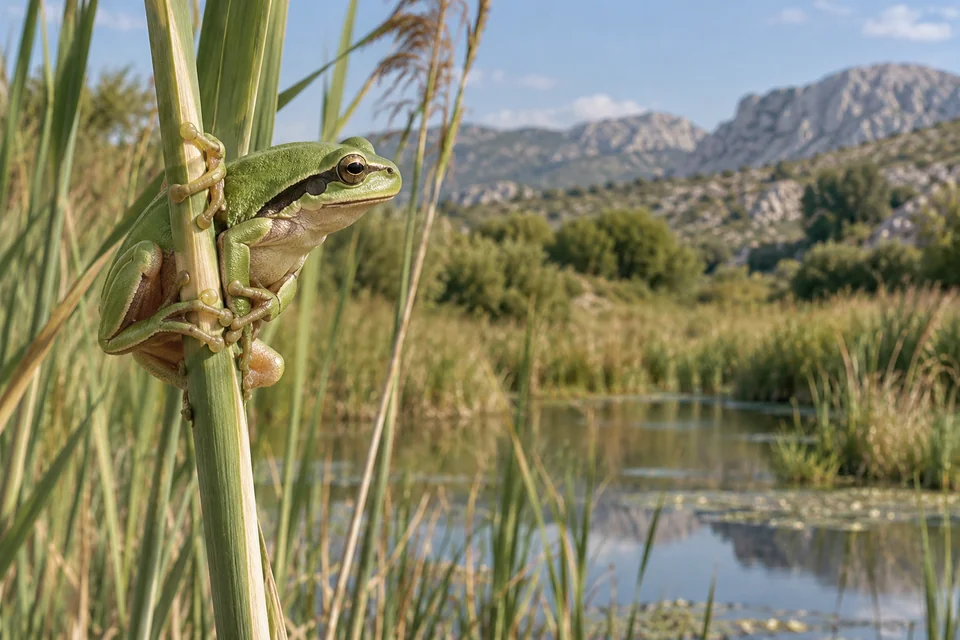
Illustration in European tree frog · AI illustration, no determination photo or evidence of an observation.
Amphibians
European tree frog
Hyla arborea
Not only CreteSources & wetlandsOlive groves & cultural land
Voorkomen: Locally at suitable water and vegetation; documented on Crete by NHMC.
This small frog can be attached to the toes on leaves and stems. A dark side stripe and often green back are useful features, but colors may vary. Water remains important for reproduction, even if adult animals rest higher in plants. The occurrence in Crete is no evidence of a separate endemic tree frog species.
That's how you look.
View shore plants from the path, without pulling stems apart. Listen to call and leave pools, eggs and animals completely untouched for your observation.
Voorkomen: Endemically and locally bound to suitable freshwater spots.
This water frog is one of the species that clearly shows Crete's biological peculiarity. It lives in and around fresh water; therefore, the continuity and quality of such places are essential. Water frogs can be very similar to each other. A green colour or a loud call alone does not give a final species determination.
That's how you look.
Stay on the existing bank route and look for animals that are visible on their own. Do not enter the pool, do not catch tadpoles and never move frogs to other water.
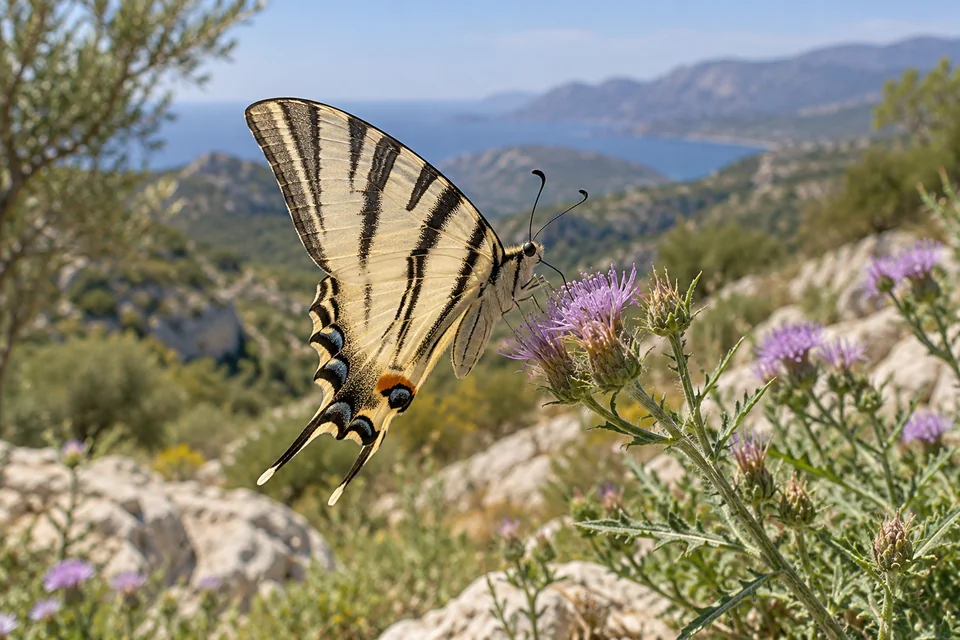
Illustration at Koningspage · AI illustration, no determination photo or evidence of an observation.
Uncircular
King
Iphiclides podalirius
Not only CreteOlive groves & cultural landForest & shrublandMountains & high plainsVillages & Gardens
Voorkomen: During the flying time local in flowery and tree-rich landscapes.
The king's page is a striking butterfly, flying along sunny slopes and orchards, with long tails and blue moons. The caterpillars use various roses, including fruit trees and hawthorns. The English name scarce swallowtail does not say that the species should be rare in every Cretan spot.
That's how you look.
Wait for flowers without chasing the butterfly. A photo of a spontaneously resting animal is more informative than a caught specimen; let caterpillars on their host plant.
Group profileForest & shrublandOlive groves & cultural landVillages & Gardens
Voorkomen: In the warm season audible; type and activity vary per place.
The vibrating summer sound from trees often comes from male singing cicadas, which make sound with special organs. They belong to a group other than locusts. For Crete, caution with names is useful: recent museum research questions several old species reports. Therefore, without detailed characteristics or sound analysis, singing cicada remains a fairer indication than a definite generic name.
That's how you look.
Listen in the shadow of an existing route to different rhythms. Look quietly with your eyes along stems; do not break down branches to find the singer.
Voorkomen: Endemic, hidden alive; no animal you need to find on a walk.
Not all of the special island animals fly or bloom remarkably. This dark spider is a Cretan endeavor and lives withdrawn from suitable shelters. Spiders have eight legs and are not insects. The specialist character of such animals shows why a stone slope or a messy soil can be more ecologically valuable than it seems at first sight.
That's how you look.
Leave cracks, stones and webs intact. Observe only what is visible from the path and do not lure spider out of her hiding place for a close-up.
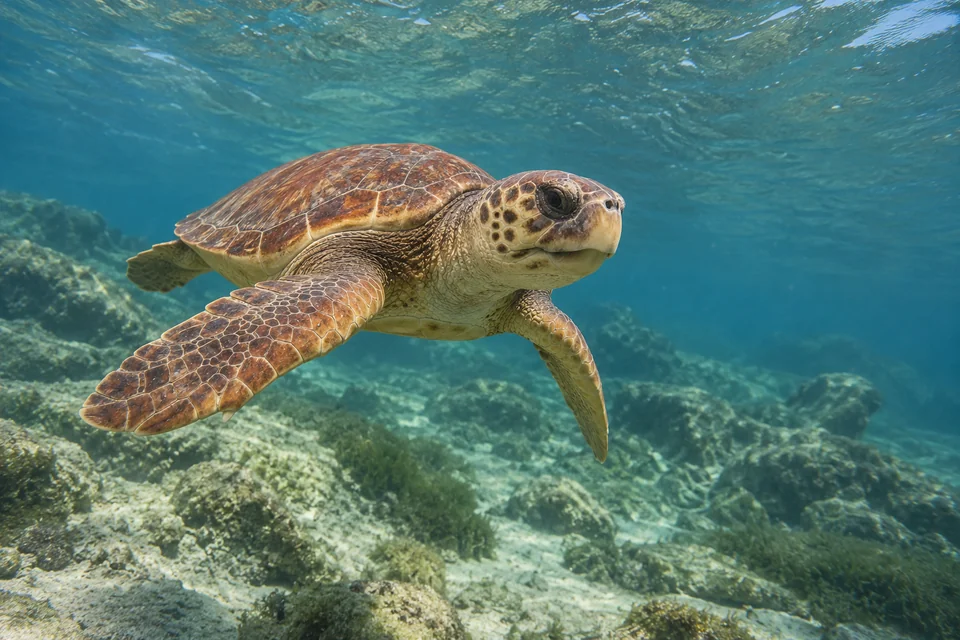
Illustration in False carat turtle · AI illustration, no determination photo or evidence of a sighting.
Sea creatures
False turtle
Caretta caretta
Not only CreteMarine & Underwater LifeDunes & Coast
Voorkomen: It is found in the surrounding sea; nesting beaches include Chania, Rethymno and Messara.
This large sea turtle has a sturdy head and comes ashore to lay eggs in sand. In Crete important nest beaches are followed by ARCHELON. A beach is not only a recreation room, but also a fragile nursery. In the sea an animal can stay underwater for a long time; coming up is not an invitation to swim there.
That's how you look.
Watch a turtle quietly from a distance. Respect marked nests and keep beach light limited; let newly hatched youngsters go their own way and follow local protection instructions.
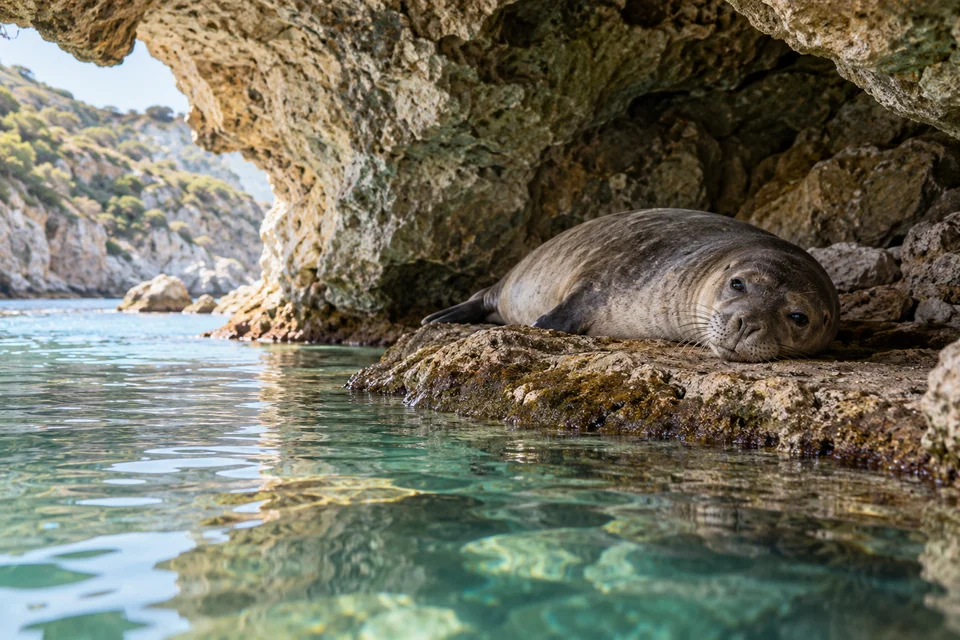
Illustration at Mediterranean monk seal · AI illustration, no determination photo or evidence of an observation.
Sea creatures
Mediterranean monk seal
Monachus monachus
Not only CreteMarine & Underwater LifeDunes & Coast
Voorkomen: Rare; presence around Crete has been confirmed, a meeting remains exceptional.
The round head and short snout are part of a sea mammal that needs undisturbed coastal spots for rest and reproduction. MOm documented among others a young animal from Crete. The species eats sea creatures and uses quiet resting places. An apparently empty cave can have a function that you do not see from the water.
That's how you look.
Admire a seal at a long distance and leave its route free. Do not enter a sea cave to search for animals; do not share an exact location of a vulnerable resting place.
Not only CreteMarine & Underwater LifeDunes & Coast
Voorkomen: Present in Greek and Cretan waters; no guaranteed coastal observation.
The robust construction, curved dorsal fin and relatively short muzzle fit the tumbler. It also uses coastal waters and hunts for various prey. Researchers sometimes recognize individuals by scars and notches in the dorsal fin. However, a quick glimpse can be insufficient to distinguish them from other dolphins.
That's how you look.
Observe from the existing sailing route without chasing a group. Note number and direction of bathing if possible; do not feed animals and do not go to water for a meeting.
Voorkomen: A kind of open sea around Greece, also the Cretan sea area.
This slimmer dolphin has characteristic dark lines along the light flanks. It is stronger connected with open and deeper water than the coastal tumbler. That difference explains why a walk along the harbor does not give a representative view of all dolphins. Species recognition requires a good view of the drawing; jumps alone are insufficient.
That's how you look.
Look at the open sea on an ordinary crossing, without expecting a meeting. Just record what comes along and let the animals keep their own course.
Not only CreteMarine & Underwater LifeDunes & CoastRocks & gorges
Voorkomen: A resident of Mediterranean coastal soils; often well hidden.
Eight arms with suction cups and a soft body help the octopus move between rocks. It can change colour and skin structure and almost coincide with its surroundings. It hunts crustaceans and uses sheltered places as shelters. A pile of shellfish remains at a crevice can be interesting, but doesn't prove an occupied hiding place.
That's how you look.
Look during responsible snorkeling without shifting rocks. Do not stick anything into a crevice, touch the animal and leave a swimming octopus alone.
Not only CreteMarine & Underwater LifeDunes & CoastRocks & gorges
Voorkomen: Present along rocky coasts; also recorded in HCMR study at Gournes.
Small dark fish hanging over rocks in small groups can be swallowtail fish. Young animals can have a striking blue appearance. The forked tail helps to recognise them. They use the water layer above the bottom to pick up food and make it visible that a rocky coast is also a three-dimensional habitat.
That's how you look.
While snorkeling, stay away from the bottom and watch the school behavior. Do not feed the fish; natural movements say more about their living environment.
Sources consulted on October 17, 2026. The guide combines scientific and local natural resources with their own viewing assignments. The selection has been extended, but not a full list of Crete species. An AI illustration supports the story and is not suitable to assess a plant for edible or to identify a species with certainty. Dissemination, names and knowledge can change; the source per profile gives the context.